Unanimous Adoption of First Joint Declaration in Busan
Agreement to Expand to G20 and Brazil COP30
Korea Highlights Its Role on the Global Stage with Energy Super Week
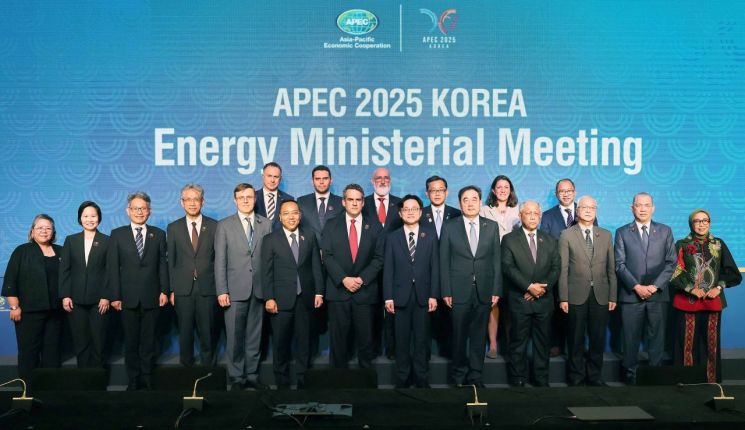
On August 28, at the APEC Energy Ministers' Meeting held in Busan, a joint declaration focusing on power grid expansion, energy security, and the introduction of responsible AI was unanimously adopted.
The joint declaration set forth the goal of achieving a "sustainable, economic, reliable, secure, and innovative energy transition," and specifically outlined: ▲ expansion and digitalization of transmission and distribution networks ▲ strengthening of distributed infrastructure such as energy storage systems (ESS) and microgrids ▲ cross-border power interconnection and construction of subsea cables ▲ increased investment in cybersecurity. The declaration also identified the surge in electricity consumption due to electric vehicles, cooling demand, and the growth of data centers as a "shared challenge," emphasizing the need for market innovation and revitalized investment to address these issues.
The stable and flexible role of gas was also recognized. Member economies pledged to invest across the entire LNG value chain, share policy options, and enhance capabilities, thereby reaffirming the importance of gas as a pillar of energy security. At the same time, they agreed to promote cross-border transactions and expand renewable energy through Energy Attribute Certificates (EAC) and innovations in power market design.
AI and digital technologies are to be utilized for power forecasting, demand management, distribution optimization, virtual power plants (VPP), and new material exploration. The declaration also made clear that improving the efficiency of data centers and ensuring their security and reliability must go hand in hand. Hydrogen policy guidelines and implementation plans were also included in the declaration, establishing them as tools to support long-term energy security.
This agreement is expected to be carried forward as a global agenda at the G20 Energy Ministers' Meeting in October and the 30th Conference of the Parties to the United Nations Framework Convention on Climate Change (COP30) to be held in Brazil in November.
Meanwhile, the APEC Energy Ministers' Meeting attracted attention for being held in a new "Energy Super Week" format. The event concentrated the Energy Ministers' Meeting, Clean Energy Ministerial (CEM), Mission Innovation (MI) Ministerial, and the International Climate Industry Expo into a single week.
Ministerial delegations from 41 countries, 111 international organizations, and over 100 global companies participated, bringing together policy, technology, and industry on one stage. The exhibition featured the "Energy Expressway Pavilion," "Clean Power Pavilion," and "Carbon Neutrality Pavilion," directly connecting government policies, corporate technologies, and investment demand on site.
In particular, the Korean government actively promoted its energy policy package during this meeting. Minister of Trade, Industry and Energy Lee Jungkwan emphasized, "Korea led the agenda and built consensus," adding, "We will further develop policies such as the Energy Expressway and distributed power grids to contribute to the international community."
Fatih Birol, Executive Director of the International Energy Agency (IEA), commented, "The expansion of AI data centers, electric vehicles, and cooling demand is placing tremendous strain on power grids," and assessed that "Korea's Energy Expressway initiative and next-generation power grid construction are models the world should pay attention to."
© The Asia Business Daily(www.asiae.co.kr). All rights reserved.

















