"Value-Added Exports Increasingly Concentrated in Specific Industries"
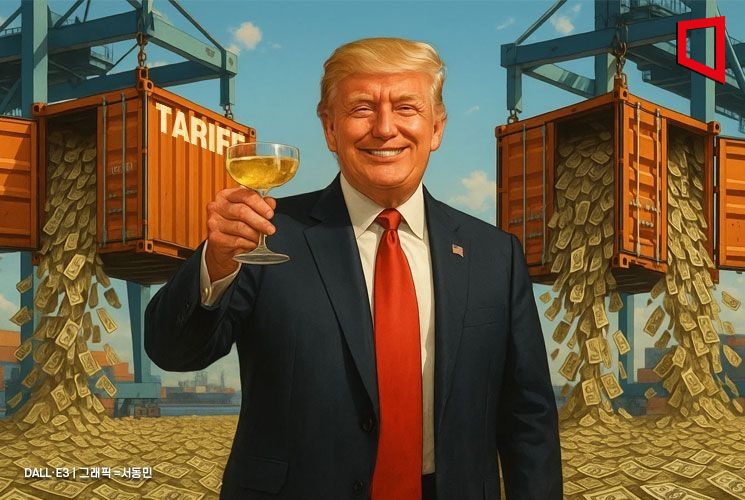
Concerns have been raised that South Korea's value-added exports to the United States are excessively concentrated in specific countries and industries, making them vulnerable to direct impacts from changes in U.S. trade policy.
According to the report "Diagnosis and Response Directions for South Korea's Value-Added Exports to the U.S." published by the Korea Institute for Industrial Economics & Trade on August 28, South Korea's direct exports to the U.S. increased for seven consecutive years, from $68.6 billion in 2017, the first year of the Trump administration, to $127.8 billion in 2024. In contrast, value-added exports to the U.S. utilizing global supply chains decreased from 2018 to 2020, saw a brief surge of 43.4% in 2021, but have since been on a declining trend.
In particular, while direct exports continued to grow rapidly, jumping 29.4% even in 2021, the first year of the Biden administration, value-added exports increased by 46.2% in 2021 but immediately shifted to a downward trend, showing a clear contrast. This is interpreted as a result of U.S. tariff policies directly affecting Korean exports through global supply chains.
Looking at the countries through which value-added exports to the U.S. pass, as of 2023, Mexico accounted for the largest share at 25.5%, followed by China, Vietnam, and Canada, with the top four countries making up 70.3% of the total. The issue is that all of these countries are among the top contributors to the U.S. trade deficit and are key targets of tariff policies under the potential second Trump administration.
The shares of China and Vietnam have declined due to strengthened export controls and currency/origin investigations, while Mexico and Canada have emerged as key bases for Korean companies entering the U.S. market since the implementation of the USMCA. However, these countries are also significantly affected by changes in the trade environment. The report pointed out, "The structural issue of value-added exports to the U.S. being concentrated in certain countries may make South Korea even more vulnerable to policy changes under a Trump administration."
By industry, more than half (55.3%) of value-added exports to the U.S. in 2023 came from the electrical and optical equipment sector. This was followed by transportation equipment, textile products, and other manufacturing industries. The top five industries accounted for 91.1% of the total, showing little change from 2007.
The report stated, "The concentration of value-added exports in specific industries overlaps with the main items contributing to the U.S. trade deficit. If the U.S. imposes item-specific tariffs targeting deficit items such as machinery, electrical equipment, and vehicle parts, South Korean exports could be directly impacted."
The U.S.-China trade dispute and regulatory tightening that began in earnest during the first Trump administration have already led to a reduction in South Korea's value-added exports to the U.S. The report emphasized, "Although it is not easy to diversify these structurally concentrated export routes in the short term, efforts to mitigate risks are needed in line with U.S. nearshoring and friendshoring policies and its de-risking strategy toward China."
In particular, Mexico has emerged as a core base for Korean companies, especially in the automotive and electrical/optical equipment sectors, due to the pronounced effects of nearshoring. However, there is a need for vigilance, as uncertainties could increase at any time depending on changes in U.S. trade policy.
The report suggested that South Korea should move away from relying solely on scaling up and instead pursue a strategy of qualitative advancement. Considering the renaissance of U.S. manufacturing and the strengthening of domestic production capacity, it is essential to develop high value-added intermediate goods and invest in advanced technologies.
Furthermore, for South Korea, whose export structure is centered on intermediate goods, to maintain and enhance its competitiveness amid a trade environment characterized by protectionism and ongoing U.S.-China tensions, it is necessary to diversify supply chains for strategic items, strengthen regional cooperation channels, and adopt a strategy focused on regional supply chains that takes economic security into account.
© The Asia Business Daily(www.asiae.co.kr). All rights reserved.

















