Returns Cause Headaches for Small Business Owners
20-30% of All E-Commerce Orders Are Returned
A story has emerged about a self-employed business owner struggling because a customer demanded a refund after bringing back a watermelon that had been used in a ritual table setting. On the 26th, a post titled "You will definitely be punished" was uploaded to an online community. The author, identified as Mr. A, wrote, "You will definitely be punished. How can you return something like this? Because it's overripe?" and added, "There is a saying that spirits know everything. The spirits must know all about this. They must be delighted."
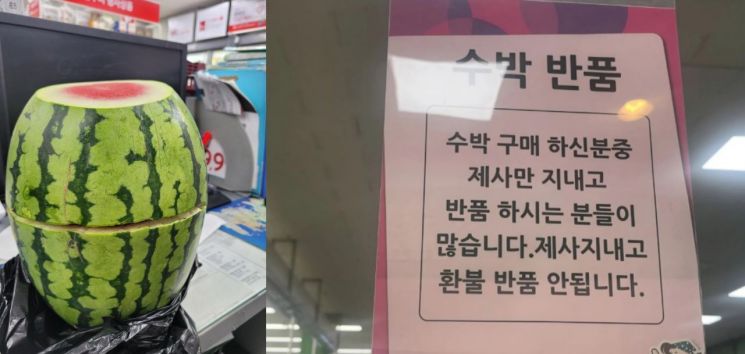 In the photos released by Mr. A, the watermelon appears to have been used for a ritual, with the top part partially cut off. In fact, it was even cut in half and stacked. Online community
In the photos released by Mr. A, the watermelon appears to have been used for a ritual, with the top part partially cut off. In fact, it was even cut in half and stacked. Such incidents are reportedly frequent. Earlier, on the 15th, a notice at a supermarket in Busan drew attention. The notice read, "Many people who purchase watermelons use them for rituals and then return them. Refunds and returns are not allowed after rituals."
Returns: A Headache for Both Small Business Owners and the Distribution Industry
Return issues are a major headache not only for self-employed business owners but also for the entire distribution industry. In the case of domestic home shopping, the average return rate is in the 10% range. For e-commerce, it is reported that 20 to 30% of all orders are returned. Last year, there were 5,157,850,000 parcels delivered in South Korea. Even with a conservative estimate, this means that about 500 million items are returned annually. However, domestic distributors are reluctant to impose restrictions on returns.
 Return issues are a major headache for self-employed individuals as well as the distribution industry. Photo is not related to the specific content of the article. Photo by Kang Jinhyung
This is because free return services are a key strategy for attracting customers, and the perception that "the customer is king" remains strong in South Korea. Naver, which has emerged as a major e-commerce player alongside Coupang, rebranded its "Naver Arrival Guarantee" to "Naver Delivery (N Delivery)" in March this year and is implementing a free return and exchange policy. The company stated that after introducing this policy, transaction volume on Naver Shopping increased by about 20%.
The home shopping industry, where the practice of trying products before purchasing has become the norm, also finds it nearly impossible to restrict returns. An industry insider said, "The number of home shopping users is already declining, so abolishing the free return and exchange policy that has been in place for decades is virtually impossible," and added, "We are selling off inventory generated by returns through online malls."
Meanwhile, Swedish SPA (Specialty store retailer of Private label Apparel) fashion brand H&M reduced the exchange and return period for products sold at its domestic stores from 30 days to 15 days around July. Until now, global SPA brands such as Uniqlo, Zara, and H&M have implemented policies allowing exchanges and returns within one month. The consumer-friendly policies of SPA brands-which quickly produce trendy clothing, frequently launch new products, allow customers to try on clothes freely in stores, and make exchanges and returns easy-have been credited with supporting the growth of these companies. However, with the recent rise of online shopping, return rates have increased, and the burden of inventory and disposal has grown, leading to a trend of tightening return policies.
© The Asia Business Daily(www.asiae.co.kr). All rights reserved.


















