Tightly Closed Wallets... Real Consumption Expenditure Continues to Decline
Income Growth Recovers for the Lowest Quintile
Effect of Increased Public Pension Benefits
Real consumption expenditure, which reflects rising prices, continued to decline in the second quarter (-1.2%) following the first quarter, marking the largest decrease in 18 quarters. Although real income has continued to rise for five consecutive months, it remained in the 0% range. This shows that households are continuing to tighten their belts amid insufficient income growth.
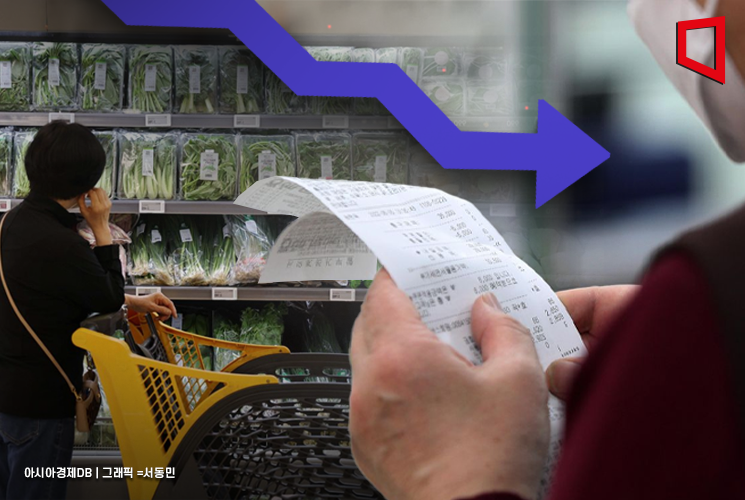
Tightly Closed Wallets... Real Consumption Expenditure Continues to Decline
According to the "2025 Second Quarter Household Trends Survey" released by Statistics Korea on August 28, the average monthly income per household in the second quarter was 5,065,000 won, an increase of 2.1% compared to the same period last year. This growth trend has continued for eight quarters since the third quarter of 2023 (3.4%). However, real income, which takes inflation into account, increased by only 0.03%. Real income has increased for five consecutive months, but the growth rate shrank sharply compared to the previous quarter (2.3%).
Labor income, which accounts for the largest share of total income, rose by 1.5% to 3,194,000 won, marking the fifth consecutive quarter of increase. This was due to both an increase in the number of wage workers and rising wages. With the increase in service industry production, business income rose by 0.2% to 941,000 won. Transfer income increased by 5.1% to 773,000 won. The rise in transfer income was driven by increases in the standard median income, as well as higher payments from the National Pension and Basic Pension this year.
Disposable income increased by 1.5% to 4,024,000 won. This is a lower growth rate than the previous quarter (4.5%) or the same period last year (3.5%). Specifically, the surplus amount increased by 3.3% to 1,188,000 won, and the surplus rate rose by 0.5 percentage points to 29.5%. The quintile share ratio of equivalized disposable income rose by 0.09 points to 5.45. The average propensity to consume fell by 0.5 percentage points to 70.5%.
The average monthly consumption expenditure per household rose by 0.8% to 2,836,000 won, marking the 18th consecutive quarter of increase. However, the growth was relatively small compared to the previous quarter (1.4%) and the same period last year (4.6%). In detail, spending increased in other goods and services (13.0%), food and lodging (3.3%), and health (4.3%), while it decreased in transportation (-5.7%), household goods and domestic services (-9.9%), and clothing and footwear (-4.0%).
Real consumption expenditure, reflecting inflation, decreased by 1.2%. This is the lowest level in 18 quarters since the fourth quarter of 2020 (-2.8%), during the COVID-19 pandemic. Real consumption expenditure turned negative in the first quarter of this year (-0.7%) for the first time in seven quarters since the second quarter of 2023, and has remained in negative territory for two consecutive quarters, with the decline widening.
Lee Jieun, Director of the Household Income & Expenditure Trends Division at Statistics Korea, explained, "Spending decreased in transportation and household goods and domestic services, and a closer look at the details shows that the decline in large durable goods such as automobiles and home appliances had a significant impact." She added, "In the second quarter, considerable domestic and international social and economic uncertainties likely dampened consumer sentiment to some extent."
The average monthly non-consumption expenditure per household rose by 4.3% to 1,040,000 won. This was mainly due to increased spending on current taxes (6.9%), inter-household transfers (4.1%), and social insurance (2.9%).
Income Growth Recovers for the Lowest Quintile... Effect of Increased Public Pension Benefits
The average monthly income of first quintile (lowest 20%) households rose by 3.1% to 1,194,000 won. After a decline in the previous quarter (-1.5%), it recovered in the second quarter. Business income (10.2%) and public transfer income (10.2%) increased, but property income (-30.8%) and labor income (-7.3%) decreased. Director Lee explained, "The relatively high income growth rate for the first quintile was influenced by the increase in public transfer income due to higher public pension benefits."
The average monthly income of fifth quintile (highest 20%) households increased by 0.9% to 10,743,000 won. Property income (13.9%), public transfer income (6.2%), and business income (4.0%) increased, while labor income (-1.1%) and private transfer income (-1.4%) decreased.
The disposable income of first quintile households rose by 2.9% to 1,018,000 won. The average propensity to consume increased by 1.5 percentage points to 128.1%. The disposable income of fifth quintile households was 8,261,000 won, similar to last year. The average propensity to consume increased by 0.8 percentage points to 59.8%.
The average monthly consumption expenditure of first quintile households rose by 4.1% to 1,304,000 won. Spending increased in food and non-alcoholic beverages (22.0%), housing, water, and utilities (19.4%), and food and lodging (12.5%).
The average monthly consumption expenditure of fifth quintile households increased by 1.4% to 4,943,000 won. The largest spending was on food and lodging (15.6%), transportation (15.0%), and food and non-alcoholic beverages (12.5%).
© The Asia Business Daily(www.asiae.co.kr). All rights reserved.


















