Q2 Conference Call: "AI Demand Outstrips Supply"
CFO Also Says "Some Chinese Clients Have Obtained Licenses"
Stock Falls in After-Hours Trading on Weak Data Center Results
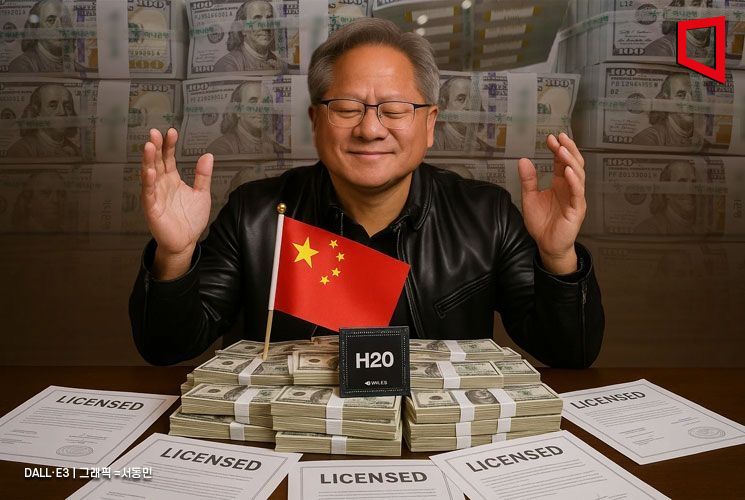
Jensen Huang, CEO of Nvidia, expressed optimism that there will be a $50 billion (approximately 70 trillion won) opportunity in the Chinese market this year. He added that although export uncertainties have increased amid President Donald Trump's strengthened sanctions against China, Nvidia is continuing to consult with the U.S. administration.
According to Bloomberg News, on August 27 (local time), CEO Huang stated during a conference call following Nvidia's second-quarter earnings announcement, "There will be a $50 billion (about 70 trillion won) opportunity for Nvidia in the Chinese market this year." However, he clarified that this is not a sales forecast.
He cited as a reason for his optimistic outlook the possibility that licenses for selling Nvidia's semiconductor chip 'H20' to some Chinese companies could be approved earlier than expected. The H20 is an artificial intelligence (AI) chip designed specifically for China, featuring lower specifications compared to existing products.
This aligns with remarks made by Nvidia CFO Colette Kress during the same conference call. She stated that if various conditions, such as geopolitical issues, are resolved, between $2 billion and $5 billion (approximately 3 trillion to 7 trillion won) worth of H20 chips could be shipped to China. She also mentioned that some Chinese customers have already obtained licenses. In the second quarter, however, sales of H20 chips to China were not reflected due to the strengthened sanctions against China.
CEO Huang also emphasized that Nvidia is in ongoing discussions with the U.S. administration and highlighted that it is positive for global AI capabilities to be built on the "American tech stack." He noted, "Frankly, that's become the catchphrase of the year."
He further stated that Nvidia will continue lobbying for approval to sell the 'Blackwell' architecture in China. This recalls President Donald Trump's comment on August 11 that even high-performance AI chips like Blackwell could be exported to China if their performance is reduced by 30 to 50 percent.
Regarding a question about the company's projection that $3 trillion to $4 trillion (about 4,182 trillion to 5,576 trillion won) will be invested in AI infrastructure over the next decade, CEO Huang responded, "Looking at the capital expenditures (CAPEX) of the top four cloud service providers (CSPs) alone, they have already more than doubled to about $600 billion (approximately 83.6 trillion won). We are just at the beginning stage of building AI infrastructure." However, he did not disclose the expected market share.
He added, "We do not simply provide chips; we offer a comprehensive full-stack solution for AI factories." This means that Nvidia is supplying not just graphics processing units (GPUs) but also more components that make up the infrastructure, which will allow the company to take a larger share of the market.
In response to a question about the AI factory business, CEO Huang said, "There is tremendous demand for AI," adding, "The buzz is everything's sold out." He explained that demand is exceeding supply not only for Nvidia's new chips but also for its older-generation chips. In particular, he noted that demand for GPU computing resources among AI companies is outstripping supply.
He concluded the event by saying, "The upcoming opportunity is enormous," and "A new industrial revolution has begun, and the AI race is already underway."
Meanwhile, despite Nvidia's second-quarter company-wide results exceeding expectations, its stock price fell more than 2.5% to $176 in after-hours trading following the close, as data center-related results came in below forecasts. Nvidia announced that in the second quarter (May to July), it recorded revenue of $46.74 billion (65.1555 trillion won) and earnings per share of $1.05 (1,463 won). These figures slightly exceeded the Wall Street averages compiled by market research firm LSEG, which were $46.06 billion in revenue and $1.01 in earnings per share.
© The Asia Business Daily(www.asiae.co.kr). All rights reserved.

















