Refining 40 Foreign Words into Korean Expressions
"Green Tech" Becomes "Eco-Friendly Technology"
"SIM Cloning" Becomes "SIM Illegal Duplication"
The Ministry of Culture, Sports and Tourism, together with the National Institute of the Korean Language, refined 40 commonly used but somewhat unfamiliar foreign words into easy-to-understand Korean expressions and released them to the public on August 28.
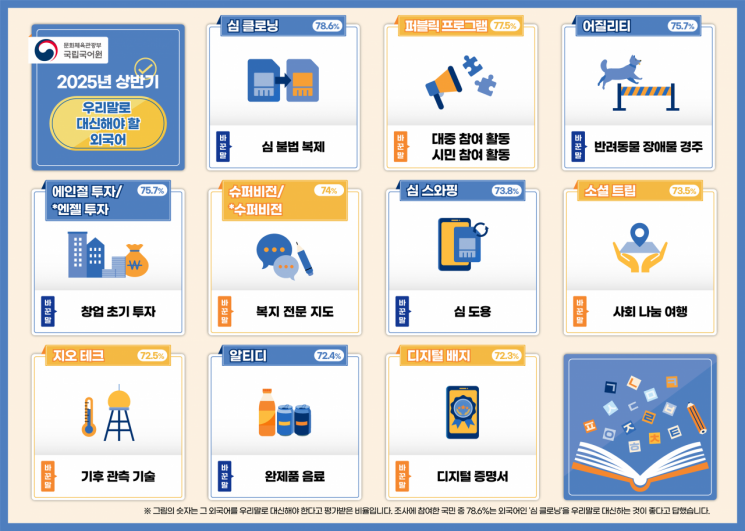 Examples of Foreign Words to Be Replaced with Korean in the First Half of 2025. Ministry of Culture, Sports and Tourism
This Korean language release was carried out through the "New Words Meeting," which included participation from the Ministry of Culture, Sports and Tourism, the National Institute of the Korean Language, the media, academia, and young people. The New Words Meeting prepared candidate terms, after which a survey of 3,000 citizens on acceptance and a review by the Korean Language Deliberation Committee’s Language Refinement Subcommittee finalized the selections.
Among the refined words, "eco-friendly technology" received the most positive evaluation in the public acceptance survey. This term is a refined version of the foreign word "green tech," which means "sustainable technology that preserves ecology by improving resource efficiency." "SIM illegal duplication (SIM cloning)," "environmentally friendly technology (eco tech)," and "climate observation technology (geo tech)" were also rated as easy to understand, in that order.
The foreign word that most respondents said "must be replaced with a Korean term" was "SIM cloning." This refers to "the method of duplicating SIM card information to create a cloned SIM card with the same number," and was refined as "SIM illegal duplication." Following this, there were many opinions that "public program (public participation activity/citizen participation activity)," "agility (pet obstacle race)," and "angel investment (early-stage investment)" should also be replaced.
Additionally, for "sovereign AI," both "independent artificial intelligence" and "domestic artificial intelligence" were selected as alternative terms to enhance usability.
The standardization of specialized terminology for central government agencies was also reviewed, refining difficult technical terms into easier Korean expressions. For example, the Ministry of Foreign Affairs requested that "initiative" be standardized as "plan," and "partnership" as "cooperative relationship" or "companion relationship." The Ministry of Personnel Management requested that "HR" be standardized as "personnel," "pool" as "candidate group," and "one-stop" as "all-in-one."
Details can be found on the "Refined Words" bulletin board on the National Institute of the Korean Language website.
The Ministry of Culture, Sports and Tourism and the National Institute of the Korean Language stated, "We plan to continue swiftly refining newly introduced foreign words, informing the public, and actively promoting them through online media such as social networking services (SNS), thereby advancing policies for easy-to-understand public language."
© The Asia Business Daily(www.asiae.co.kr). All rights reserved.

















