Revenue and Net Profit Exceed Expectations
Investor Sentiment Dampened by China Risks and AI Bubble Concerns
Nvidia, the leading company in artificial intelligence (AI) semiconductors, announced on the 27th (local time) that it recorded $46.7 billion in revenue and adjusted earnings per share (EPS) of $1.05 for the second quarter of its fiscal year (May to July). This result exceeded Wall Street's expectations of $46 billion in revenue and $1.01 in EPS. Compared to the same period last year, revenue increased by 56% and net profit rose by 59%.
Nvidia projected that third-quarter revenue will reach $54 billion, more than 50% higher than the same period last year, driven by strong demand for AI chips. Wall Street had anticipated $53.14 billion. However, this outlook does not include sales of the H20 chip in China, which were suspended in April due to regulations by the Donald Trump administration and only received approval to resume in July.
The majority of Nvidia's revenue came from its data center division, which includes graphics processing units (GPUs). Revenue in this segment rose 56% year-on-year to $41.1 billion.
Although Nvidia was unable to sell the H20 chip in China during the second quarter, the company stated that it sold $180 million worth of H20 inventory to customers outside China instead. The H20 chip had been restricted from export to China in April by the Trump administration's regulations, but sales were approved to resume in July.
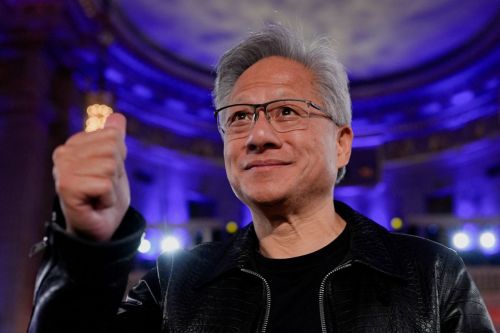
About half of the data center revenue was generated from large cloud service providers, which are purchasing the latest generation of chips, Blackwell. Nvidia's Blackwell sales in the second quarter increased by 17% compared to the first quarter. CEO Jensen Huang said in a press release, "Blackwell represents a generational leap in AI platforms. Demand is explosive, and Blackwell is at the center of the AI race."
Revenue from the gaming division increased by 49% year-on-year to $4.3 billion, while revenue from the robotics division surged by 69% to $586 million. Nvidia views robotics as its biggest growth driver going forward.
Despite the strong performance, Nvidia's share price fell by more than 3% in after-hours trading. The decline was attributed to missing some analysts' forecasts, concerns about an overheating AI market, and risks related to China, all of which dampened investor sentiment. Nvidia's stock price dropped by more than 5% at one point during the session.
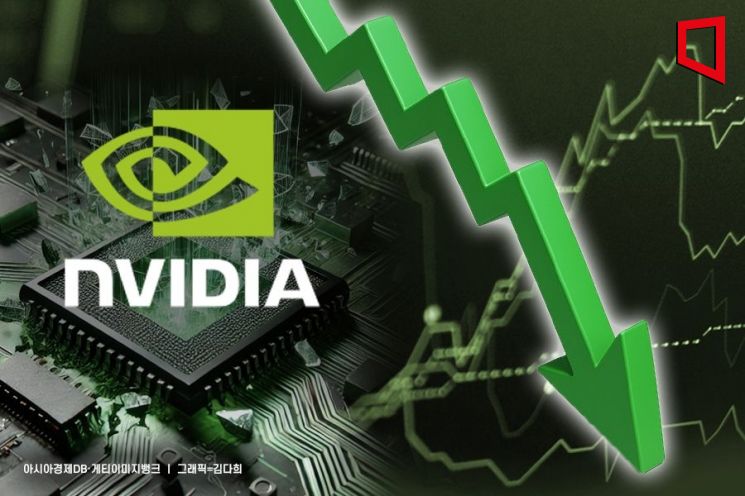
Reuters reported that after-hours stock prices fell as investor sentiment weakened due to geopolitical uncertainties, such as the temporary suspension of H20 chip sales in China. Investing.com analyzed, "Expectations related to AI have already been largely priced in, so volatility may increase in the short term."
© The Asia Business Daily(www.asiae.co.kr). All rights reserved.
![Clutching a Stolen Dior Bag, Saying "I Hate Being Poor but Real"... The Grotesque Con of a "Human Knockoff" [Slate]](https://cwcontent.asiae.co.kr/asiaresize/183/2026021902243444107_1771435474.jpg)

















