Discovery of Gilt Buddha Fragments and Buddhist Relics
First Evidence of Temple Facilities Within the Royal Palace in Buyeo Gwanbuk-ri
Artifacts and architectural remains indicating the existence of a Buddhist temple have been identified for the first time at Sabidoseong, the last capital of Baekje, which is present-day Buyeo in South Chungcheong Province.
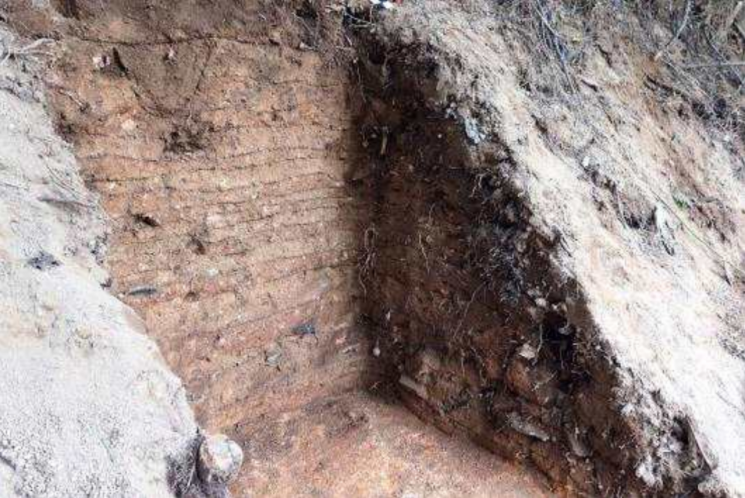
The Buyeo National Research Institute of Cultural Heritage announced on August 28 that, together with Buyeo County, it discovered Buddhist-related artifacts and an embankment layer (evidence of artificially piled soil) during the 18th excavation of the Gwanbuk-ri site in Buyeo, which was conducted over two months starting in June.
The excavation area is located in Ssangbuk-ri, northeast of Sabidoseong. This core area has already revealed the sites of the royal palace, major government offices, and ancient roads, and is also well known for the discovery of numerous wooden tablets (mokgan) inscribed with characters.
In this excavation, an embankment layer approximately one meter thick was found in the northern section adjoining the edge of Busosan Mountain. The application of the "horizontal embankment tamping" technique, which Baekje used when constructing the Gwanbuk-ri site and Busosanseong Fortress, suggests that an important building once stood here. The horizontal embankment tamping method involves evenly piling soil to a certain height to level the surface, then repeatedly compacting it within wooden frames to make it firm and stable.
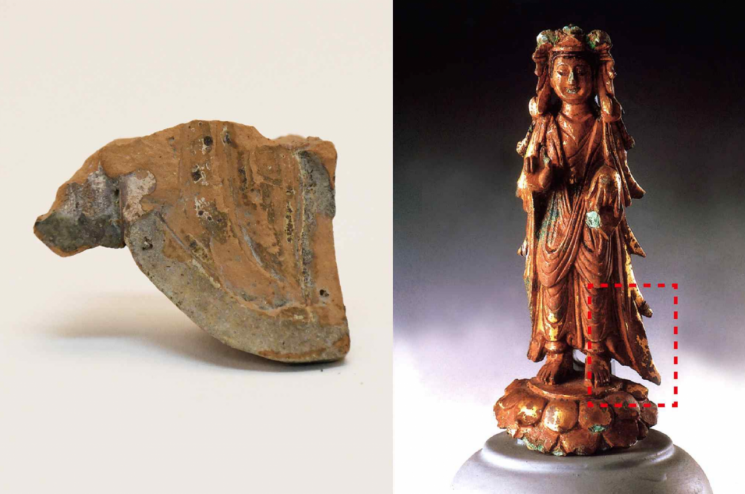 Cloth edge of the small standing Buddha statue (left) and reference photo of the gilt-bronze Bodhisattva statue from Gunsuri, Buyeo [Photo by National Heritage Administration]
In the southern excavation area and east of Buyeo Girls’ High School, a large number of Buddhist artifacts were uncovered. These include a "halo" (gwangbae) representing the light radiating from a Buddha statue, a "small Buddha" (hwabul) delicately engraved above it, and fragments of small clay statues shaped like the edges of robes. Some halos were coated with "geumni," a gold powder pigment, along the flame patterns, and traces of colored pigments were also found on the robes of Buddha and Bodhisattva statues.
An official from the institute explained, "This is the first time the use of geumni has been confirmed in clay statues from the Three Kingdoms period," adding, "It demonstrates the very high level of sculptural technique in the Ssangbuk-ri area."
This discovery is considered to provide new clues for understanding Buddhist faith and temple structures during the Baekje Sabidoseong period. The institute plans to continue investigating the entire Ssangbuk-ri area until May next year and to develop a plan for the preservation and maintenance of the site.
© The Asia Business Daily(www.asiae.co.kr). All rights reserved.


















