Industrial Crisis Response Committee
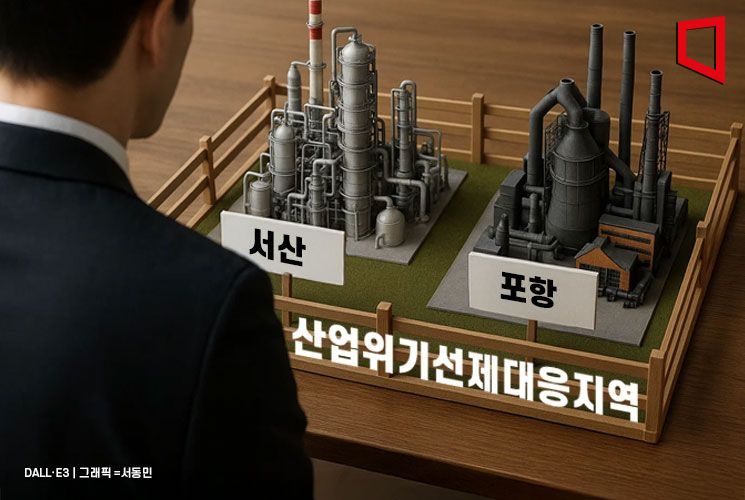
Seosan in South Chungcheong Province, which is experiencing structural difficulties in the petrochemical industry, and Pohang in North Gyeongsang Province, which is facing a crisis in the steel industry, have been designated as "Proactive Industrial Crisis Response Areas." The government plans to strengthen policy-based financial support for these regions.
The Ministry of Trade, Industry and Energy announced on August 28 that, following a review by the Industrial Crisis Response Deliberation Committee, Seosan and Pohang will be designated as Proactive Industrial Crisis Response Areas for two years, until August 27, 2027.
On July 18, the South Chungcheong Provincial Government applied for the designation, citing serious concerns over the deterioration of Seosan’s petrochemical industry due to structural challenges. The North Gyeongsang Provincial Government also applied, pointing to significant concerns about the decline of Pohang’s steel industry due to global oversupply and the influx of unfairly traded imports.
In response, the Ministry of Trade, Industry and Energy reviewed the applications, conducted on-site inspections, held working-level discussions with relevant ministries and local governments, and carried out deliberations by the Industrial Crisis Response Committee, all in accordance with the procedures set forth in the Regional Industrial Crisis Response Act. As a result, the local governments were designated as Proactive Industrial Crisis Response Areas. In the case of Seosan, this is the second such designation for a petrochemical industry crisis, following Yeosu.
With Seosan and Pohang designated as Proactive Industrial Crisis Response Areas, the government will prioritize measures such as emergency management stabilization funds, preferential local investment promotion subsidies, and strengthened policy-based financial support for small and medium-sized enterprises (SMEs). For emergency management stabilization funds, the Korea SMEs and Startups Agency will provide up to 1 billion won per company at an interest rate of 3.71% for five years (with a two-year grace period). The Small Enterprise and Market Service will offer up to 70 million won at an interest rate of 2.68% for five years (with a two-year grace period).
Policy-based financial institutions will support SMEs with maturity extensions and repayment deferrals, while the Korea Credit Guarantee Fund and the Korea Technology Finance Corporation will launch preferential guarantee support programs for partner companies and small business owners. In addition, to encourage proactive support from policy-based financial institutions, staff will be exempt from liability in the absence of willful misconduct or gross negligence.
Furthermore, through the newly established "Regional Industrial Crisis Response" project in the second supplementary budget, the government will provide additional support such as interest subsidies to reduce the loan burden for companies in the main industries of crisis regions, as well as customized support (business support and workforce development) to strengthen corporate competitiveness. The customized support will be provided by selecting implementing agencies within the crisis areas based on the needs of local companies. The Korea Institute for Advancement of Technology (KIAT) will serve as the lead agency, and detailed information on the projects will be announced on the websites of the Ministry of Trade, Industry and Energy and KIAT.
In addition, the Ministry plans to actively reflect various support programs necessary for overcoming industrial crises-such as research and development (R&D), management consulting, and employment stabilization-in the budget after 2026.
© The Asia Business Daily(www.asiae.co.kr). All rights reserved.


















