Transformation of Junghwa-dong 309-39 Area
Waterfront Residential Complex with 1,280 Households Planned
Central Living Zone to Leverage Local Nature and Culture
Enhanced Community Facilities and Pedestrian-Friendly Spaces
132 Out of 205 Rapid Integrated Planning Projects Now Complete
The area around 309 Junghwa-dong, Jungnang-gu will be transformed into a residential complex with 1,280 households.
On August 27, the Seoul Metropolitan Government announced that it had finalized the rapid integrated planning for the "Junghwa-dong 309-39 Area Redevelopment Project."
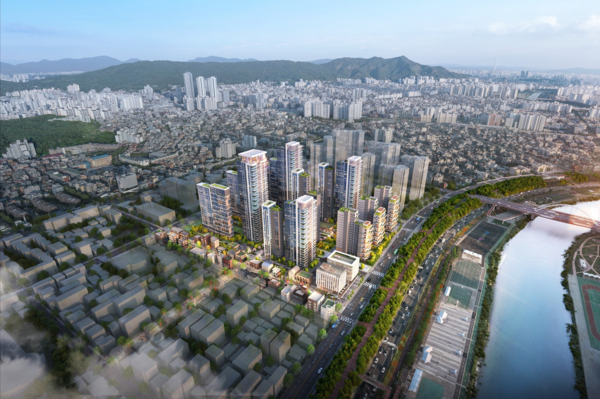 Aerial view of the rapid integrated planning area around 309-39 Junghwa-dong, Jungnang-gu Provided by Seoul City
With this decision, the site will be reborn as a waterfront residential complex with 35 stories and 1,280 households. The area was designated as the Junghwa Redevelopment Promotion District in 2009 but was lifted in 2023, resulting in deteriorating residential conditions and inconveniences for residents.
The city plans to create a central residential complex by utilizing the area's natural and cultural assets, such as Jungnangcheon Stream, Bonghwasan Mountain, and the Rose Festival. The plan is based on four principles: creating a new waterfront landscape along Jungnangcheon Stream, developing a residential complex that energizes the area, establishing a pedestrian-friendly living environment connected to the surrounding region, and providing convenient living conditions through the development of essential infrastructure.
First, the city has planned a waterfront-specialized complex harmonizing with the foothills of Jungnangcheon Stream and Bonghwasan Mountain. The area near the waterfront will feature mid-rise buildings of around 18 stories, while the center of the complex will have a landmark high-rise (up to 35 stories) offering views of Jungnangcheon Stream and Bonghwasan Mountain.
Facilities to support local residents' leisure, culture, and welfare are also planned. Community facilities and public spaces for residents will be placed near Jangmi Jeil Market, so the site can become a driving force for local vitality. Public facilities planned for the northwest side of the site will include a daycare center and a senior welfare center to prepare for an aging society, along with a public parking lot.
There are also plans to create a children's park and a green pedestrian corridor on the route from Junghwa Station to Jungnangcheon Stream, aiming to connect the disconnected old downtown with the waterfront. Pedestrian routes and specialized street space plans connecting key local facilities such as Sinmuk Elementary School and Jangmi Jeil Market have been established to improve residents' convenience.
In addition, the existing Bae Flower Park at the center of the complex will be integrated with the southern children's park to make efficient use of the apartment site.
Cho Namjun, Director of the Urban Space Headquarters at the Seoul Metropolitan Government, said, "Amid changes in the area, such as the reorganization of the Jungnangcheon Stream waterfront, we hope that the Junghwa-dong 309-39 area will be reborn as a vibrant waterfront complex, leading to a more pleasant daily life for residents and revitalization of the local community."
Meanwhile, with the finalization of the "Junghwa-dong 309-39 Area Redevelopment" plan, planning has been completed for 132 out of 205 rapid integrated planning sites in Seoul.
© The Asia Business Daily(www.asiae.co.kr). All rights reserved.

















