Asset Managers Rush In Ahead of End of Government Tax Incentives
Vestas Makes Its Debut... "Two to Three More Firms Considering Entry"
JB Asset Management Plans Bulk Purchase of 990 'Ghost Apartments' in Daegu
Liquidity Boost Expected for L
Corporate Restructuring Real Estate Investment Trusts (CR REITs) are emerging as a solution to the so-called "toxic unsold units"-unsold apartments remaining after completion. As government tax benefits are set to end within this year, new asset management companies are entering the market this month, while existing operators are expanding their portfolios in a rush to take advantage of the benefits before they expire. It is expected that by the end of this year, more than 3,000 units of toxic unsold apartments could be absorbed through CR REITs.
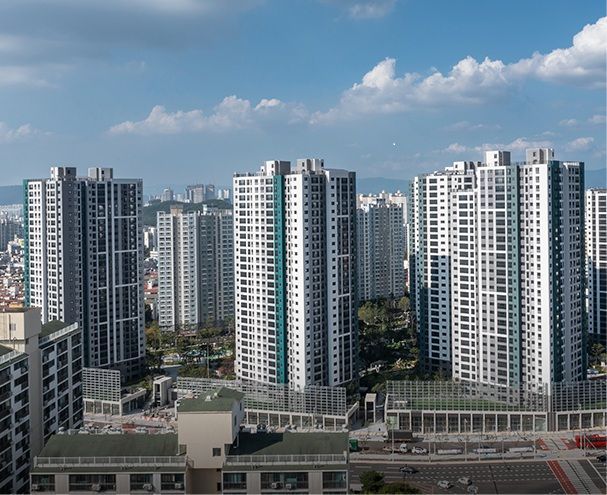
According to the Ministry of Land, Infrastructure and Transport on August 28, Vestas Asset Management recently applied to register a new CR REIT. The company reported its plan to the ministry to purchase, lease, operate, and sell unsold housing units located in Dong-gu, Busan, under the "Vestas No.1 CR REIT." This makes Vestas the second CR REIT operator after JB Asset Management, creating a competitive landscape in the market.
The size and targets of Vestas Asset Management’s acquisitions have not yet been disclosed. This information is expected to be announced after the registration process is completed. A ministry official stated, "In addition to Vestas, other asset management companies, particularly those focusing on Jeju, are also considering CR REITs," adding, "There is a possibility that two or three more operators will join the market."
Asset management companies are actively pursuing CR REIT projects to benefit from the tax incentives-such as exemptions from acquisition tax surcharges, comprehensive real estate tax aggregation, and additional capital gains tax-before they expire. The CR REIT system was revived by the government in March last year, after a decade, to address the issue of toxic unsold apartments. The structure involves pooling funds from multiple investors to purchase unsold housing units, leasing them out, and then selling them during a market recovery to generate returns.
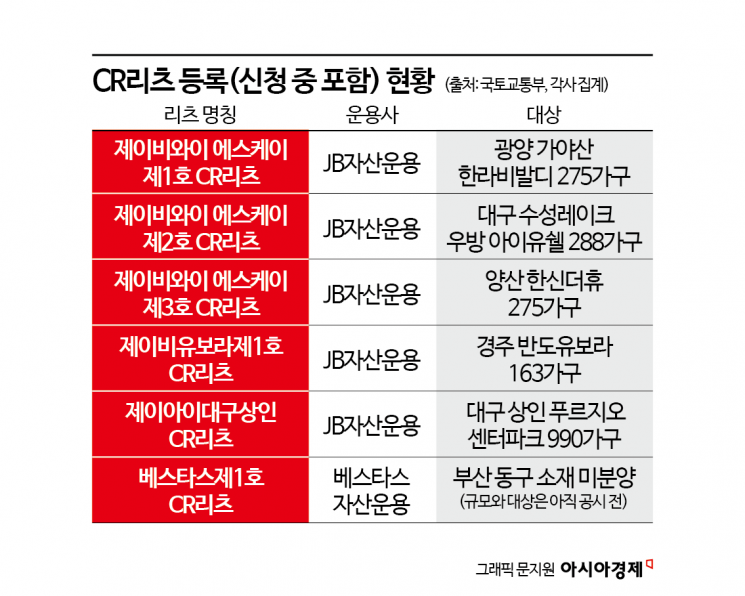
JB Asset Management, which entered the market early last year, is aggressively expanding its CR REIT business. This month, it registered the "JI Daegu Sangin CR REIT," which acquired 990 units of Sangin Prugio Centerpark in Daegu. This apartment complex, which received completion approval in April last year, was put up for post-sale, but the subscription competition ratio was only 0.03 to 1. As a result, nearly 1,000 units remained vacant for two years, turning the complex into one of Daegu’s most prominent "ghost apartments." JB Asset Management’s acquisition covers most of the complex and is estimated to be worth about 600 billion won.
JB Asset Management has already completed registration procedures for several other CR REITs: "JBY SK No.2 CR REIT," which acquired 288 units of Suseong Lake Woobang IUShell in Daegu; "JBY SK No.3 CR REIT," which secured 275 unsold units of Hanshin The Hue in Yangsan, South Gyeongsang Province; and "JBY No.1 CR REIT," which took over 275 units of Gayasan Halla Vivaldi Premier in Gwangyang, South Jeolla Province. The company is also in the process of registering a CR REIT to acquire Bando Yubora in Gyeongju (163 units secured, with plans for further expansion).
A representative from JB Asset Management explained, "Some REITs have direct investment from construction companies, but in the case of Sangin Prugio Centerpark in Daegu, external investors are also involved," adding, "In addition to the already confirmed REITs, we are planning at least one or two more projects."
In particular, analysts point out that resolving large-scale complexes with nearly 1,000 units, such as Sangin Prugio Centerpark in Daegu, through CR REITs could do more than just reduce statistical figures-it could serve as a turning point for market sentiment. As the CR REIT market grows, it could invigorate the local construction and real estate sectors alongside Korea Land & Housing Corporation’s (LH) toxic unsold apartment acquisition projects (3,000 units this year and 5,000 units next year). As of the end of June, the nationwide number of toxic unsold apartments stood at 26,716 units, marking the first month-on-month decrease in 23 months.
Over the remaining four months of the year, the cumulative number of units acquired by CR REITs is expected to exceed 3,000. The government is supporting the swift progress of these projects, making it possible to complete the registration process within a month if all documents are in order. A ministry official stated, "During the past financial crisis, CR REITs absorbed about 2,000 out of 70,000 unsold housing units, but the current acquisition ratio is much higher," adding, "If the number expands to around 3,000 units, CR REITs could absorb more than 10% of all toxic unsold apartments, providing substantial help in resolving unsold inventory and securing liquidity for construction companies."
© The Asia Business Daily(www.asiae.co.kr). All rights reserved.


















