Survey of 100 Foreign-Invested Companies in South Korea
35.6% Considering Reducing Investment or Withdrawing Branches
47% Negative Toward Damages Limitation Provision
Following the passage of the Yellow Envelope Act (Amendment to Articles 2 and 3 of the Labor Union and Labor Relations Adjustment Act), a survey found that one out of three foreign companies operating in South Korea is considering reducing investment or withdrawing from the country.
On August 27, the Korea Foreign Company Association (KOFA) announced the results of a survey conducted among the CEOs and HR managers of 100 foreign-invested companies in South Korea regarding changes to their investment plans after the law was passed. According to the survey, 35.6% responded that they are "considering reducing investment or withdrawing their Korean branches." Meanwhile, 64.4% said "there will be no impact."
The amendment to Articles 2 and 3 of the Labor Union Act expands the definition of employer to strengthen the responsibility of principal employers for subcontracted workers, and limits the scope of damages claims against unions or workers. The bill passed the National Assembly plenary session on August 24.
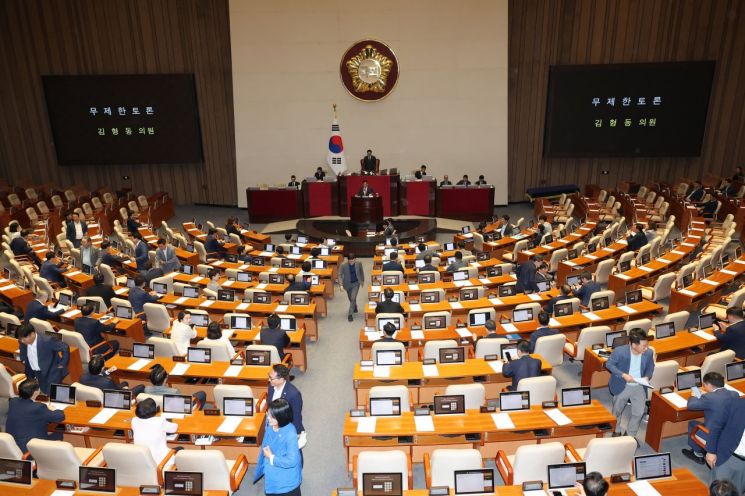 Kim Hyungdong, a member of the People Power Party, is conducting an unlimited debate on the Yellow Envelope Act (Partial Amendment to the Labor Union and Labor Relations Adjustment Act) at the National Assembly plenary session in Yeouido, Seoul, on the 23rd. Photo by Yonhap News.
There was also significant negative feedback regarding Article 3 of the Labor Union Act, which adjusts liability for damages related to industrial action. Only 7% responded positively to the provision limiting damages claims, while 47% responded negatively. The remaining 46% were neutral.
Regarding the provision expanding protections for strike participants, 40% responded positively and 44% negatively. The neutral response rate was 16%. For the provision limiting civil liability for illegal strikes, 30% responded positively, 50% negatively, and 20% were neutral.
Established in September 1999, KOFA is a non-profit organization that serves as a bridge between approximately 15,000 foreign-invested companies in South Korea and the government, and currently has about 600 member companies.
Regarding the regions of the parent companies of survey respondents, 53.5% were based in Europe, followed by North America (United States) at 22.8%, and Asia at 21.8%.
By number of employees, companies with 100 to 299 employees accounted for the largest share at 27.7%, followed by those with fewer than 30 employees at 23.8%, 300 to 499 employees at 16.8%, 50 to 99 employees at 12.9%, and those with more than 1,000 employees at 7.9%.
Based on annual sales, companies with sales between 30 billion and 50 billion won accounted for 22.8%, those with more than 200 billion won accounted for 20.8%, less than 10 billion won for 19.8%, 50 billion to less than 100 billion won for 16.8%, and 100 billion to less than 200 billion won for 13.9%.
This survey focused primarily on Article 3 of the Labor Union Act, and additional surveys on Article 2 and the expanded definition of employer are planned for the future.
© The Asia Business Daily(www.asiae.co.kr). All rights reserved.

















