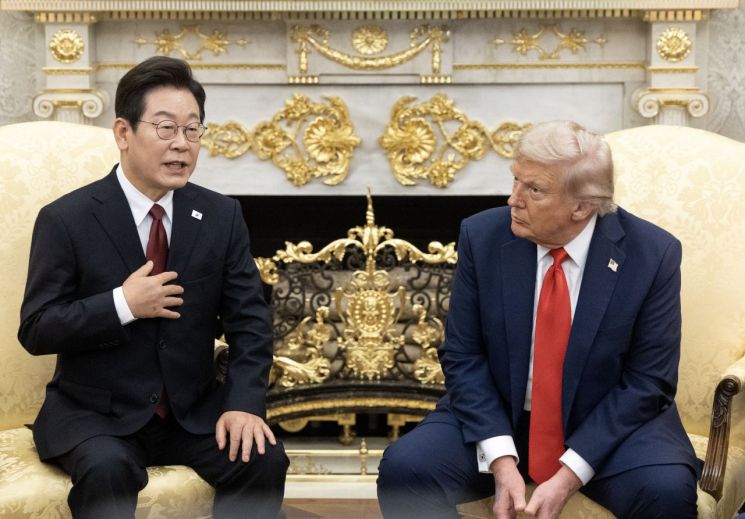
On August 27, Samjong KPMG published a report titled "Impact of the Korea-U.S. Summit on Domestic Industries: Focusing on Investment in the U.S." and identified the following as the core keywords of the summit: ▲Security and defense cooperation ▲Economic and industrial cooperation ▲Maintaining the original text of the Korea-U.S. tariff negotiation.
The report presented the expected impact of the summit's outcome on each industry and suggested response strategies for companies. In the shipbuilding sector, the MASGA (Make American Shipbuilding Great Again) project led by U.S. President Donald Trump and President Lee Jaemyung's "Shipbuilding and Manufacturing Renaissance" policy are expected to create synergy, leading to expanded cooperation in various areas such as joint shipbuilding, naval MRO (Maintenance, Repair, and Operations), and shipyard modernization. The report emphasized, "Korean companies should secure market leadership by expanding local joint ventures and investing in eco-friendly ships."
In the energy industry, cooperation in the nuclear power sector, including SMRs (Small Modular Reactors), is set to begin in earnest, alongside the expansion of U.S. energy imports such as LNG, projected to reach a scale of 100 billion dollars by 2028. The report stated, "Korean companies should actively seek opportunities to diversify energy import sources and collaborate on next-generation nuclear power technologies."
In the defense sector, both countries agreed to strengthen practical cooperation under the framework of "Alliance Modernization." In the short term, cooperation is expected to expand in various fields, including the supply of strategic minerals for the defense industry and the introduction of advanced U.S. weaponry. In the mid- to long-term, enhancing the competitiveness of K-Defense to target the global market is expected to become a key task.
For the pharmaceutical and biotech industries, ongoing concerns about pharmaceutical tariffs require Korean companies to consider investments in the U.S., such as acquiring production facilities to secure a presence in American biotech clusters.
Secondary batteries were discussed as a sub-agenda in the supply chain sector at the Korea-U.S. Business Roundtable, where both countries reaffirmed their commitment to strengthening production capacity in the U.S. As a result, K-Batteries are expected to expand their presence in the U.S. market and accelerate their global expansion using the U.S. as a base.
In the automotive industry, with the confirmation of a 15% tariff as a result of the summit, it is necessary to expand local investment targeting the U.S. market, which accounts for more than half of Korea's automobile exports, and to closely cooperate with the government.
Regarding the agri-food industry, the report stated, "As the Korea-U.S. tariff negotiation agreement is maintained overall, an additional 15% tariff is expected to be applied to future exports to the U.S.," and added, "New growth drivers should be secured through response strategies such as utilizing OEM (Original Equipment Manufacturing) and establishing local factories."
Meanwhile, the roundtable also discussed ways to expand cooperation in advanced technologies such as AI, beyond the manufacturing sector. The report noted, "While expanded Korea-U.S. cooperation in digital and AI is expected, companies should be cautious as new opportunities and risks may arise depending on whether non-tariff barriers such as the U.S. Online Platform Act and Google Maps data export restrictions are eased."
The Samjong KPMG Economic Research Institute stated, "With the recent Korea-U.S. summit alleviating risk factors and expanding positive impacts such as new cooperation opportunities in strategic industries like shipbuilding, energy, and defense, Korean companies should seek new growth engines through advanced technology cooperation and discussions on stabilizing critical mineral supply chains." The institute also emphasized, "In particular, follow-up monitoring of the implementation process for the 150 billion dollar investment in the U.S. and the discovery of new business opportunities are necessary."
© The Asia Business Daily(www.asiae.co.kr). All rights reserved.
![Clutching a Stolen Dior Bag, Saying "I Hate Being Poor but Real"... The Grotesque Con of a "Human Knockoff" [Slate]](https://cwcontent.asiae.co.kr/asiaresize/183/2026021902243444107_1771435474.jpg)
















