"No Disadvantageous Agreements, but Uncertainty Remains"
"Possibility of Trump Applying Pressure via Social Media... The Summit Is Just Beginning"
Song Eonseok: "$600 Billion Investment... Concerns Over Domestic Investment"
With the leaders of South Korea and the United States taking their first steps toward building trust in diplomacy, security, and trade at the Korea-US summit, the political circles in Yeouido are closely monitoring the potential political repercussions. The Korea-US summit itself is a major issue that could influence the political landscape and is also a matter that could become a significant variable for the national economy.
The Democratic Party of Korea is openly expressing its satisfaction with the positive evaluations coming from both domestic and international sources. In contrast, the People Power Party is emphasizing caution, pointing out that unresolved issues still remain.
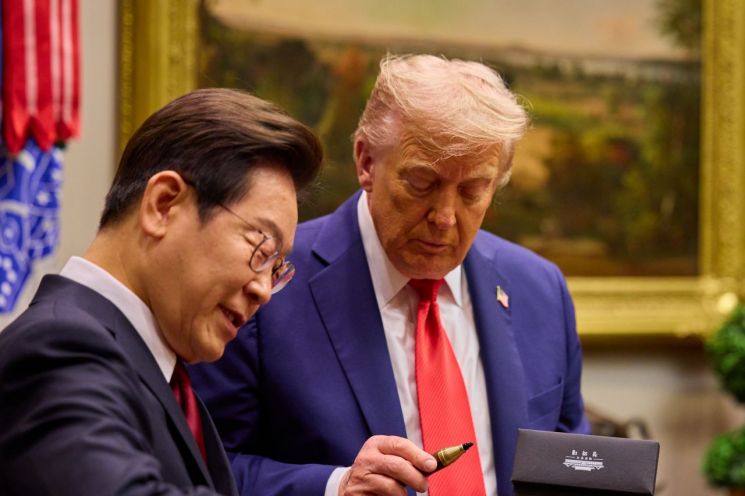 President Lee Jae Myung is presenting a fountain pen he used to write in the guestbook to U.S. President Donald Trump at the Korea-U.S. summit held at the White House in Washington DC on the 25th (local time). Photo by Yonhap News
Jeong Cheongrae, leader of the Democratic Party of Korea, stated at the Supreme Council meeting held at the Daejeon City Party office on the 27th, "President Donald Trump of the United States, who is thoroughly equipped with a business mindset, has opened his heart. President Lee Jae Myung approached President Trump in a style and with content that he greatly favors, bringing about effects for the national interest of South Korea that are too significant to quantify."
Jeong added, "I am greatly relieved that this extremely important Korea-US summit was successful."
The Policy Committee and the Foreign Affairs and Unification Committee of the People Power Party held an emergency briefing at the National Assembly this morning to evaluate the results of the Korea-US summit. Opposition parties and experts raised concerns that, since neither a joint statement nor details from the closed-door meetings were released, there is no way to know the specifics of agreements on key issues such as additional opening of the agricultural market, the strategic flexibility of US Forces Korea, and the Korea-US nuclear cooperation agreement.
Song Eonseok, floor leader of the People Power Party, pointed out, "With an additional $150 billion investment in the US, the previously agreed $350 billion investment, and $100 billion in energy purchases, the total amount South Korea is investing is $600 billion, which is more than Japan. This inevitably means a decrease in domestic investment." He continued, "The public and farmers have no way of knowing to what extent agricultural markets will be opened. Also, although it is said that the transfer of wartime operational control was not discussed this time, since the cost-sharing for US Forces Korea is set to increase on the premise that their status and role will be adjusted, I am concerned that this could be a negative for our security."
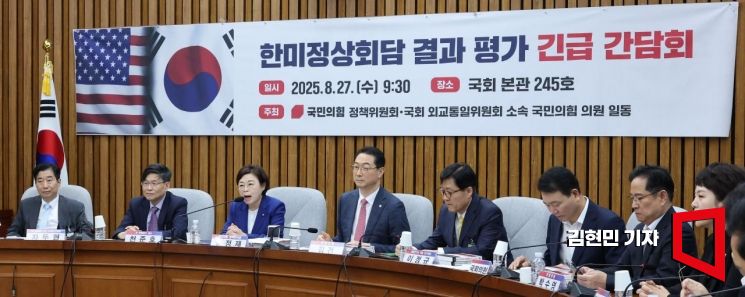 Kim Jungjae, chairman of the Policy Committee of the People Power Party, is speaking at an emergency briefing evaluating the results of the Korea-US summit held at the National Assembly on the 27th. 2025.8.27 Photo by Kim Hyunmin
Former Ambassador to Finland, Chun Junho, commented at the briefing, "There were numerous reports during the July 30 working-level talks that the US strongly pressured for detailed plans regarding the $350 billion investment fund and for further opening of the agricultural and livestock markets. So I was watching closely to see how this would be resolved, but surprisingly, there was no announcement on these issues." He explained, "In the case of the European Union, which reached a trade agreement around the same time as us, the detailed conditions were agreed upon in a joint statement, so it would have been natural for us to reach an agreement this time as well, but it did not happen."
Lee Jeonggyu, visiting research fellow at the Sejong Institute and former Ambassador to Sweden, said, "Since the contents of the closed-door meetings have not been disclosed, it is difficult to judge whether the summit was successful or not. However, President Trump, by nature, does not limit himself to face-to-face meetings and tends to communicate very important matters through social media and other channels, so the summit has not ended but is just beginning."
However, there are also evaluations that, at least outwardly, the summit was successful, even as President Trump continues to strongly push 'America First' policies against major countries around the world. According to a poll conducted by Realmeter at the request of Energy Economy News on this day, surveying 507 men and women aged 18 and over nationwide, 53.1% of all respondents evaluated the summit positively.
Former Ambassador Chun summarized, "Overall, there were no additional agreements disadvantageous to us at this summit, but uncertainties were not resolved either, making the outcome incomplete. However, the current Trump administration's trade policy is so revolutionary that it is expected to bring significant practical difficulties. This aspect should also be taken into account in our evaluation."
© The Asia Business Daily(www.asiae.co.kr). All rights reserved.


















