Governor Park Wansu Holds "Win-Win Talk" with Jinju Citizens
Event Takes Place at Gyeongnam e-Sports Permanent Stadium
Over 300 Jinju Citizens Participate
Governor Park Wansu announced on the 27th that he directly engaged with Jinju citizens on local issues and policy tasks during the "Win-Win Talk with Residents" held at the Gyeongnam e-Sports Permanent Stadium in Jinju.
In his opening remarks, Governor Park said, "It is a pleasure to greet you again after meeting with citizens at City Hall three years ago. I would like to thank the mayor and citizens for their warm welcome." He continued, "Over the past three years, Jinju has achieved remarkable results, including designation as a specialized satellite district, the groundbreaking of the Future Aircraft (AAV) Demonstration Center, the launch of micro-launch vehicles, and the hosting of international sports events. Jinju is now emerging as a global city. These achievements are the result of citizens working together."
He also stated, "Gyeongnam's key industries, such as defense, aerospace, and shipbuilding, are entering a new era. With the groundbreaking of the southern inland railway, the revitalization of Sacheon Airport, and the expansion of the Free Economic Zone, Jinju will develop into the central city of the southern inland region of the Korean Peninsula." He added, "I will continue to communicate openly with citizens and actively reflect their voices in city and provincial administration."
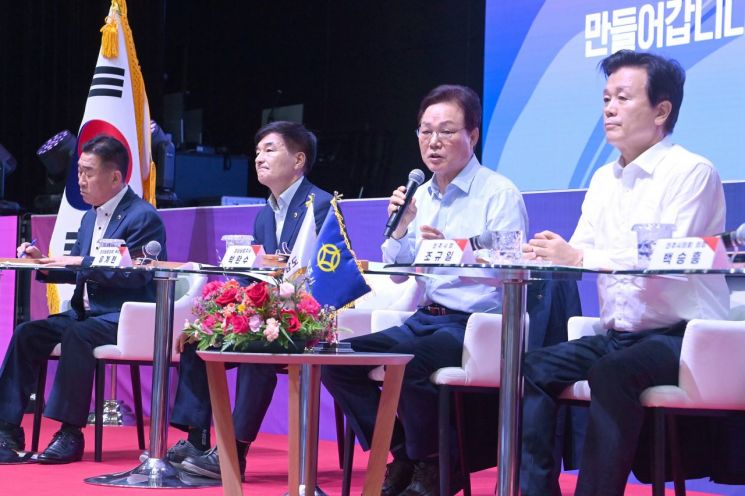
The event was attended by Governor Park Wansu, Jinju Mayor Cho Gyuil, and about 300 Jinju citizens, who freely proposed ideas on daily inconveniences and policies, and received direct responses from the province and city.
The Vice President of the Jinju Small Business Association requested practical support measures for small business owners. In response, Governor Park said, "Beyond financial support such as improving traditional market facilities and issuing local gift certificates, it is important to create an environment that increases the chances of success and reduces failure by providing local commercial information and government consulting to entrepreneurs. The province is also working to build related systems."
One citizen pointed out, "Public institution employees relocated to the innovation city mainly use high-speed trains (KTX) and flights, but the limited number of services causes significant inconvenience," and suggested improving transportation between Jinju and the Seoul metropolitan area. The province responded, "Based on the high usage of this route, we will continue to request increased KTX services from the Ministry of Land, Infrastructure and Transport and Korail, and will actively promote the introduction of new flights by small airlines."
Another citizen said, "The foreigner civil service outreach provided by the Changwon Immigration Office has not resumed since being suspended due to COVID-19," and proposed establishing a Jinju branch office. The province replied, "We understand the administrative needs of foreigners in the northwestern region, which is far from the Changwon Immigration Office, and will continue to consult with relevant ministries."
A local businessperson emphasized, "It is essential for Gyeongnam to attract a testbed equipped with a future aircraft demonstration system," and requested active support from the province. In response, Governor Park stated, "To firmly establish Gyeongnam as a hub for aerospace, it is necessary to build a cluster where global companies, research institutes, and universities are concentrated. Jinju and Sacheon should work together to attract branches of research institutes."
Other suggestions included: ▲ the establishment of the Korea Entrepreneurship Museum, ▲ the promotion of the Wolasan Forest Jinju National Garden, ▲ the creation of a full-cycle standardization hub for natural materials, and ▲ support for the Jinju Traditional Craft Biennale.
Meanwhile, in the morning, Governor Park visited the Korea Aerospace Industries (KAI) Rotary Wing Flight Center in the Gasan General Industrial Complex in Jinju to inspect the foundation for the future aircraft (AAV) industry.
On site, Governor Park remarked, "The development and demonstration of future aircraft is realistically too large in scale and budget for the region to handle alone. Bold government investment and strategic support are necessary." He added, "Until national support is fully implemented, Gyeongnam Province and Jinju City must provide initial support."
The Korea Aerospace Industries (KAI) Rotary Wing Flight Center covers approximately 41,000 pyeong (135,197 m²), with a five-story building, helicopter hangar, and a 700-meter runway. It was completed in December 2024.
In particular, in connection with the Future Aircraft (AAV) Demonstration Center scheduled for completion this year, the center aims to establish an environment for demonstrating rotary-wing and future aircraft, with the goal of building an ecosystem for the Korean Advanced Air Mobility (AAM) industry.
© The Asia Business Daily(www.asiae.co.kr). All rights reserved.

















