Promotion of Anyangcheon Regional Garden and Forest-type Gardens on Four Major Mountains
Specialized Gardens for Citizen Gardeners, Kids, and Seniors
Gwangmyeong City in Gyeonggi Province has unveiled its vision to transform every space in the city into a garden. On August 27, Gwangmyeong City held a briefing in the main conference room at City Hall and announced its five-year Garden City implementation plan.
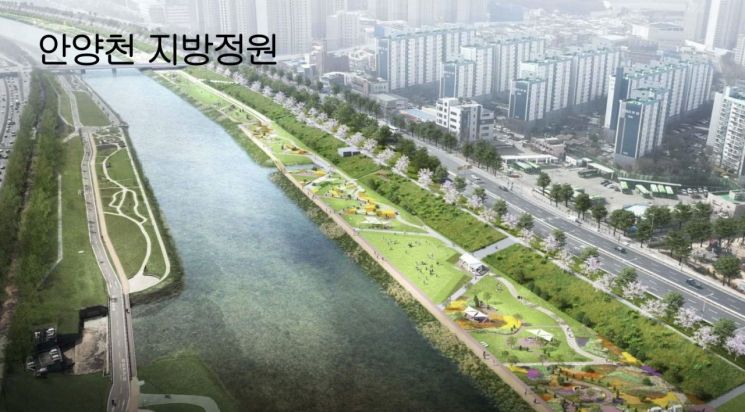 Aerial view of Anyangcheon Regional Garden, the core project of Gwangmyeong City's five-year Garden City plan. Provided by Gwangmyeong City
This plan, which lays out a policy roadmap for creating a Garden City over the five years from this year to 2029, includes six key initiatives: the creation of the Anyangcheon Regional Garden, the establishment of forest-type community gardens on the city's four major mountains, the creation of Kids Gardens and the training of play gardeners, the training of citizen gardeners, senior-friendly initiatives, and the realization of an Environmental, Social, and Governance (ESG) Garden City.
For Anyangcheon, the city will collaborate with Anyang, Gunpo, and Uiwang to develop it into a regional garden where communication, relaxation, culture, and nature coexist. The basic and detailed designs were completed in March, and a pilot project is currently underway in part of the Gwangmyeong section. The Anyangcheon Regional Garden will be created as a participatory garden, cultivated directly by citizens.
On the four mountains that run north to south across the city-Dodeoksan, Gureumsan, Gahaksan, and Seodoksan-forest-type community gardens will be established. These gardens will be designed to preserve the existing forest ecosystem while allowing citizens free access and opportunities for activities.
Across the city, 'Kids Gardens' will be created and expanded as play-based educational spaces. To achieve this, the city will develop a variety of educational content and train specialists in garden playgrounds.
The citizen gardener training program, which has been in operation since 2022, will also be strengthened. So far, 169 citizens have completed the program, with 55 of them currently active as citizen gardeners. In June, a 'Garden Promotion Team' composed of about 70 citizens was also launched.
The city plans to enhance the momentum of the Garden City initiative by integrating corporate ESG values into the process. By collaborating with the 'Gwangmyeong ESG Action Team,' which was launched last year and consists of local public institutions, private companies, and social organizations, the city aims to develop the Garden City as a model for sustainability and the creation of social value.
Last month, the city also amended the 'Ordinance on the Promotion and Development of Garden Culture' to support the Garden City initiative. The revised ordinance includes provisions for establishing a garden culture promotion plan, creating and operating a garden support center, forming a garden culture promotion committee, and guidelines for the creation and management of regional gardens.
Kim Wongon, Director of the Urban Housing Bureau of Gwangmyeong City, said, "The Garden City policy is a challenge that will transform citizens' lifestyles and the sustainability of the city," adding, "With a systematic roadmap, we will realize a Garden City where citizens can directly participate, communicate, and enjoy."
© The Asia Business Daily(www.asiae.co.kr). All rights reserved.

















