Three-Stage Disaster Information System:
Text Alerts, Village Broadcasting, and In-Person Visits
Disaster Messages to Include Detailed Evacuation Information
To address recent concerns such as seniors not receiving disaster text messages and ambiguous guidance, the government will establish a three-stage disaster information delivery system.
On August 27, the Ministry of the Interior and Safety announced measures to improve the disaster information delivery system. The core of this plan is to eliminate information blind spots by moving away from a fragmented, text message-centered approach and instead building a three-stage overlapping delivery system: local governments (disaster text messages), village-level (alert and warning facilities), and vulnerable groups (in-person support).
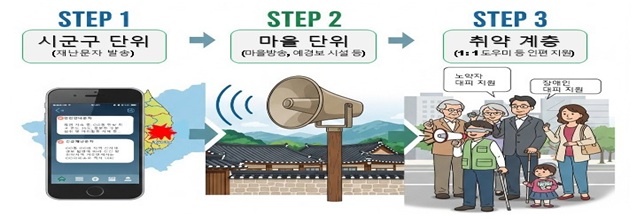 The triple disaster information delivery system improved by the Ministry of the Interior and Safety. Provided by the Ministry of the Interior and Safety
First, local governments will serve as the primary information network by sending swift and accurate disaster text messages. The types of disaster messages will be strictly classified according to the level of risk: safety guidance messages, emergency disaster messages, and critical disaster messages. In urgent situations such as extreme heavy rainfall and evacuation orders, emergency disaster messages will sound on mobile phones at a maximum volume of at least 40 dB.
Additionally, the standard format for disaster text messages will be revised to help people determine when, where, and how to evacuate. Previously, vague phrases like "evacuate to a safe place" were criticized for being unhelpful during actual evacuations. The new standard messages will include specific evacuation locations and instructions. The character limit for disaster messages will also be gradually increased from 90 to 157 characters.
Redundant disaster messages that could reduce public alertness will be minimized. A function to review similar or duplicate messages will be gradually introduced into the disaster message system. In the long term, through research and development, the government plans to implement "geofencing" technology to block unnecessary disaster messages from other regions. Geofencing is a technology that subdivides disaster message transmission areas based on regional boundaries.
At the second, village-level stage, all alert and warning facilities will be mobilized to deliver disaster information to seniors who cannot read messages, people without mobile phones, and residents in areas with communication disruptions. When emergency or critical disaster messages are sent, their content will be rebroadcast through village broadcasting systems and similar channels.
The adoption of the "smart village broadcasting" system by local governments will be expanded to automatically deliver disaster information via voice calls to residents in vulnerable areas who have given prior consent. The government also plans to coordinate with relevant agencies to allow local governments, in addition to central ministries, to request disaster broadcasts. This is to ensure that, in case of communication failures, local governments can use disaster broadcasts to deliver evacuation orders.
Finally, for the third stage targeting vulnerable groups, a "last safety net" will be established, where people deliver information in person. For seniors and people with disabilities who are especially vulnerable during evacuations, staff will visit directly to provide disaster information and assist with evacuation. When extreme heavy rainfall is forecast, village broadcasts and in-person visits will be used to inform residents in vulnerable areas of shelter locations in advance. Priority evacuees will be visited directly by the Resident Evacuation Support Team or evacuation helpers.
The Ministry of the Interior and Safety will hold a briefing session for local governments on August 28 and plans to produce and distribute a "Disaster Information Delivery Guidebook" with detailed information to relevant agencies in the future.
Kim Yongkyun, Director General for Safety and Prevention Policy at the Ministry of the Interior and Safety, stated, "We will continue to improve and supplement the disaster information delivery system so that the public can receive disaster information properly in dangerous situations."
© The Asia Business Daily(www.asiae.co.kr). All rights reserved.

















