Consensus on Cross-Subsidization Issues...
Securing Funding Is the Key
"LH Regional Headquarters Should Be Split
and Transferred to Local Corporations"
The government has decided to embark on a comprehensive "reform" of Korea Land and Housing Corporation (LH). Unlike previous high-intensity innovation measures, which were triggered by employee misconduct and revolving door issues at LH, this time the government has determined that the current business structure itself is problematic and plans to address it by forming a temporary task force. Given that past improvement measures have often fizzled out and that this issue is deeply entangled with the complex interests of the real estate system, many expect the process to be highly challenging.
According to the "Five-Year State Administration Plan of the Lee Jaemyung Administration," recently made public by the National Planning Committee, the government has included a diagnosis of problems related to LH’s sale of land to the private sector and the preparation of fundamental improvement measures. President Lee Jaemyung has made clear his intention to overhaul LH’s "land speculation" business, which he has criticized for years. Since taking office, President Lee has emphasized the need for public institution reform, and in the case of LH, he has already signaled strong restructuring measures, such as requiring LH to attend Cabinet meetings.

General Agreement on Cross-Subsidization Issues... The Key Is Securing Funding
The cross-subsidization business structure of LH has long been consistently criticized both internally and externally. Cross-subsidization refers to the structure in which LH covers losses incurred from carrying out housing welfare policies, such as public rental housing, using profits earned from developing and selling land to the private sector. In order to generate profits, LH must sell land at high prices.
However, selling land at high prices leads to increases in housing prices. As a result, LH’s cross-subsidization structure has been criticized for fueling instability in the real estate market. The uncertainty is further exacerbated by the increasing number of rental units LH must manage and the corresponding rise in costs, while profits from land sales fluctuate greatly depending on the real estate market and region.
Lee Hyunkyung, Senior Research Fellow at the LH Land and Housing Research Institute, stated in her report "The Structure of LH’s Development Profits and the Performance and Limitations of the Cross-Subsidization System," published last year, "Recently, the sustainability of the cross-subsidization system has reached its limit," adding, "Efforts to minimize imbalances in profit structures and investment-recovery cycles, as well as government support, are needed."
One alternative under consideration is to promote public development. This would involve LH directly taking the lead as the developer and overseeing operations and management to generate profits. At a recent National Assembly forum, there was also a suggestion to switch to a model where land is supplied by leasing it rather than selling it to the private sector.
However, for LH to serve as the main developer, it is essential to secure the massive funding required. Large-scale land development projects are both time-consuming and costly. Currently, most land development projects are carried out under the Special Act on Public Housing, which means they are not eligible for government budget or fund support. LH has been proceeding with these projects using its own resources, such as issuing corporate bonds.
Jang Kyungseok, Senior Researcher at the National Assembly Research Service, explained, "Under the current cross-subsidization business structure, after developing land, LH donates about half of it free of charge to local governments or the state for roads, rivers, and parks, while some is used for public housing, and the remaining one-third is sold to the private sector for profit." He cautioned, "If LH is no longer allowed to sell land, it may become difficult to develop land at all, potentially resulting in the unintended consequence of 'destroying the dock to kill the mouse.'"
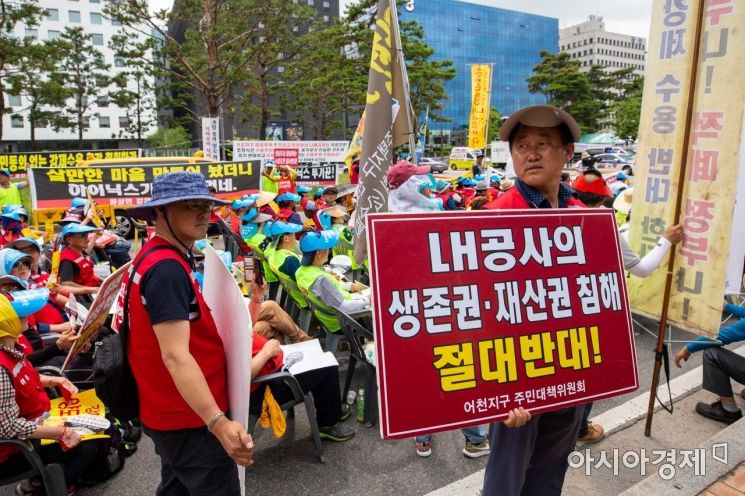 In 2019, near the Industrial Bank of Korea in Yeouido, Seoul, officials affiliated with the Public Housing District Union held a protest rally urging the withdrawal of the 3rd New Town project. Photo by Kang Jinhyung aymsdream@
"LH Regional Headquarters Should Be Split and Transferred to Local Public Corporations"
There have recently been renewed calls to split LH's regional headquarters and transfer their work to local governments or regional development public corporations. This suggestion arises from the view that, rather than focusing on the sheer volume of housing supply, it is now time for more detailed housing policies to be implemented at the municipal level.
Kim Seyong, a professor at Korea University and a member of the Economic Subcommittee 2 of the National Planning Committee, has proposed integrating metropolitan local public enterprises such as Seoul Housing & Communities Corporation and Gyeonggi Housing & Urban Development Corporation with LH’s regional headquarters to take charge of various development work, while LH would be responsible for housing welfare policy on a broader scale. This is considered a highly feasible alternative, especially as it aligns with the new administration’s focus on balanced regional development.
Professor Kim has previously argued in media columns, citing the example of Japan’s Urban Renaissance Agency, that it is necessary to divide LH’s development authority. However, when asked about his views on the current direction of government-led LH reform, he declined to comment. If Professor Kim’s proposal to split LH by regional headquarters is implemented, it would mark the most significant organizational change since the 2009 merger of the Land Corporation and the Housing Corporation.
There is also interest in whether the LH structural reform process will include measures to ensure that development profits are fairly shared among all members of society. President Lee has pointed out that, in the process of developing land transferred to the private sector, development profits have been captured solely by construction companies or apartment buyers. Underlying this is the belief that development profits should not be privatized by specific groups. During his tenure as mayor and governor, President Lee implemented the "Provincial Return of Development Profits System" as a policy to address this issue. Lee Sangkyung, who has been appointed as the new Vice Minister of Land, Infrastructure and Transport, previously provided a theoretical basis for this while analyzing the Daejang-dong development project in Seongnam as a professor.
In the report "Introducing a National Return System for Public Development Profits," published by Gyeonggi Research Institute during Governor Lee Jaemyung’s term, he explained, "While development projects can exacerbate wealth inequality, they also play a role in providing essential infrastructure for social development." He added, "Rather than viewing development profits as unearned income, they should be seen as the result of the developer’s efforts and public authorization." He also proposed specific institutional reforms, such as differentiating policy objectives according to the type of developer and utilizing separate accounting to calculate development profits by project unit.
© The Asia Business Daily(www.asiae.co.kr). All rights reserved.


















