Expert Advice Urges Travelers to Take Extra Precautions
Temporary Devices, Data Transfers Recommended Amid Stricter U.S. Entry Inspections
Advice from experts such as lawyers and personal data consultants has been reported for those planning to travel to the United States. Recommendations include bringing a temporary device instead of your usual mobile phone or transferring data from your mobile device to a hard drive.
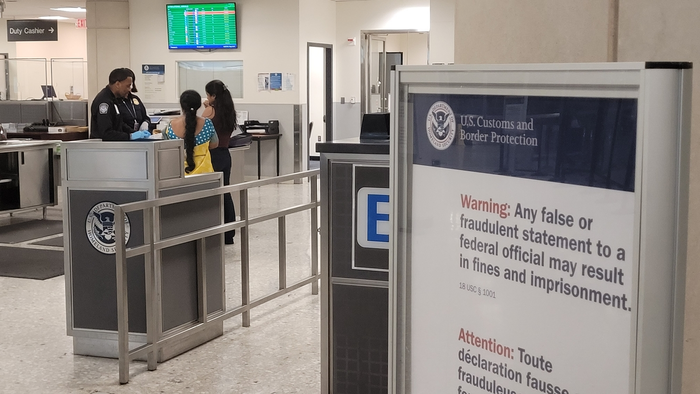
On August 26, Yonhap News, citing the British daily The Guardian and others, reported that travelers to the United States are now following expert advice by locking their social media accounts and deleting photos and messages.
This is because, since the launch of the Trump administration, U.S. border control has increased to an unprecedented level and become much stricter. As a result, some travelers have disabled facial recognition features on their smartphones or prepared temporary mobile phones.
Certain countries, including Australia and Canada, have changed their travel guidelines for the United States. These guidelines now state that electronic device inspections may occur upon entry.
In fact, there have been several cases where travelers were denied entry to the United States after failing smartphone inspections.
Why Are People Denied Entry?
In March, French scientist Philippe Baptiste was denied entry after a mobile phone inspection revealed posts critical of President Donald Trump. In June, Australian writer Alistair Kitchen was questioned during immigration about articles related to pro-Palestinian protests. Immigration officers reportedly even checked his personal photos on his smartphone. Ultimately, he was informed that he would be denied entry after evidence of past drug use was found.
As a result, more travelers are postponing or canceling trips to the United States. Keith Serry, a Canadian lawyer and storytelling performer, had originally planned to perform at the New York Fringe Festival this year but canceled a few weeks before the event. Serry said, "It was very uncomfortable to know that our opinions would be evaluated when entering a country that, until recently, was a model of democracy," and added that he no longer felt safe traveling to the United States.
Donald Rothwell, a professor at Australian National University, also declined an invitation to give a lecture out of concern that his past criticism of the United States could become an issue. Until last year, only 47,000 out of 420 million travelers-just 0.01%-were subject to device inspections. The Guardian predicted that the third quarter of this year would see the highest quarterly increase in searches since data collection began in 2018.
The U.S. Customs and Border Protection (CBP) has the authority to inspect travelers' devices with minimal justification.
On this issue, the nonprofit Electronic Privacy Information Center (EPIC) pointed out that "it appears the inspections are being focused on individuals whose political views are disagreeable."
However, a spokesperson for the U.S. Department of Homeland Security denied claims that the Trump administration had intensified device searches or targeted individuals based on political views.
In a statement, the Department of Homeland Security said, "Under the leadership of the Trump administration and Secretary of Homeland Security Kristi Noem, we have the safest borders in American history," adding, "As a result, CBP can focus on screening and questioning those seeking entry into our country."
The Guardian noted that this statement implies that entry inspections have indeed been strengthened.
Previously, in April, officials from the European Union Commission who attended the IMF and World Bank Spring Meetings in Washington, DC, were issued disposable mobile phones and basic laptops to avoid U.S. espionage activities. At the time, instructions were given to turn off mobile phones at the border and to store them in special sleeves for protection against spying.
© The Asia Business Daily(www.asiae.co.kr). All rights reserved.


















