Union Demands "Total Ban" While Ministry Supports "Limited Permission"
Narrow Passages, Heavy Equipment, and Faulty Apps Create Harsh Conditions
On-Site Workers Say, "Everyone Has Nearly Died on the Job"
Ministry Cites "Public Inconvenience" to Maintain Sangnye Work
Tripartite Task Force to Be Formed Within a Month; Full-Scale Policy Talks Set for September and October
At a National Assembly forum aimed at identifying the root causes of railway safety accidents, the practice of "Sangnye work" and poor on-site conditions emerged as major issues. "Sangnye work" refers to tasks performed near railway tracks while trains are in operation. Recently, two workers lost their lives during Sangnye work in Cheongdo. Although the forum concluded with labor, management, and government representatives maintaining their differing positions, they agreed to form a task force (TF) involving all three parties within the next month to develop effective safety measures.
The Outcry of On-Site Workers: "Everyone Has a Story About Nearly Being Hit by a Train"
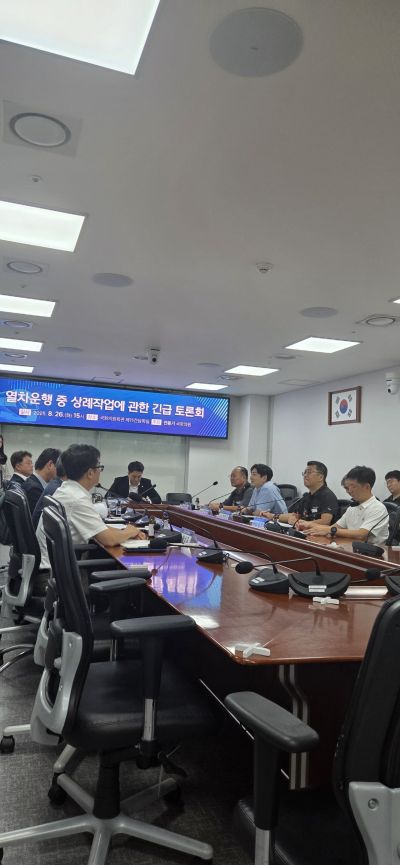 On the 26th, labor-management and government officials related to railway safety are holding a related forum at the National Assembly Members' Office Building. Photo by Oh Yugyo.
On August 26, an emergency forum on Sangnye work during train operations was held at the National Assembly Members' Office Building, hosted by Assemblyman Jeonggi Jeon of the Democratic Party. Jeong Hyeoncheol, Director of Planning at the Korean Railway Workers' Union, vividly described the grim realities on site. He stated, "Everyone working on site has a legendary story about nearly being hit by a train, how urgently they had to escape, and even unbelievable tales like high-fiving the train engineer after a close call." He emphasized that even after the 2019 Miryang accident led to the separation of blocking work and Sangnye work, the risk of collisions between workers and trains during Sangnye work still remains.
According to the railway union, workers are forced to carry loads weighing 20 to 30 kilograms through narrow passages and slopes, creating extremely poor working conditions. Jeong pointed out the structural cause of the recent accident, saying, "With the space for workers to move and inspect disappearing, at that moment, stepping onto the tracks may have actually felt safer." Additional criticisms included the insufficient number of apps to alert workers to approaching trains, frequent malfunctions and delayed alerts that have eroded workers' trust in these systems, and weakened safety management due to excessive workforce reductions and outsourcing, resulting in discrepancies between the number of people signing the work plan and those actually deployed on site.
Sangnye Work Controversy: "Total Ban" vs. "Limited Permission"
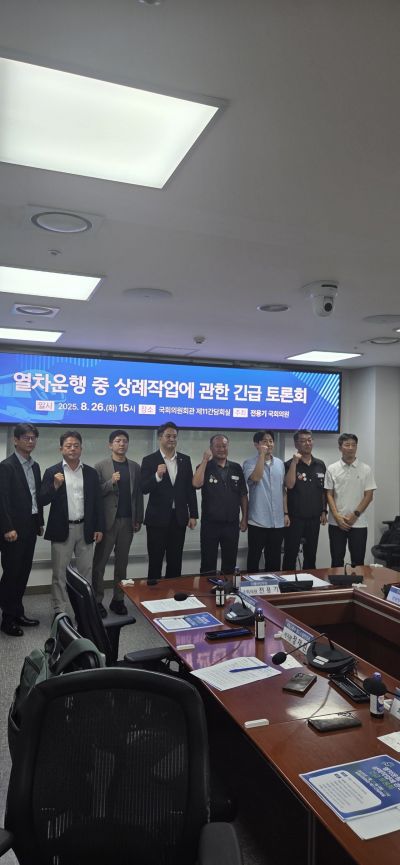 On the 26th, Representative Jeonggi Jeon (fourth from the left) and other participants of the discussion on railway safety accidents are taking a commemorative photo. Photo by O Yugyo.
The core issue of the forum was the future of Sangnye work. The railway union demanded a complete halt to Sangnye work and called for all tasks to be performed as blocking work. Choi Changgyu, Head of the Daejeon Regional Headquarters of the Korean Railway Workers' Union, expressed strong regret that the demand to abolish Sangnye work had not been met even after the 2019 Miryang Station accident and the 2022 Jungnang Station accident. He said, "While we support modernization and mechanization themselves, these should not be used as tools for workforce reduction." The union also stressed that "piecemeal measures without clear directions regarding work patterns or safety personnel are no longer acceptable."
In response, Lee Sanguk, Director of the Railway Facility Safety Division at the Ministry of Land, Infrastructure and Transport, stated, "There are many facilities that can only be inspected during the day, and a complete suspension of Sangnye work could cause significant inconvenience to the public." He clarified that "it would be difficult to abolish Sangnye work entirely," but emphasized that "allowing Sangnye work only in areas where safety is ensured" should be the basis for any countermeasures.
Although the forum ended without a clear conclusion, a blueprint for future solutions was presented. The Ministry of Land, Infrastructure and Transport plans to prepare countermeasures for this accident within a month. Related issues are expected to be discussed in greater depth during the regular National Assembly session in September and the National Assembly audit in October. Jeong Jaewon, Deputy Director of the Railway Facility Safety Division at the Ministry, stated, "Within a month, we will form a task force including representatives from labor, management, and government to establish scientific safety measures." He added, "We recognize the problems on site and, following this year, will increase the budget for next year to invest in improving safety infrastructure, such as securing passageways."
© The Asia Business Daily(www.asiae.co.kr). All rights reserved.


















