Calls to Sever Ties with Pro-Impeachment Faction Raise Fears of Party Split
Main Opposition Faces Test of Strength in Restoring Its Presence
Boosting Approval Ratings and Laying Groundwork for Local Elections Also Key Tasks
Jang Donghyuk, the newly elected leader of the People Power Party, now faces a series of daunting challenges. As Jang, a prominent opponent of the impeachment and an active ally of far-right factions, has been chosen as party leader, internal conflict with the pro-impeachment camp is expected to intensify. With the possibility of a party split being discussed, he must resolve divisions, strengthen the party's ability to confront the ruling bloc, and raise approval ratings-all formidable tasks ahead.
On August 26, Jang was elected party leader with 50.27% of the votes in the leadership race held at the National Assembly Library in Yeouido, Seoul. Former Minister of Employment and Labor Kim Moonsoo, his opponent, received 217,935 votes (49.73%). In this leadership election, votes from party members and a public opinion poll were weighted at 80% and 20%, respectively. Although Jang lagged behind Kim in the public poll, he led by more than 20,000 votes in the party member vote, which had greater weight. In his acceptance speech, Jang declared, "I will dedicate everything I have to unite all conservative citizens and bring down the Lee Jaemyung administration," adding, "From now on, I will reform the People Power Party to realize the aspirations of our members."
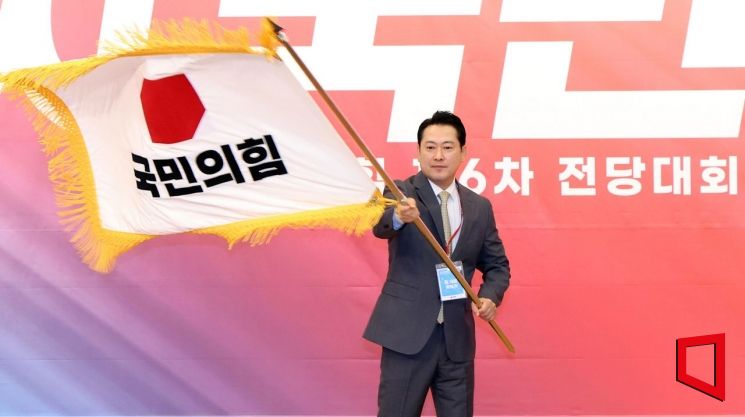 Jang Donghyuk, the newly appointed leader of the People Power Party, is waving the party flag at the 6th Party Convention runoff held at the National Assembly Library on August 26, 2025. Photo by National Assembly Press Photographers Group
Jang's top priority is to resolve internal strife. Since the impeachment of former President Yoon Sukyeol, the People Power Party has been divided between anti-impeachment and pro-impeachment factions, with repeated infighting. The rift has deepened through the last presidential election and this party convention. As candidates from both camps attacked each other over their relationships with the former president and his spouse, and over the need for personnel reform, the party has been described as being in a 'psychological state of division.' The newly elected five-member Supreme Council consists of three anti-impeachment members (Shin Dongwook, Kim Minsu, and Kim Jaewon) and two pro-impeachment members (Yang Hyangja and Woo Jaejun), raising the likelihood of escalating internal conflict. Moreover, throughout the convention, Jang maintained a hardline stance on severing ties with the pro-impeachment camp, insisting, "We cannot move forward with those who attack from within." If he moves beyond confrontation to actively expel the pro-impeachment faction, there are even predictions of a potential party split.
Another challenge is restoring the party's presence as the main opposition and effectively checking the ruling supermajority. The People Power Party, with its minority in the National Assembly, has appeared powerless in handling contentious bills such as the Broadcasting Three Laws, the Yellow Envelope Act (amendments to Articles 2 and 3 of the Trade Union Act), and revisions to the Commercial Act. Since Jeong Cheongrae became leader of the Democratic Party, the ruling party has increased its attacks, even mentioning the 'dissolution of the party.' On top of this, the special prosecutor issue has further heightened tensions. As the Kim Keonhee special prosecutor pushes for a raid on party headquarters, pressure from three major special prosecutor investigations is mounting, and the ruling bloc is pushing for an even stronger special prosecutor law. This is why strengthening the party's ability to confront the ruling party is seen as essential for its survival. Jang has consistently promised a tough response to the government and ruling party. In protest against the Kim Keonhee special prosecutor's attempt to raid party headquarters, he has held solo protests in front of the Seoul Central District Court, the special prosecutor's office, and the presidential office in Yongsan. In this context, Jang is likely to continue confrontational tactics such as boycotting the upcoming regular National Assembly session and state audits. He is also expected to rally supporters through sit-ins in the Assembly or outdoor rallies, and to wage a public opinion campaign. A senior lawmaker from the Yeongnam region commented, "We must start by injecting energy into a lethargic party and build the competitiveness needed to stand up to the Democratic Party."
Finally, Jang must raise the party's approval ratings to lay the groundwork for next year's local elections. After the impeachment and presidential election, the People Power Party's approval rating has dropped to a historic low of 16%. Even in its traditional stronghold of Daegu and North Gyeongsang Province, the party has trailed the Democratic Party in support. Despite these difficult circumstances, as Jang is responsible for the local elections, he is expected to pursue reforms in candidate nominations and related areas. Jang emphasized, "I urge all party members who have entrusted me with this heavy responsibility to stand with me to reform the People Power Party and help it become a winning party."
© The Asia Business Daily(www.asiae.co.kr). All rights reserved.

















