Trump Criticizes Until Just Before Summit
President Lee Praises Oval Office Decor
Jokes About Trump Tower Exchanged
Key Issues Like Trade Agreement Coordination Remain
Despite President Donald Trump's explosive comments on social media right before the summit, major international media outlets reported that the South Korea-U.S. summit held at the White House on the 25th (local time) concluded on a positive note, avoiding the anticipated tensions. In particular, foreign media interpreted this as a characteristic tactical move by President Trump, while noting that President Lee Jaemyung's use of praise and a conciliatory tone helped change the atmosphere in the meeting room. Some observers pointed out that President Lee aimed to focus on investment and managing the alliance between South Korea and the United States, whereas President Trump placed more emphasis on showcasing North Korea-U.S. diplomacy than on bilateral issues.
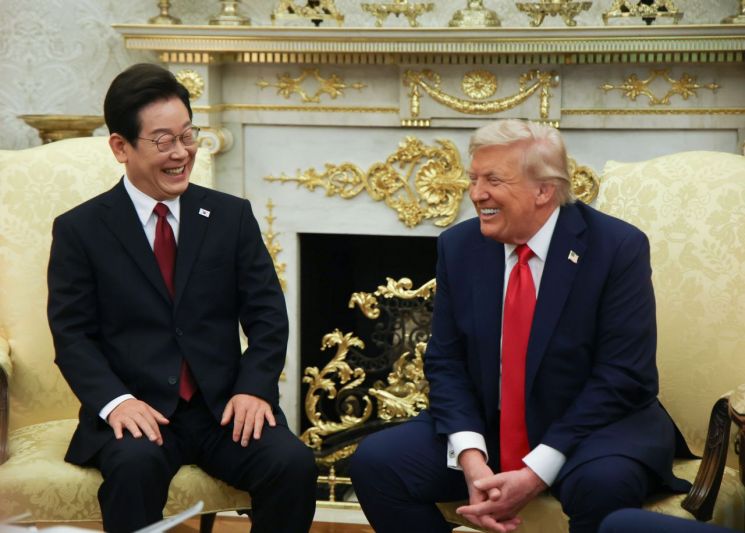
Before meeting President Lee Jaemyung, President Trump threatened on his own social media platform, Truth Social, stating, "A 'purge' or 'revolution' is happening in South Korea," and warned that he would not do business with South Korea.
However, the meeting held in the Oval Office at the White House proceeded smoothly without any notable tension. President Lee set a positive tone from the start by mentioning one of President Trump's pet projects, the "Oval Office interior." President Lee also brought up golf and referenced the idea of a "Trump Tower," creating a friendly atmosphere. President Trump responded by saying, "It's good that we know each other well."
Major international media outlets assessed that President Lee skillfully steered the meeting with agreeable responses and humor. The Associated Press reported, "President Lee lightened the mood with compliments on the Oval Office decor, calls for peace on the Korean Peninsula, and jokes about 'Trump Tower,' creating a warm atmosphere. This illustrates how world leaders in Washington are choosing praise and flattery over confrontation with President Trump to secure trade terms and military aid."
The Asahi Shimbun reported, "President Trump posted a message on Truth Social that seemed critical of the Lee administration before the meeting, but there was no clash in the public remarks released to the media." The Washington Post also stated, "President Trump criticized the political situation in South Korea on Truth Social, but avoided tension during the summit."
President Trump, who had previously expressed discomfort over church and U.S. military base raids, softened his stance after President Lee's explanation, saying it was a misunderstanding-further evidence of the friendly atmosphere during the summit. In this regard, Bloomberg News interpreted it as "a sign that President Lee's efforts to win over President Trump were successful."
Foreign media noted that President Lee focused on trade, investment, and cooperation in the shipbuilding industry. The Guardian reported, "This summit was President Lee's most high-profile diplomatic stage since taking office. He sought to focus discussions on trade issues, while President Trump mentioned the possibility of cooperation in the shipbuilding sector with South Korea." The South China Morning Post interpreted President Trump's direct mention of joint energy investment and cooperation in shipbuilding as a message emphasizing mutual benefit between South Korea and the United States.
However, there were also observations that the summit's focus shifted toward North Korea-U.S. relations. President Trump highlighted his relationship with Kim Jong Un and his intention for a North Korea-U.S. summit, which led to alliance issues receiving relatively less attention. The New York Times noted, "Amid recent signs of cracks in the South Korea-U.S. alliance, President Trump appeared to intervene in sensitive issues of South Korean politics and consistently emphasized his relationship with Kim Jong Un throughout the talks." Reuters reported that President Trump emphasized a message centered on the possibility of a North Korea-U.S. summit, while the Financial Times also stated, "President Trump mentioned the possibility of a summit with Kim Jong Un, signaling a message that weighed not only on South Korea-U.S. relations but also on dialogue with North Korea."
Although the first South Korea-U.S. summit concluded amicably, pending issues between the two countries, such as detailed coordination of the trade agreement, remain unresolved. While a broad agreement on tariffs has been reached, negotiations on the details are still ongoing. Reuters also reported, "Despite reaching a trade deal last July to avoid harsh U.S. tariffs on South Korean exports, both sides are still locked in negotiations over the details of the agreement, including nuclear energy, military spending, and South Korea's $350 billion investment pledge in the United States."
Wendy Cutler, Vice President of the Asia Society Policy Institute and a U.S. expert on Korean Peninsula affairs, also noted that tension remains between the two countries in the areas of trade and security. She specifically pointed out that the two sides have differing interpretations regarding South Korea's $350 billion investment plan in the United States. Cutler explained, "South Korea, a U.S. FTA partner, is disappointed at not receiving preferential treatment on auto and steel tariffs, while the United States is demanding that South Korea reduce digital trade barriers and expand (U.S.) access to its agricultural market."
© The Asia Business Daily(www.asiae.co.kr). All rights reserved.

















