Business and Trade Experts Assess the South Korea-U.S. Summit
"Peacemaker" Reference Highlights Security Issues
Disappointment Over Lack of Additional Gains Beyond Existing Agreements
During the South Korea-U.S. summit, U.S. President Donald Trump announced that he would uphold the existing trade agreement, leading the business community to express relief, saying they had "overcome a major hurdle." However, there was also some disappointment over lingering uncertainty, as there was no mention of additional agreements regarding steel, semiconductors, and other sectors.
Shin Wonkyu, an invited research fellow at the Federation of Korean Industries, told Asia Economy on the 26th, "President Trump steered the conversation toward security, which he perceives as a higher value than economic issues, and this helped set a positive tone for the talks." He added, "Going forward, it will be important to secure elements that can bring tangible benefits through detailed working-level negotiations and cooperation between public and private bilateral channels."
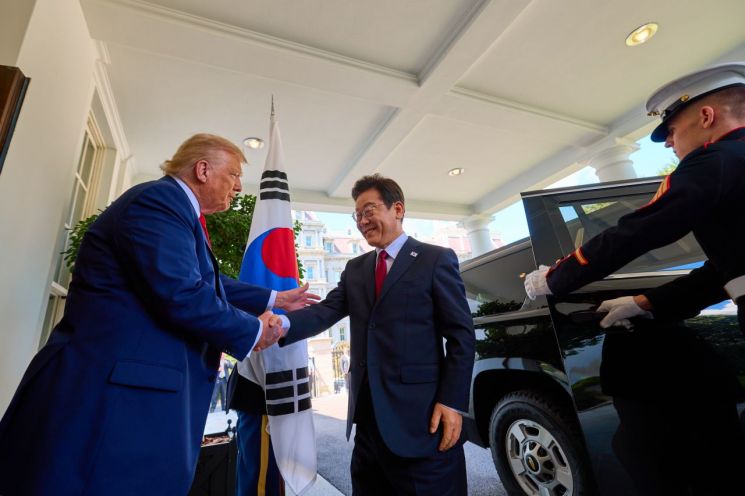 President Lee Jae Myung is shaking hands with U.S. President Donald Trump, who came out to greet him at the White House in Washington DC on the 25th (local time). Photo by Yonhap News Agency
Corporate representatives also expressed the sentiment that "the worst has been avoided." A representative from the electronics industry commented, "Although South Korea did not gain any additional concessions, the outcome was acceptable. However, there was no discussion of specific issues such as semiconductor tariffs, so the uncertainty remains, which is disappointing."
Meanwhile, some sectors such as shipbuilding, nuclear power, and aviation, which have opened new avenues for cooperation with American companies as a result of this summit, celebrated significant achievements. A representative from Korea Zinc, which agreed to establish a supply chain with U.S. defense contractor Lockheed Martin, stated, "There is a convergence of economic and security interests regarding germanium, a strategic mineral not currently produced, and it is highly meaningful that we have created the first successful case of Korea-U.S. cooperation on key rare metals with Lockheed Martin."
On the other hand, there was some disappointment that no further achievements were made, similar to the introduction of the tariff rate quota (TRQ) system for certain volumes of European steel and aluminum. Jang Sangshik, head of the International Trade Research Institute at the Korea International Trade Association, said, "There were expectations in South Korea for considerations regarding steel or tariff exemptions for companies investing in the U.S., such as those in the semiconductor sector, but it is disappointing that these were not included."
Kim Taehwang, professor of international trade at Myongji University, also commented, "The negotiations concluded smoothly, but there were no substantive outcomes. There had been expectations for measures on specific issues such as steel and the rumored Samsung equity investment, but there was no mention of these." He added, "There are indications that non-tariff barriers and the issue of opening up the agricultural and livestock sectors could return to the negotiating table, so we will need to closely monitor the progress of working-level negotiations."
© The Asia Business Daily(www.asiae.co.kr). All rights reserved.
![Clutching a Stolen Dior Bag, Saying "I Hate Being Poor but Real"... The Grotesque Con of a "Human Knockoff" [Slate]](https://cwcontent.asiae.co.kr/asiaresize/183/2026021902243444107_1771435474.jpg)
















