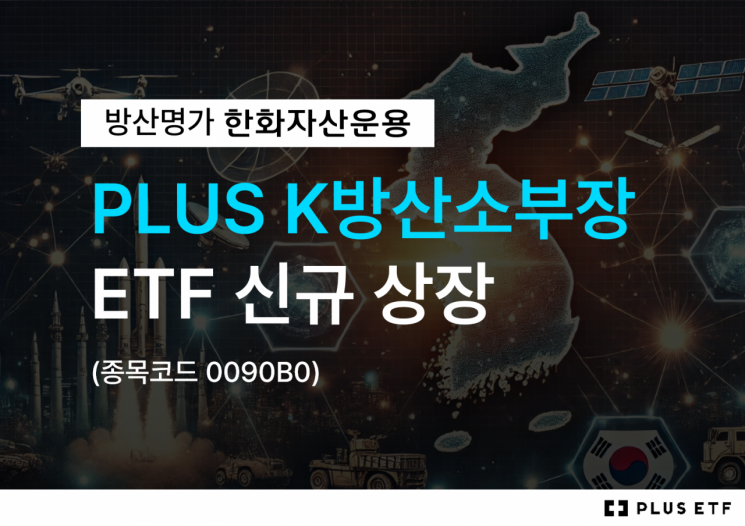
The PLUS K-Defense Materials, Parts & Equipment ETF is based on the perspective that the "trickle-down effect" from large contracts secured by defense contractors producing finished products can extend to companies supplying materials, parts, and equipment. The order backlog of the four major domestic defense companies-Hanwha Aerospace, Hyundai Rotem, Korea Aerospace Industries, and LIG Nex1-reaches 100 trillion won.
The ETF’s component stocks include: HD Hyundai Infracore, which produces engines for K2 tanks; STX Engine, which manufactures engines for K9 self-propelled howitzers; SNT Dynamics, which supplies transmissions; M&C Solution, which provides drive systems and hydraulic systems; Poongsan, which manufactures ammunition; and i3system, which supplies infrared imaging sensors. Additionally, it includes Firstec, which produces core components for guided weapons; Kencoa Aerospace, a globally competitive small and medium-sized enterprise in the defense and aerospace sector; RFHIC, which manufactures high-power, high-efficiency power amplifiers; and HVM, which produces advanced special alloys.
Domestic defense materials, parts, and equipment companies have typically engaged in "indirect exports" by supplying parts to domestic system integrators that deliver finished products overseas. Recently, however, there has been an increase in "direct export" cases, where technologically advanced domestic defense materials, parts, and equipment companies sign contracts directly with overseas firms. This is expected to result in higher profitability compared to indirect exports.
There is also strong anticipation that the localization of key parts, which were previously sourced from overseas, will shorten delivery times and expand the number of export destinations. For example, exports of the K2 tank to the Middle East were previously blocked due to an export ban from Germany, the main producer of its powerpack (engine and transmission). Now, with the localization of the K2 tank’s engine and transmission, there are expectations that exports to the Middle East will increase.
K-Defense is also relatively unaffected by U.S. tariffs. Recently, the United States has been considering imposing item-specific tariffs based on Section 232 of the Trade Expansion Act. This is expected to affect steel and aluminum, automobiles and auto parts, semiconductors, and pharmaceuticals. However, since a significant portion of defense exports are destined for Europe and the Middle East, the impact of U.S. tariff policies is relatively limited. Even when exporting to the United States, many contracts are government-to-government (B2G), and are likely to be subject to tariff exemptions or exceptions, making tariff risks limited.
Choi Youngjin, Chief Marketing Officer (CMO) of Hanwha Asset Management, introduced the PLUS K-Defense Materials, Parts & Equipment ETF as "a product that invests in materials, parts, and equipment companies fostered by national policy, and aims to capture growth opportunities from the trickle-down effect of system integrator orders, expansion of direct exports, and localization of parts."
He added, "As the growth story of K-Defense is spreading from system integrators to materials, parts, and equipment companies and this is being reflected in actual performance, proactive investment in this area is required."
© The Asia Business Daily(www.asiae.co.kr). All rights reserved.

















