Investment in High-Growth Bio Sector Amid Stagnation of Traditional Industries
Orion, OCI, and Others Accelerate Investments
Cash-Strapped Bio Ventures Come to Market
As Koas, an office furniture company, acquires the new drug developer Novelty Nobility, the entry of non-pharmaceutical industrial capital into the K-bio sector is once again coming into the spotlight. Investments in the bio industry by companies from diverse sectors-including Orion in food, OCI in chemicals and energy, and major conglomerates like Lotte and GS-are no longer seen as one-off events, but are solidifying into a structural trend.
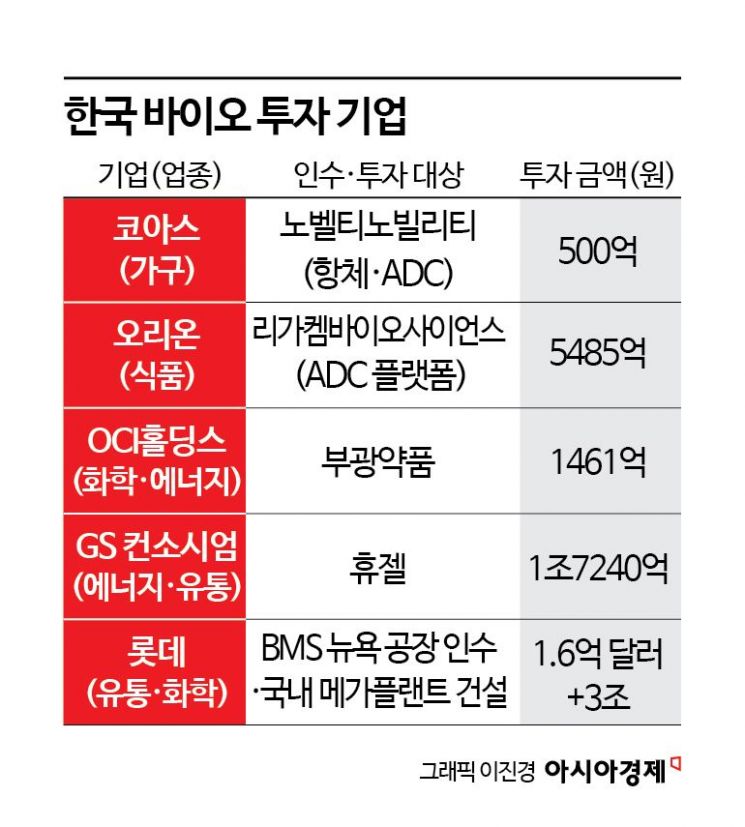
According to industry sources on August 26, Koas is set to acquire 2,441,009 shares of Novelty Nobility on September 8 for approximately 15 billion won. This will give Koas a 14.3% stake, making it the largest shareholder. The total committed investment amount is 50 billion won. Koas plans to use Novelty Nobility's antibody and ADC (antibody-drug conjugate) pipeline as a new growth engine.
Orion, a food company, already became the largest shareholder of LegoChem Bio (now Ligachem Bio) last year by acquiring a 25% stake for about 548.5 billion won. Ligachem Bio has signed more than 13 technology transfer deals with multinational pharmaceutical companies, totaling over 10 trillion won. Orion's investment is seen as a clear example of a food company positioning bio as its next growth pillar.
The same is true for OCI, which is based in chemicals and energy. In July, OCI invested 26.8 billion won in Bukwang Pharmaceutical’s paid-in capital increase, raising its stake to 17%. OCI is betting on its stable cash flow and plant operation experience to combine the production of active pharmaceutical ingredients and intermediates. This is an attempt to leverage its manufacturing strengths and expand into bio production.
A representative example of a large-scale merger and acquisition (M&A) is the GS Group consortium’s acquisition of Hugel. In 2022, GS, together with private equity fund IMM Investment and others, invested 1.724 trillion won to secure a 46.9% stake in Hugel. Hugel, a leading player in the botulinum toxin and filler market, has seen its stock price triple since then. Lotte, meanwhile, acquired the BMS plant in Syracuse, New York, for 160 million dollars (about 222.6 billion won), and domestically, Lotte Biologics is building a ‘mega plant’ valued at 3 trillion won. The company aims to make the CDMO (contract development and manufacturing organization) business a new growth axis.
The reason industrial capital is focusing on bio investments is growth potential. Unlike traditional manufacturing, which has stagnated, bio is considered a global high-growth industry. Traditional manufacturing sectors such as furniture, food, and chemicals have seen their growth slow due to market saturation at home and intensified competition abroad. While these companies have secured stable cash flows, they lack new growth engines, making bio-a global high-growth industry-an attractive choice.
The timing for investment is also favorable. As bio ventures that went public through the technology special listing system face funding difficulties, more assets are coming to market, giving strategic investors (SI) more opportunities to secure quality assets at attractive valuations. With the adjustment period in the KOSDAQ bio sector, a ‘buy low and nurture for the long term’ strategy has become possible. Another reason is the government’s increased support, such as designating bio as a national strategic industry. Lee Seungkyu, Vice Chairman of the Korea Biotechnology Industry Organization, said, “Bio investments and M&As across different and similar industries are more active than ever. In order to foster the ecosystem of the pharmaceutical and bio industry, the government should expand incentives such as tax benefits so that domestic companies can invest actively and continuously in venture firms.”
© The Asia Business Daily(www.asiae.co.kr). All rights reserved.

















