Gyeongsangnam-do is launching an emergency response to reduce the occurrence of green algae blooms, which have been intensifying due to the ongoing heatwave.
On this day, the provincial government held a briefing at the provincial office press center and announced, "With an algae alert upgrade expected for the Nakdong River, we will ensure the supply of safe tap water by blocking sources of water pollution, removing green algae, and strengthening water treatment plant management."
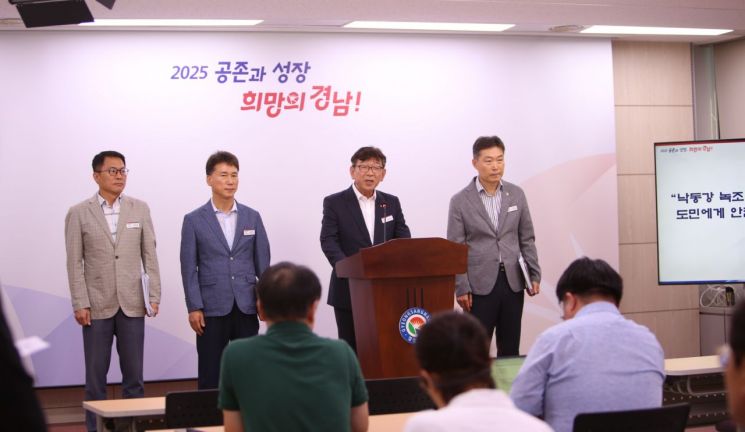 Kim Yongman, Director of the Environment and Forestry Bureau of Gyeongnam Province, is announcing plans to respond to green algae in the Nakdong River and to supply safe tap water. Photo by Lee Seryung
First, in order to reduce the discharge of total phosphorus (T-P), which is a major cause of green algae blooms, the province will conduct special inspections of factories, livestock facilities, and individual wastewater treatment facilities at least once a week until the situation improves.
Sewage and wastewater treatment plants operated by cities and counties will strengthen discharge concentration standards by up to 80% beyond the legal requirements to reduce pollutant emissions.
Since the end of July, the province has been operating a total of seven "green algae removal vessels" deployed at Hapcheon-Changnyeong Weir, Chilseo Intake Station, Changnyeong-Haman Weir, and the Mulgeum and Maeri points to physically remove algae from the water.
If the green algae blooms worsen further, the province plans to coordinate releases from dams, weirs, and estuary banks.
On August 26, a cooperative meeting on green algae response will be held, attended by officials in charge of green algae management from 15 cities and counties along the Nakdong River basin, to collaborate on reducing algae blooms.
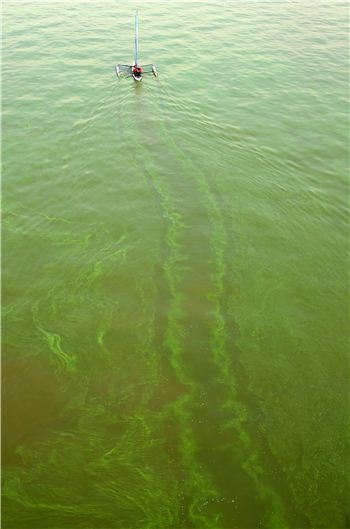 A river turned blue-green due to algal bloom. Photo by Asia Economy DB
In addition, algae-blocking barriers will be installed around tap water intake points, and devices such as water sprayers to push algae away and surface disturbance devices powered by water wheels to prevent algae from approaching will be operated to block algae inflow.
Any green algae that is not filtered out during the intake stage will be removed through advanced water treatment processes, including pre-ozonation and intermediate chlorine injection, enhanced coagulation and sedimentation, and the use of activated carbon.
Furthermore, the frequency of inspections for algal toxins (microcystin) and odor-causing substances in both raw and treated water will be increased from twice to three times a week.
Facility inspections and simulation drills will continue for 50 water treatment plants in the province, along with the implementation of household tap water quality testing services and strengthened water quality monitoring. The province will also continue to establish a response system for small organisms at water treatment plants, build an emergency supply network for local waterworks, and promote the introduction of artificial intelligence (AI) water treatment plants.
According to Gyeongsangnam-do, there have been no cases of algal toxins detected in treated tap water so far.
Kim Yongman, Director of the Environment and Forestry Bureau, stated, "Supplying clean and safe tap water is not just a matter of convenience, but an essential element in protecting the lives and health of residents during summer climate disasters. We will continue to systematically respond to green algae in the Nakdong River and actively expand water quality safety policies that residents can experience in their daily lives."
© The Asia Business Daily(www.asiae.co.kr). All rights reserved.

















