Experts: "'Substantial Control' at the Center of Debate"
"Minimize Management Impact, Seek Mutual Prosperity Between Principal and Subcontractors"
Layoffs and Corporate Restructuring May Also Become Subjects of Bargaining
With the passage of the Yellow Envelope Act (the amendment to the Trade Union and Labor Relations Adjustment Act), there are growing concerns that confusion in the workplace is inevitable as the duty to engage in collective bargaining has been expanded to include principal employers with "substantial control." Experts advise that companies should proactively prepare, as not only managerial decisions such as layoffs and restructuring, but also issues such as employment retention, demands for direct employment, and industrial safety could become subjects of negotiation.
On the 25th, attorneys from Law Firm Taepyungyang held a seminar at their headquarters in Jongno-gu, Seoul, titled "Prospects and Responses to Labor-Management Relations After the Yellow Envelope Act," where they shared these insights. Attorney Lee Ukrae stated, "Yesterday's legislation proceeded at a pace that far exceeded expectations," and warned, "If collective bargaining is recognized based on 'substantial control,' which is merely a factual concept rather than the legal concept of an employment contract, it will inevitably cause significant confusion." He added, "Under the newly established legal framework, we must minimize the impact on management and seek ways for mutual prosperity between principal and subcontracting companies."
According to the amended bill, with respect to the definition of 'employer' in Article 2, Paragraph 2 of the Trade Union Act, a new provision has been added: "Even if a party is not the counterparty to an employment contract, a person who is in a position to substantially and specifically control or determine the working conditions of employees" is now included.
However, there have been criticisms that the very definition of an employer with substantial control is ambiguous. Park Hwajin, Advisor (former Vice Minister of Employment and Labor), said, "If workers who fall within the scope of substantial control organize and demand bargaining, the employer must respond to such requests," but also noted, "There are ambiguous aspects to the criteria for determining 'substantial control.'"
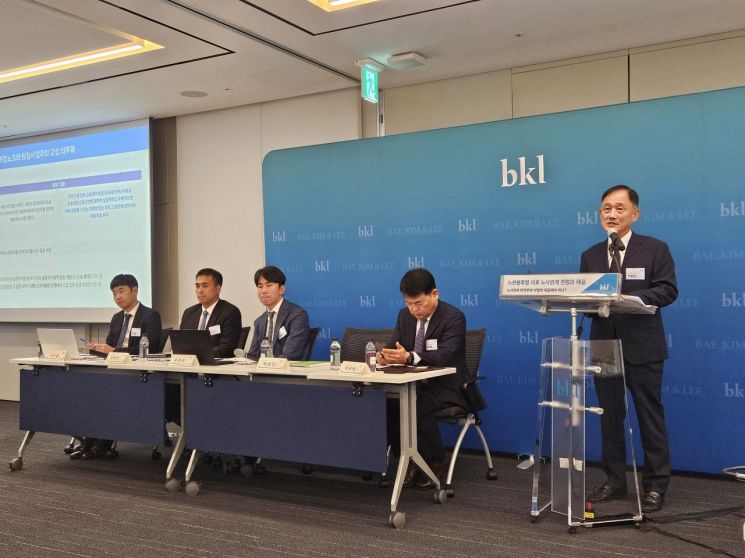 Park Hwajin, Advisor (former Vice Minister of Employment and Labor), is speaking at the seminar "Prospects and Responses to Labor-Management Relations After the Yellow Envelope Act" held at the headquarters in Jongno-gu, Seoul on the 25th. Photo by Park Juni.
He further noted that there will be issues regarding who should be designated as the parties to the bargaining process. He explained, "Whether or not substantial control is exercised should be the standard for determining the bargaining counterpart and the subjects of negotiation. If substantial control is found, then first-tier subcontractors, second- and third-tier subcontractors, in-house subcontractors, and external subcontractors and suppliers could all become parties to collective bargaining."
Attorney Kim Sangmin also predicted that changes in labor-management relations will occur following the amendment of the Yellow Envelope Act. While previously, negotiations took place between principal employers and their labor unions, after the amendment, negotiations may also occur between principal employers and subcontractor unions, as well as between principal employers and their own unions. Furthermore, depending on whether substantial control is exercised, there is the possibility of separate negotiations from the holding company (parent company) to each affiliate (subsidiary) and even to labor unions of sub-subsidiaries. In such cases, he added, it will also be necessary to discuss how to define the bargaining units between principal employers and subcontractor unions.
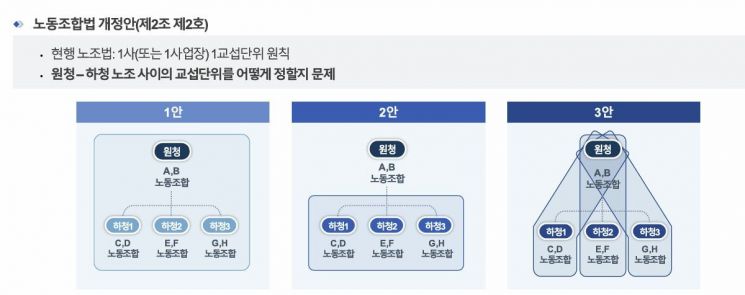
He especially pointed out that confusion will increase because the scope of employers and unions could change depending on each agenda item. Attorney Kim explained, "If a company claims it does not have substantial control over a particular issue and refuses to negotiate, will that be accepted? Many companies are likely to make legal decisions to contest incoming bargaining requests."
He also noted that within companies, various issues such as layoffs, corporate changes (restructuring, mergers, company splits, etc.), organizational restructuring, personnel evaluation and placement, and management performance bonuses could all potentially become subjects of negotiation.
Experts at the seminar pointed out that, due to the legal amendment, the scope of bargaining could be expanded to include employment retention and demands for direct employment, and that various risks could arise, such as overlapping negotiations between principal employers and subcontractors and issues related to industrial safety.
Accordingly, experts advised that companies should revise internal regulations and proactively prepare response manuals, taking into account the possibility that managerial decisions such as layoffs and restructuring could become bargaining issues, the risk of duplicate negotiations with subcontractor and affiliate unions, and the obligation to negotiate on industrial safety matters.
There were also concerns that if performance bonus standards or wage structures are unified at the group level, collective bargaining could be extended to the parent company. Therefore, it is necessary to manage risks by preparing materials to demonstrate the independence of each company. Attorney Lee advised, "Group companies sometimes have unified systems, such as standardized performance bonus criteria between parent and subsidiary companies, which could lead to situations where even the chairman is called to the table. It is important to ensure that companies can implement various systems tailored to their needs to avoid becoming targets of such demands."
© The Asia Business Daily(www.asiae.co.kr). All rights reserved.