Prolonged Heatwave Drives Sea Temperatures Higher
Production of Flatfish and Rockfish Drops, Prices Surge
All-Out Response from Fishermen and Government
"Customized Measures by Species and Region"
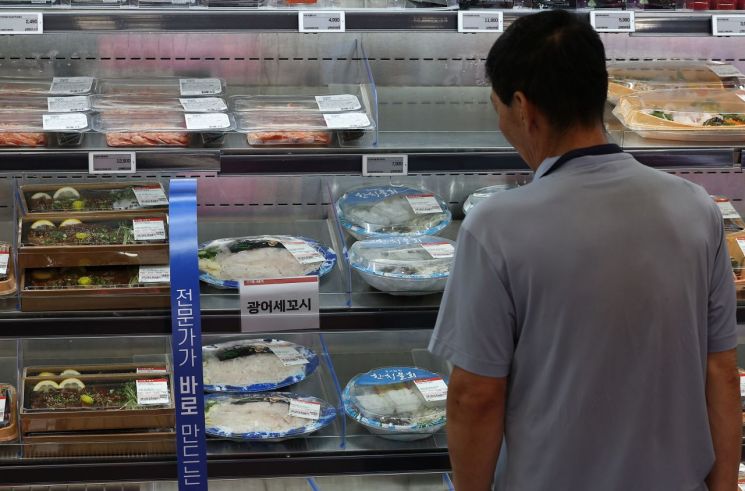 Flatfish sashimi and other items are displayed at a large supermarket in Seoul on the 27th of last month. Photo by Yonhap News
This summer, the rapid rise in sea temperatures compared to previous years has put the aquaculture industry on high alert. Both the issuance of high-temperature warnings and the actual occurrence of damage have happened earlier than last year, making concerns over supply disruptions of flatfish and rockfish-popular choices for sashimi in Korea-a reality.
According to the Ministry of Oceans and Fisheries on August 25, the "caution" level of the high-temperature crisis alert was issued on July 3, a week earlier than last year. The next higher "warning" level was issued on July 9, which is fifteen days earlier than last year. Experts analyze that the rapid rise in sea temperatures after the end of the monsoon season, following a temporary drop due to heavy rainfall during the rainy season, is the main cause.
Prolonged Heatwave...Sea Temperatures Expected to Continue Rising
The bigger issue is that the ongoing heatwave is likely to keep pushing sea temperatures higher. The National Institute of Fisheries Science stated, "The nationwide heatwave that resumed last week is sustaining the upward trend in sea temperatures," adding, "Continued increases in sea temperature are expected, which could lead to more high-temperature advisories and an escalation of alert levels."
Abnormal temperature phenomena caused by climate change are resulting in mass deaths of farmed fish species. According to the National Institute of Fisheries Science, mortality damage has been concentrated among farmed species such as rockfish and flatfish. This year, the deaths of farmed fish began earlier than last year. According to the daily safety management report by the Ministry of the Interior and Safety, the first mass death of farmed fish this year occurred on July 27, four days earlier than last year.
Flatfish and Rockfish Production Drops, Prices Surge
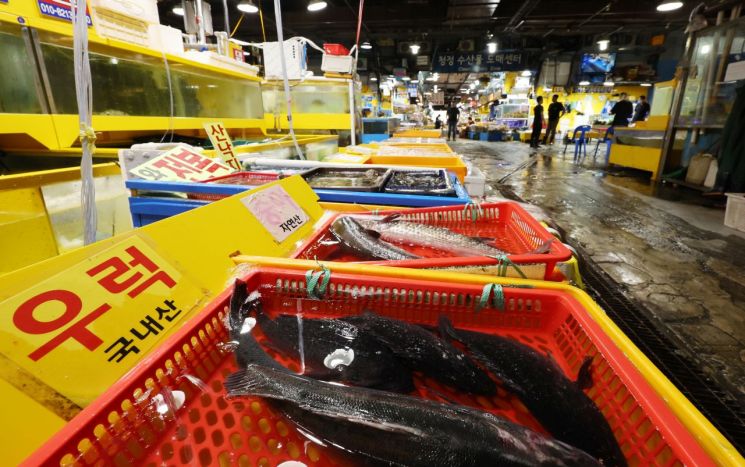 The scene of Garakdong Agricultural and Marine Products Wholesale Market in Songpa-gu, Seoul, on the 13th of last month. Photo by Yonhap News
The impact of high sea temperatures has been immediately reflected in both production volumes and prices. According to fisheries monitoring by the Korea Maritime Institute (KMI) Fisheries Industry Observation Center, last month’s shipment of rockfish was 1,017 tons, a 17.5% decrease compared to the same month last year and a 21.0% drop from the previous month.
The decrease in supply has led directly to higher prices. Last month, the wholesale price of rockfish was 7,000 won per kilogram, which, depending on the region and weight, is 9.2% to 55.6% higher than the same month last year. For flatfish, last month's shipment was tallied at 3,057 tons, a 2.3% decrease from the same month last year due to the effects of the heatwave and heavy rainfall. The Korea Maritime Institute forecasts that this month’s shipment of flatfish will be down 6% compared to the same month last year.
All-Out Response from Fishermen and Government: "Customized Measures by Species and Region"
Aquaculture farmers have launched emergency measures such as releasing juvenile fish to minimize mortality. Farms in Goseong, Tongyeong, Geoje, and Namhae in South Gyeongsang Province released 1.58 million rockfish, filefish, and mullet, while around 1.5 million fish were released in the Taean area of South Chungcheong Province. The government is encouraging and supporting the early release of juveniles, providing subsidies of up to 50 million won, and expanding the distribution of liquid oxygen supply devices.
In addition to the "Comprehensive Climate Change Response Plan for the Fisheries and Aquaculture Sector" announced last year, the Ministry of Oceans and Fisheries is preparing new customized measures by species and region. An official stated, "We are considering not only relocating and converting aquaculture licenses but also introducing smart aquaculture technology to expand land-based aquaculture," adding, "The new measures are scheduled to be announced by the end of the year."
© The Asia Business Daily(www.asiae.co.kr). All rights reserved.


















