Seongsu-dong Emerges as a 1.5 Trillion Won Urban Powerhouse
Jung Wono, Mayor of Seongdong-gu: "A Leading Success Story in Urban Regeneration"
Corporate Surge Drives 184% Increase in Corporate Tax Revenue
Visitor Card Sales Up by 274%
Once a declining semi-industrial area, this neighborhood has transformed over the past 10 years into a symbol of dramatic urban change. In 2014, the economic value of this area was 436.5 billion won, but by last year, it had increased to 1.5497 trillion won, a 3.5-fold rise. The number of foreign visitors, which stood at 60,000 in 2018, soared to 3 million last year-a 50-fold increase in six years-and already surpassed 3 million in the first half of this year, with projections to exceed 6 million by the end of 2025.
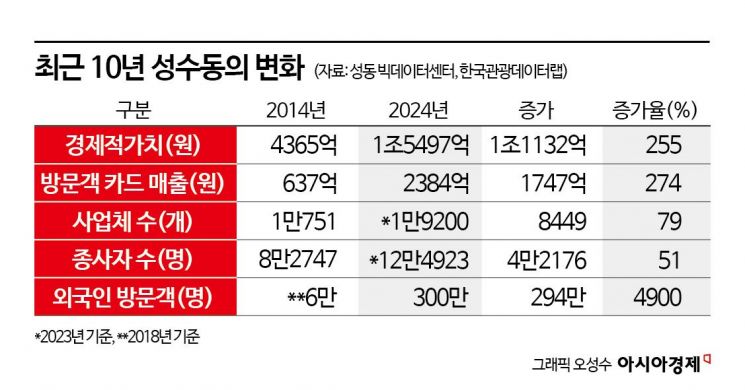
Many corporate headquarters have relocated or newly established themselves here, bringing the number of corporations close to 20,000. The number of employees has also risen by 51%, reaching 124,923.
Seongsu-dong in Seongdong-gu, Seoul, has achieved remarkable changes in economic value and urban competitiveness over the past decade. Seongdong-gu implemented an urban regeneration policy focused on preserving urban identity rather than large-scale redevelopment. This approach, combined with geographical advantages, has successfully transformed the city’s DNA.
Jung Wonoh, mayor of Seongdong-gu, stated, “Urban regeneration policies that balance local identity and sustainability have led to tangible economic benefits. Seongsu-dong is a prime example demonstrating that when people gather, companies follow, and when companies arrive, the city grows.”
The success of urban regeneration is supported by statistics. According to a comprehensive analysis by the Seongdong Big Data Center, the economic value of Seongsu-dong reached 1.5497 trillion won last year, an increase of 1.1132 trillion won compared to ten years ago. Considering that the budget invested in urban regeneration was around 10 billion won, the economic effect generated over the decade exceeds 100 times the initial investment.
The number of foreign visitors to Seongsu-dong has grown astronomically. From just 60,000 in 2018, the figure jumped to 3 million last year. During the same period, domestic visitors also increased by 31%, reaching 26.2 million this year. The number of subway passengers at Seongsu Station rose from 18.71 million in 2015 to 32.13 million last year, marking a 71% increase.
This surge in visitors has translated into higher sales. According to Korea Tourism Data Lab, last year’s credit card sales by tourists reached 238.4 billion won, up 174.7 billion won from 2014 (63.7 billion won). This demonstrates a tangible virtuous cycle for the local economy.
As more people flocked to Seongsu-dong, businesses followed suit. The number of businesses in the area increased from 10,751 in 2014 to 19,200 in 2023, a 78% rise, and the number of employees grew by 51% to 124,923. Companies from various sectors, including SM Entertainment, Krafton, Musinsa, Socar, Hyundai Glovis, and Clio, have set up operations in Seongsu-dong. Corporate tax revenue also surged, with corporate tax rising from 372.7 billion won in 2014 to 1.0588 trillion won last year, a 184% increase.
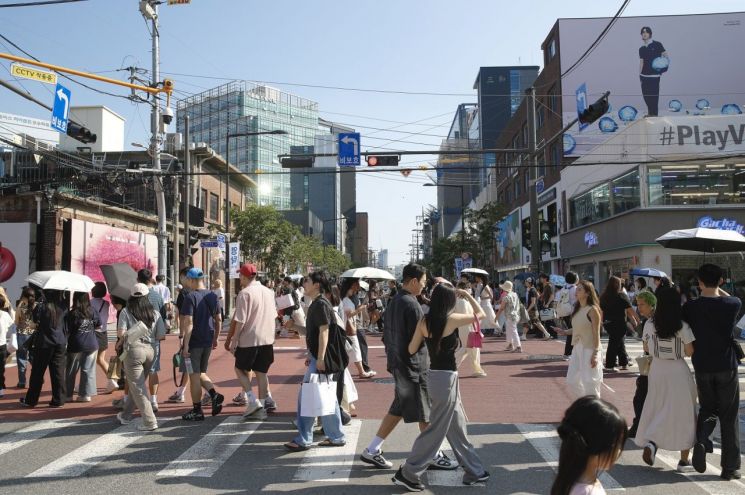 The economic value of Seongsu-dong in Seongdong-gu, Seoul, which is recognized as a successful model of urban regeneration, has increased 3.5 times over the past 10 years. Provided by Seongdong-gu.
Over the past 10 years, the number of social enterprises grew from 24 to 129, and social venture companies increased from 12 to 297. The district hosted events such as the Creative x Seongsu Festival, Social Venture Expo, and Social Innovation Competition, generating direct sales and derivative consumption, resulting in an annual economic effect of 96.9 billion won last year.
The value of assets has also risen significantly. The officially assessed land price in Seongsu-dong increased by 123%, from 3.21 million won per square meter in 2014 to 6.8 million won last year. Over the past decade, the district acquired 77 buildings and plots in Seongsu-dong, with their accounting value at the time of acquisition totaling 157.6 billion won. Most of these properties were secured through public contributions (donations in kind) tied to new private building constructions.
Seongdong-gu explained, “The core of urban regeneration lay in preserving red-brick buildings and reviving them as diverse innovation spaces to attract people. Alongside this, we have focused on fostering social economy enterprises and social ventures, implementing measures to prevent gentrification, and striving to create a sustainable Seongsu-dong. Our urban regeneration and business attraction policies have triggered a sustainable virtuous cycle, leading to local development, income growth, job creation, and increased tax revenue.”
© The Asia Business Daily(www.asiae.co.kr). All rights reserved.


















