Sargassum Habitats Expected to Shift Northward Under High-Carbon Climate Change Scenario
Scientific Analysis Highlights Significant Decline in Distribution and Diversity Along Korean Coasts
The Korea Institute of Ocean Science and Technology (President: Lee Heeseung, KIOST) has published research findings in an international academic journal indicating that the habitats of Sargassum species along Korea's coasts may shrink due to climate change.
Notably, this paper was also selected as a "Feature Paper" by the editorial board of the journal, in recognition of the impact and scientific contribution of the research results (June 27, 2025).
Sargassum species are representative marine algae that form underwater forests and provide spawning grounds and habitats for various marine organisms, with about 30 species growing in Korea.
Because they play an essential role in maintaining the ecosystem by providing habitats and food webs for key marine resources, scientific predictions regarding changes in their habitats offer significant implications for marine environmental management and conservation.
The research team led by Dr. Choi Seonkyung and Dr. Ko Seonggil at the KIOST Jeju Research Institute's Tropical and Subtropical Research Center, in collaboration with Professor Park Sangyul's team at Jeju National University, analyzed future distribution changes of four Sargassum species-Sargassum horneri, Sargassum macrocarpum, Sargassum thunbergii, and Sargassum fusiforme-by applying climate change scenarios presented in the Intergovernmental Panel on Climate Change (IPCC) Sixth Assessment Report. The scenarios are categorized as low-carbon (SSP1-1.9), intermediate (SSP2-4.5), and high-carbon (SSP5-8.5), and the analysis periods are the 2030s, 2060s, and 2090s.
The results showed that, while all four Sargassum species are currently distributed along the entire Korean coastline, under the low-carbon scenario, their distribution is predicted to remain largely unchanged through the 2090s. In contrast, under the high-carbon scenario, most habitats are expected to shift northward, resulting in a significant decline in both the distribution and species diversity of Sargassum along Korea's coasts. In particular, it was found that only 47% to 61% of potential Sargassum habitats are currently included within marine protected areas.
The low-carbon scenario assumes a transition to a low-carbon society through sustainable development, strengthened eco-friendly technologies, enhanced international cooperation, and the implementation of strong policies for carbon neutrality.
The high-carbon scenario assumes rapid industrial technological development, high fossil fuel consumption, and the expansion of indiscriminate urban-centered development.
This study is significant as it provides scientific evidence for the need to protect Sargassum habitats by expanding marine protected areas, at a time when marine algae are being highlighted as potential blue carbon resources to address the climate crisis.
KIOST President Lee Heeseung stated, "This research provides important clues for predicting the impact of climate change on marine ecosystems and developing countermeasures," and added, "KIOST will continue research to protect our changing seas from the climate crisis and to conserve a sustainable marine ecosystem."
This research was conducted as part of the Ministry of Oceans and Fisheries' project, "Development of Adaptation Scenarios and Utilization Systems for Subtropical Marine Environments."
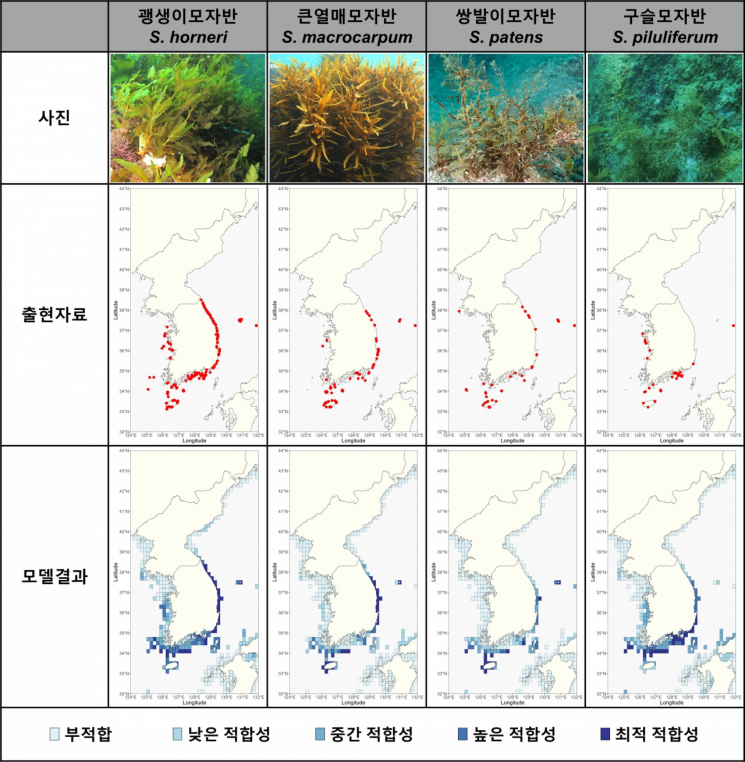 Photos of different types of Mozaban (Source: National Institute of Biological Resources) and occurrence locations, estimated current suitable habitats using models.
© The Asia Business Daily(www.asiae.co.kr). All rights reserved.

















