Most Murder Suspects Are in Their 60s or Older
For the first time last year, the proportion of criminal suspects aged 60 and older surpassed that of those in their 20s.
According to the "2024 Crime Statistics" published by the National Police Agency on August 24, the total number of crimes committed last year was recorded at 1,583,108 cases. By age group, suspects in their 50s accounted for the largest share at 262,570 people (20.6%). This was followed by those in their 40s (260,991 people, 20.5%), those aged 60 and older (238,882 people, 18.8%), those in their 20s (232,924 people, 18.3%), those in their 30s (216,386 people, 17%), and those aged 18 or younger (61,729 people, 4.8%).
The proportion of suspects aged 60 and older has increased every year, surpassing those in their 20s for the first time this year. In contrast, over the past five years, the shares of suspects in their 20s, 40s, and 50s have generally been on the decline.
 A man in his 60s who killed his wife with a weapon one week after a court's restraining order ended appeared in court on the afternoon of June 21 for a detention hearing. Photo by Yonhap News
Looking back at the 2014 statistics, suspects aged 60 and older accounted for 8.8% of the total. This means their proportion has more than doubled in the past ten years. In contrast, the share of those in their 20s was 17.5% during the same period, showing little change compared to now.
Most Murder Suspects Are in Their 60s or Older
By crime type, those aged 60 and older made up the largest group of murder suspects. Of the 276 murder suspects apprehended last year, 64 (23.2%) were aged 60 and older. This was followed by those in their 40s (22.1%), 30s (20.4%), and 50s (17.8%). There were also 44 elderly murder suspects aged 65 and older, of whom 29 (65.9%) were unemployed. In addition, 12 (29.5%) were first-time offenders, the largest group. Only one person had a mental disorder. Combined, murder suspects in their 50s and those aged 60 and older accounted for 41%, nearly half of the total.
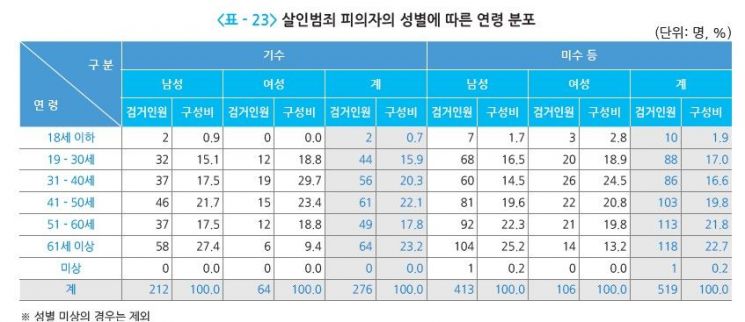
Among theft suspects, which are often considered "crimes of livelihood," those aged 60 and older also accounted for the largest share at 33.9%. When combined with those in their 50s (16.1%), these age groups made up exactly half of all theft suspects. Those in their 50s accounted for the largest proportions in violent (20.8%), intellectual (22.1%), and traffic (21.6%) crimes.
Experts point to changes in the social status and economic standing of the so-called "second baby boomer" generation-about 10 million people born between 1964 and 1976 who have begun to retire-as the background for this trend. Although improvements in physical health mean they are still capable of playing active roles in society, a lack of opportunities has led to growing frustration and anger, resulting in an increase in crimes committed by this group.
© The Asia Business Daily(www.asiae.co.kr). All rights reserved.


















