Ruling Party: "The Yellow Envelope Act Will Address Social Inequality"
Opposition: "Only Gives False Hope to the Most Vulnerable Workers"
The Yellow Envelope Act (Amendment to Articles 2 and 3 of the Trade Union and Labor Relations Adjustment Act) passed the National Assembly plenary session, led by the ruling party, following an unlimited debate (filibuster).
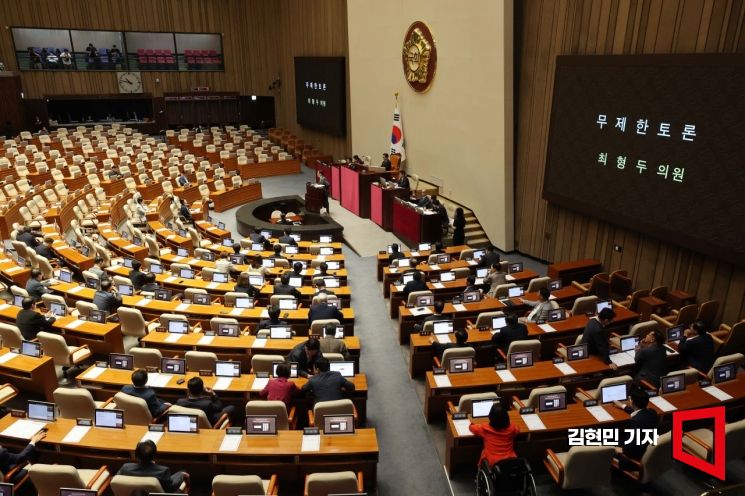 On the 21st, Rep. Hyeongdu Choi of the People Power Party conducted a filibuster as the partial amendment bill to the Korea Educational Broadcasting System Act (EBS Act) was submitted at the National Assembly plenary session. 2025.8.21 Photo by Hyunmin Kim
On the 24th, the National Assembly put the Yellow Envelope Act to a vote at the plenary session, and it was passed with 183 votes in favor and 3 against out of 186 members present. The Yellow Envelope Act was passed under the leadership of the ruling party, with the People Power Party absent. Three members of the Reform Party participated in the vote and cast votes against the bill.
The People Power Party requested a filibuster on the Yellow Envelope Act, which was submitted to the plenary session at around 9:09 a.m. the previous day. The filibuster ended after 24 hours in accordance with the National Assembly Act. The vote was held at around 9:12 a.m. on this day.
The Yellow Envelope Act expands the definition of employers and the scope of labor disputes, and restricts companies from claiming damages against striking workers. During the Yoon Suk-yeol administration, the Yellow Envelope Act also passed the National Assembly plenary session, but was scrapped due to the president's exercise of the right to request reconsideration (veto).
The ruling party believes that the Yellow Envelope Act will help address social inequality. Assemblyman Kim Juyeong of the Democratic Party of Korea stated during the filibuster the previous day, "The Yellow Envelope Act is a groundbreaking measure that can resolve the structural inequality in our society and reduce the gap between principal contractors and subcontractors, as well as between large corporations and small and medium-sized enterprises," adding, "Despite experiences with the trickle-down effect and the fountain effect, there are still no signs of improvement in our society's inequality structure."
On the other hand, the opposition party is concerned that it will dampen business activities. Assemblyman Kim Hyeongdong of the People Power Party said during the filibuster, "The Yellow Envelope Act is far from sufficient to resolve the dual structure of the labor market and social disparities. It is not an appropriate means," adding, "It is not the duty of the National Assembly to give false hope to the most vulnerable workers."
© The Asia Business Daily(www.asiae.co.kr). All rights reserved.

















