Meeting with Japanese Political Leaders, Including the Japan-Korea Parliamentarians' Union,
Concludes Japan Visit
Preparing for Korea-U.S. Summit on the 25th
On August 24, President Lee Jaemyung will conclude his two-day visit to Japan and head to Washington, D.C. for a summit with U.S. President Donald Trump.
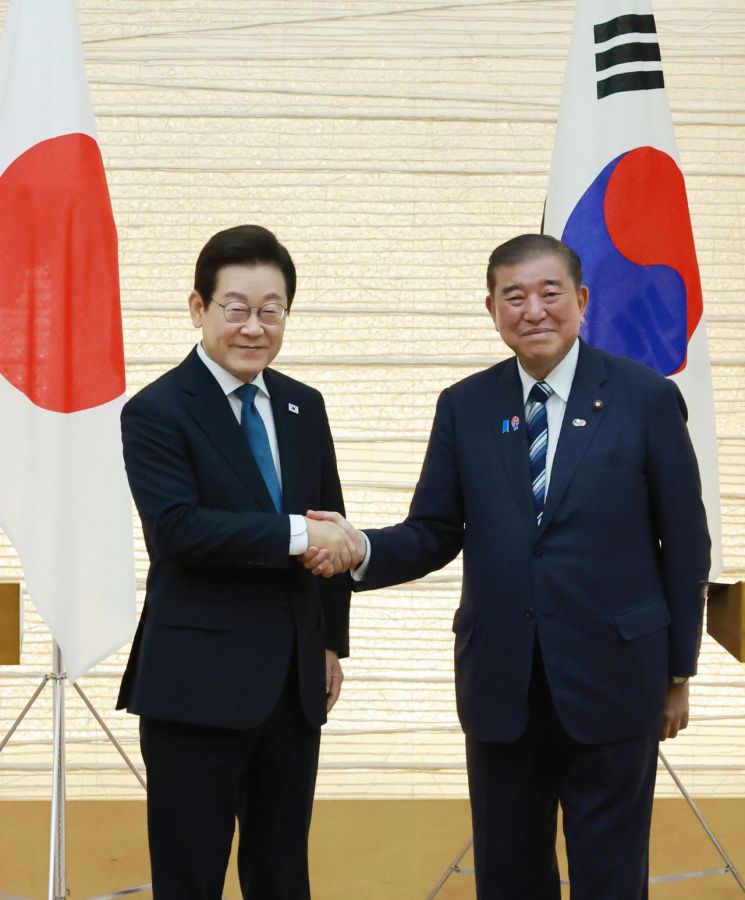
According to the presidential office, President Lee plans to meet with Japanese political figures from the Japan-Korea Parliamentarians' Union for a conversation, thereby concluding his schedule for the Japan summit. After traveling to the United States, President Lee will arrive in Washington, D.C. on the afternoon of August 24 (local time) to prepare for the Korea-U.S. summit scheduled for August 25.
The summit with President Trump is expected to address a wide range of challenging issues in trade and security. Notably, the so-called “three chiefs”-Chief of Staff Wi, Policy Chief Kim Yongbum, and Secretary-General Kang Hunsik-will all be present. Minister of Foreign Affairs Cho Hyun and Minister of Trade, Industry and Energy Kim Junggwan have already traveled to the United States and are in discussions with their counterparts. The objectives of the summit are threefold: stabilizing Korea-U.S. economic and trade relations, modernizing the security alliance, and pioneering new areas of cooperation.
On the trade front, the main focus will be to solidify the follow-up implementation of the tariff negotiation agreement reached at the end of July at the summit level. The U.S. government has resumed pressure to open Korea’s agricultural and livestock markets, an issue that seemed to be settled in previous mutual tariff negotiations. In addition, on the occasion of this summit, the United States may have requested a more concrete “roadmap” regarding Korea-U.S. shipbuilding cooperation, including the U.S. investment fund and the so-called MASGA project.
If working-level discussions between the two sides, which will continue right up to the summit, do not proceed smoothly, instability may actually increase, contrary to the Korean government’s expectations. While the government plans to respond to the pressure to open agricultural and livestock markets according to its existing position, there are also observations that unforeseen developments cannot be ruled out.
The core of the security agenda is “modernizing the alliance.” This concept encompasses all aspects, including the operation of U.S. Forces Korea, increases in South Korea’s defense budget, and the transfer of wartime operational control. The Korean government’s goal is to modernize the alliance in a way that strengthens the joint defense posture without escalating regional tensions. Regarding the increase in defense spending, the Korean government plans to address the issue within the context of alliance modernization. However, it is reported that there are no ongoing discussions about specific scenarios related to the “strategic flexibility” of U.S. Forces Korea, and the transfer of wartime operational control is not expected to be a deeply discussed issue at this summit.
Meanwhile, President Lee will also attend a “business roundtable” with business leaders from both Korea and the United States, as well as deliver a speech at the Center for Strategic and International Studies (CSIS), a U.S. think tank. On the final day of his trip, August 26, he will travel to Philadelphia, Pennsylvania, to visit Philly Shipyard, which was acquired by Hanwha Ocean, before returning to Korea.
© The Asia Business Daily(www.asiae.co.kr). All rights reserved.


















