Revealed in Joint Press Briefing After Small-Group and Expanded Meetings... First Joint Document in 17 Years
Advancing Korea-Japan Relations to Strengthen Korea-U.S.-Japan Cooperation, Building a Virtuous Cycle
Korean and Japanese Youth to See I
On August 23, President Lee Jaemyung announced during a 'joint press statement' held immediately after the Korea-Japan summit that the two countries have agreed to launch a consultative body to jointly address common challenges. The two sides also agreed to maintain close cooperation in their North Korea policy aimed at the 'complete denuclearization' of the Korean Peninsula, and to expand people-to-people exchanges by increasing the number of times young people can participate in working holiday programs. This marks the first time in 17 years that Korea and Japan have issued a joint document on the occasion of a summit meeting.
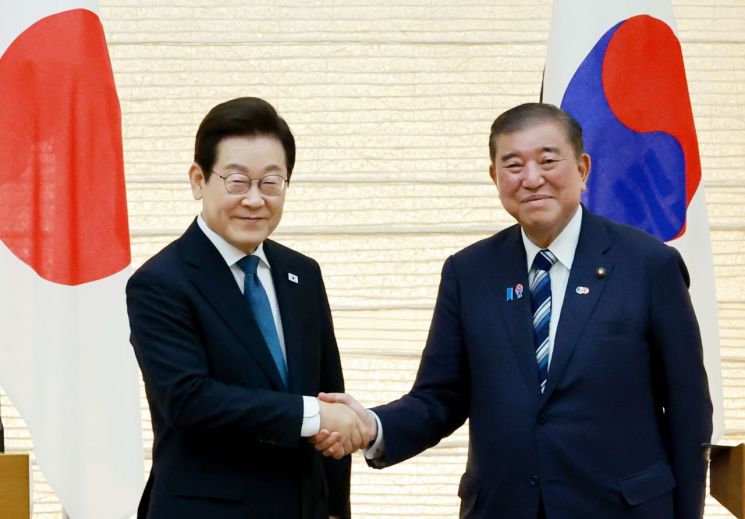
President Lee made these remarks at a joint press statement immediately after the Korea-Japan summit held at the Japanese Prime Minister's Office in Tokyo on August 23, stating, "Since the normalization of diplomatic relations between Korea and Japan in 1965, it is said that this is the first time a Korean president has chosen Japan as the destination for his first bilateral visit after taking office. I believe this demonstrates how much importance we place on Korea-U.S. and Korea-Japan relations."
During the summit, the two leaders held in-depth discussions on the future direction of Korea-Japan relations, major practical cooperation measures, peace on the Korean Peninsula and the North Korean issue, as well as key global challenges. First, the two countries discussed ways to cooperate in future industries such as hydrogen and artificial intelligence to create synergy in the economic sector. They also agreed to establish a consultative body to address common social challenges faced by both countries, including low birth rates, an aging population, concentration in metropolitan areas, agriculture, disasters, and safety. President Lee explained, "We agreed on the need for joint responses to these common challenges, to share policy experiences, and to seek solutions together."
Korea and Japan also agreed to closely consult for the 'complete denuclearization' of the Korean Peninsula. President Lee explained the government's plans and policy direction to resolve the North Korean nuclear issue and achieve tangible progress for peace on the peninsula. Both leaders reaffirmed their firm commitment to the 'complete denuclearization' of the Korean Peninsula and the establishment of lasting peace. President Lee's mention of 'complete denuclearization' in the three-step approach of 'freeze → reduction → denuclearization' he presented in an interview with the Yomiuri Shimbun is seen as a further step forward. Additionally, the two countries emphasized in the joint press statement the need to jointly address North Korea's illegal cyber activities and the deepening of military cooperation between Russia and North Korea, while also stressing the importance of a peaceful resolution of North Korea's nuclear and missile issues through dialogue and diplomacy.
Furthermore, to expand personnel exchanges, the two countries agreed to increase the maximum number of times individuals can participate in the Korea-Japan working holiday program from once to twice. President Lee stated, "In this era of 12 million exchanges, we have agreed to expand the number of times Korean and Japanese youth can participate in working holiday programs to provide more opportunities to experience and understand each other's cultures."
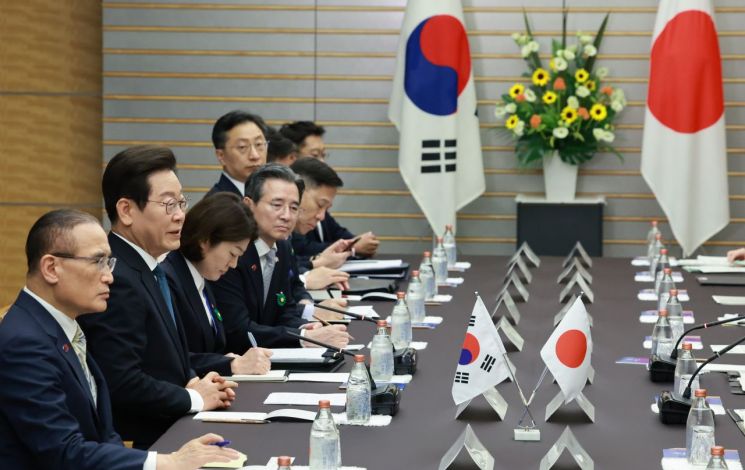
The two sides also shared the recognition that unwavering Korea-Japan and Korea-U.S.-Japan cooperation is more important than ever amid rapidly changing international circumstances, and agreed to create a virtuous cycle whereby the development of Korea-Japan relations leads to stronger trilateral cooperation. In addition, they agreed to closely cooperate for the successful hosting of the Asia-Pacific Economic Cooperation (APEC) summit to be held in Gyeongju, Korea in October, as well as the Korea-China-Japan summit, for which Japan will serve as chair.
Meanwhile, President Lee concluded a 113-minute summit schedule with Prime Minister Ishiba. President Lee arrived at the Japanese Prime Minister's Office in Tokyo at 4:54 p.m. and held a small-group meeting from 4:55 p.m. to 5:57 p.m., followed by an expanded meeting from 6:00 p.m. to 6:51 p.m. The meetings lasted much longer than originally planned. This was the second meeting between President Lee and Prime Minister Ishiba, coming 67 days after their previous encounter on June 17 on the sidelines of the Group of Seven (G7) summit.
© The Asia Business Daily(www.asiae.co.kr). All rights reserved.


















