Kim Hyungdong of People Power Party Delivers Nearly 5-Hour Opposition Speech
Democratic Party Stresses Bill’s Necessity
People Power Party Warns of “False Hope” for Subcontractors
The ruling and opposition parties clashed over the "Yellow Envelope Act" (Amendment to the Labor Union and Labor Relations Adjustment Act) at the National Assembly plenary session on the 23rd, engaging in a filibuster-an unlimited debate used as a legal means to obstruct parliamentary proceedings.
On this day, Kim Hyungdong, the People Power Party's secretary on the Environment and Labor Committee, was the first to take the floor for the filibuster, continuing his opposition speech for a total of 4 hours, 54 minutes, and 58 seconds.
Assemblyman Kim first pointed out that the amendments to Articles 2 and 3 of the Labor Union Act were "far from sufficient to resolve the dual structure of the labor market and social disparities. It is not even an appropriate means." He particularly emphasized the provision to expand direct bargaining between subcontracted workers and the primary contractor, stating, "This is placing an endless burden on subcontractor unions." He also said, "It is not the duty of the National Assembly to give false hope to the workers at the very bottom."
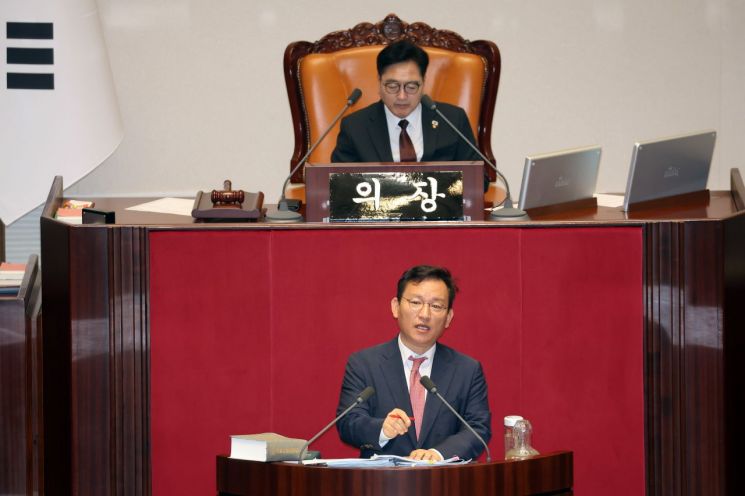 Kim Hyungdong, member of the People Power Party, is conducting an unlimited debate on the Yellow Envelope Act (Partial Amendment to the Labor Union and Labor Relations Adjustment Act) at the National Assembly plenary session in Yeouido, Seoul, on the 23rd. Photo by Yonhap News
He argued that, to address the issue, the fundamental cause-multi-layered subcontracting-should be restricted, and the principle of 'equal pay for equal work' should be realized. He asserted that this problem cannot be left solely to union negotiations.
He also argued that the implementation of the Yellow Envelope Act could likely lead to a contraction in corporate management. Assemblyman Kim said, "According to the amendment, every managerial decision made by a company could become the subject of industrial action, which would shrink business activities. Companies may move their subcontracting overseas or bring manufacturing lines in-house, forcing subcontractors to shut down their factories."
He continued, "Just as in the saying 'correcting the horn and killing the cow,' in trying to advance and sophisticate basic labor rights, the workplace itself could disappear. The burden and damage are highly likely to fall on the most vulnerable workers."
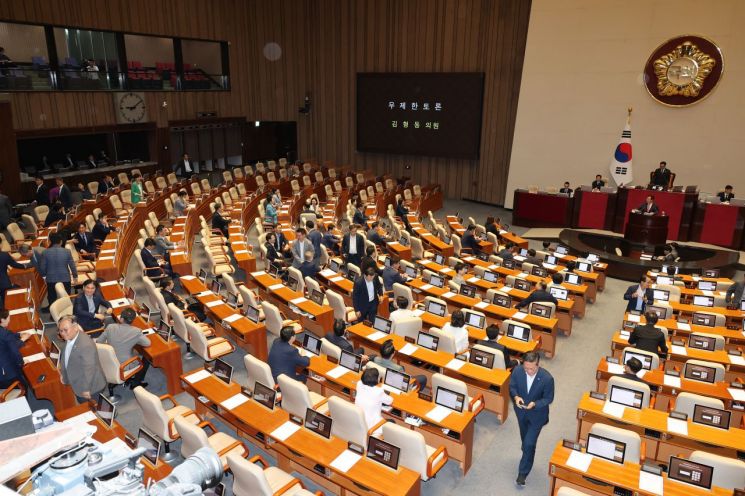 Kim Hyungdong, member of the People Power Party, is conducting an unlimited debate on the Yellow Envelope Act (Partial Amendment to the Labor Union and Labor Relations Adjustment Act) at the National Assembly plenary session in Yeouido, Seoul, on the 23rd. Photo by Yonhap News
Next, Kim Jooyoung, the Democratic Party's secretary on the Environment and Labor Committee, took the floor. He emphasized the necessity of the Yellow Envelope Act, saying, "The amendment to Articles 2 and 3 of the Labor Union Act is a groundbreaking measure to resolve the structural inequalities in our society and to reduce the gaps between primary and subcontractors, as well as between large, medium, and small enterprises." He also pointed out the polarization of jobs caused by the development of artificial intelligence (AI) and the spread of multi-layered subcontracting, stating, "We have experienced both trickle-down and trickle-up effects, but there are no signs that the structural inequality in our society is improving."
Regarding the increasing problem of non-standard forms of labor, such as special-type workers, he said, "The situation is becoming so chaotic that it is almost impossible to address," and asserted, "One of the ways to improve this is by amending Articles 2 and 3 of the Labor Union Act."
He also predicted that the amendment would reduce wasteful conflicts between subcontractors and workers. He said, "If responsible primary contractors participate in negotiations, the economic income gap will decrease, and the social costs associated with strikes will also go down. As economic benefits increase, we can expect a virtuous cycle that will alleviate structural inequality."
Regarding concerns about a contraction in corporate management activities, he stated, "Even if the bill passes the National Assembly plenary session, it will only take effect six months later," and added, "If employers use those six months to prepare, there should not be significant difficulties."
© The Asia Business Daily(www.asiae.co.kr). All rights reserved.


















