A 3-Meter, 100-Kilogram Shark Carcass Discovered
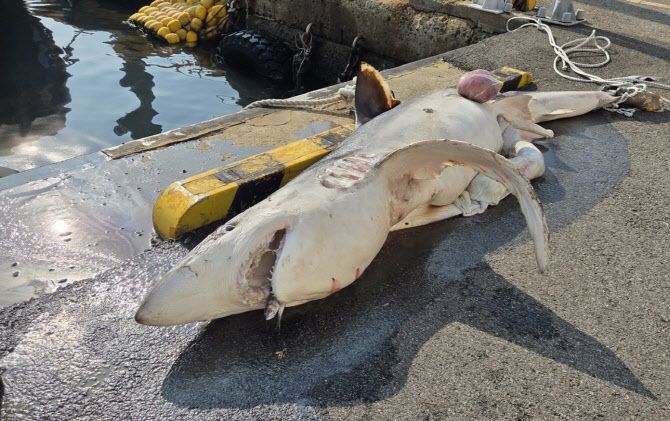
A shark carcass over 3 meters in length was discovered in the waters off Yeongdo District, Busan. No signs of capture were found.
On August 22, the Busan Coast Guard announced, "We discovered a shark carcass in the waters in front of the pier in Bongnae-dong, Yeongdo District, Busan, and salvaged it at around 6:30 a.m." The shark, measuring 3 meters in length and weighing 100 kilograms, was identified as a white-bellied blacktip shark. This species is classified as having low aggressiveness.
It is widely distributed from coastal to offshore waters in tropical to temperate regions around the world, inhabiting depths from the ocean surface down to 370 meters. Its diet is known to consist mainly of schooling fish and squid.
The Coast Guard discovered the floating shark during a maritime patrol, and the shark was already dead at the time of discovery. The carcass showed no wounds and was already in an advanced state of decomposition.
A Coast Guard official stated, "There were no signs of capture," and added, "It appears the shark carcass was carried by the current and discovered at sea."
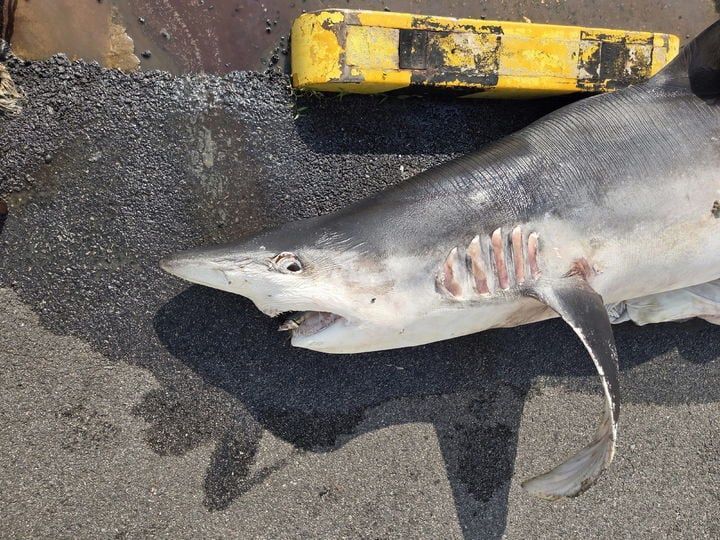 The carcass of a white-bellied blacktip shark salvaged from the sea off Yeongdo District, Busan. Photo by Busan Coast Guard
Meanwhile, this is not the first time a shark has appeared in the waters off Busan. In July of last year, a shark was caught by a fishing vessel operating near Taejongdae, Busan.
In September of the same year, a shark carcass, believed to be a highly aggressive shortfin mako shark, was found in the waters in front of the Jagalchi Cruise dock. Later that month, a crew member fishing at night near Saengdo, Yeongdo District, was injured in an attack by a blue shark.
According to the National Institute of Fisheries Science, the number of reports of sharks being caught or sighted on the east coast increased sharply from just 1 case in 2022 to 29 cases in 2023, and 44 cases last year.
Experts cite climate change as a reason for the frequent sightings of sharks in Korean waters. As rising sea temperatures have led to an increase in warm-water fish species such as amberjack, horse mackerel, and Spanish mackerel, sharks chasing these prey are believed to be entering coastal areas.
© The Asia Business Daily(www.asiae.co.kr). All rights reserved.


















