Free Domestic Flights for Tourists from September to November
Thailand Launches Incentives to Revive Tourism Industry
New App to Enable Easy Cryptocurrency Exchange for Visitors
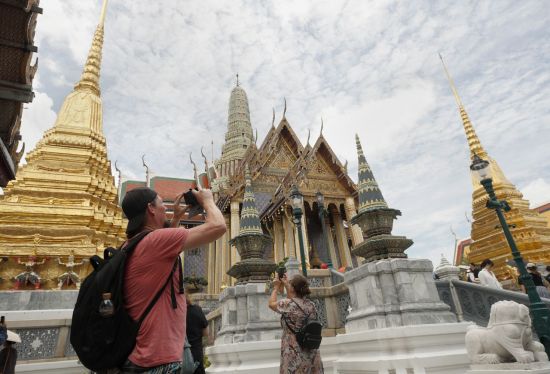 Foreign tourists are sightseeing at a temple in Bangkok, Thailand, on the 18th (local time). Photo by EPA
In response to a recent series of criminal incidents that have led to a slump in the tourism industry, the Thai government has decided to launch a program distributing free domestic flight tickets to foreign travelers, backed by a budget of 3 billion won. The government is also developing an application that will allow users to easily exchange cryptocurrency for Thai baht, aiming to enhance payment convenience for tourists.
According to local media outlet The Nation on August 22, Sarawut Thienthong, Thailand's Minister of Tourism and Sports, plans to request a budget of 700 million baht (approximately 3 billion won) from the Cabinet to fund the free domestic flight ticket program. The allocated budget is expected to be used to provide free one-way domestic flight tickets worth 1,750 baht (about 75,000 won) and round-trip tickets worth 3,500 baht from September to November.
Minister Sarawut explained that the 'Free Domestic Flights with International Ticket' initiative aims to attract at least 200,000 foreign tourists across Thailand, with a particular focus on UNESCO World Heritage cities, popular tourist destinations, and major attractions nationwide.
The Thai government expects this program to generate at least 8.81 billion baht (about 377 billion won) in direct revenue from overseas tourist spending, and to create an economic impact of 21.8 billion baht (about 933 billion won). The initiative was reportedly inspired by Japan's 'Free Domestic Flights' campaign, which encouraged foreign tourists to travel from major cities to other domestic destinations.
Tourism, a key industry in Thailand, has been in decline since the beginning of the year following a series of incidents in which Chinese tourists were kidnapped and taken to large-scale scam operations in countries such as Myanmar. Even celebrities, such as Chinese actor Wang Xing, who appeared in the film 'Ip Man 3,' were reportedly among the victims. Wang Xing received an offer to appear in a Thai drama and entered Bangkok in January, only to be kidnapped and forced to participate in a call center scam. He testified that he was detained, had his head shaved, and was coerced into criminal activity before returning to China after eight days.
As crimes involving Chinese nationals continued, the number of Chinese tourists visiting Thailand in the first half of the year dropped by about 33%. From the start of the year through August 10, the total number of foreign tourists visiting Thailand was 20.2 million, a 6.9% decrease compared to the same period the previous year. According to the Ministry of Tourism and Sports, there was significant damage in mid-August, with a large number of hotel reservations canceled or postponed in three eastern provinces bordering Cambodia-Sa Kaeo, Trat, and Chanthaburi. Thai authorities have revised their forecast for foreign tourist arrivals this year down from 37 million to 33 million. This figure is about 17% lower than the record 39.9 million visitors in 2019, prior to the COVID-19 pandemic.
Additionally, the Thai government will introduce a pilot program called 'TouristDigipay,' which will allow foreign tourists to easily exchange cryptocurrency for Thai baht. The pilot program is scheduled to run for 18 months starting in the fourth quarter of this year. Foreign tourists can exchange cryptocurrency for baht through local exchange platforms regulated by the Thai government, and the funds will be credited to a wallet app. Tourists can then use this app to pay for goods and services at restaurants, shops, and other locations throughout Thailand. However, to prevent money laundering, the exchange amount will be limited to 550,000 baht (about 23.5 million won).
© The Asia Business Daily(www.asiae.co.kr). All rights reserved.

















