Increased by 19.3% from Last Year
Focus on Strategic Technologies, Defense Industry, and AI
The government’s research and development (R&D) budget for next year has been set at a record-high 35.3 trillion won. Of this, 30.1 trillion won is included in the main R&D budget allocation and adjustment plan.
On August 22, the Ministry of Science and ICT announced that at the plenary session of the National Science and Technology Advisory Council held at the Presidential Office, it had reviewed and approved the “2026 National R&D Project Budget Allocation and Adjustment Plan.” Next year, 35.3 trillion won will be invested in R&D, which is 19.3% more than this year’s 29.7 trillion won. This plan will be submitted to the National Assembly along with the general R&D budget after the government’s budget proposal process.
The main R&D budget for next year has been established around two pillars: “technology-driven growth” and “growth for all.”
For technology-driven growth, the government will invest 2.2 trillion won. The core goal is to make decisive investments in R&D to support a leap in productivity, foster and upgrade future strategic industries.
Specifically, the largest allocation of 8.5 trillion won will go to the “strategic technology” sector, marking a 29.9% increase compared to this year. The government plans to secure cutting-edge strategic technologies to nurture advanced industries. National strategic technologies will focus on achieving self-sufficiency in core technologies within five years by generating joint research outcomes between the public and private sectors and actively supporting their growth into advanced industries. Additionally, the government aims to secure foundational technologies such as quantum computing and synthetic biology, and internalize key technologies essential for supply chain and security, such as AI semiconductors and quantum-resistant cryptography.
In the “defense industry” sector, investment will increase by 25.3% to 3.9 trillion won, aiming to replace imported weapons and move away from a technology development system focused solely on upgrading existing weapons. The plan is to enhance the performance of equipment such as the K-9 self-propelled howitzer and Cheongung missile system, and to incorporate new technologies like AI and quantum into the defense sector.
Corporate R&D will not focus solely on resolving short-term challenges but will instead provide systematic support to capable companies through thorough verification. Accordingly, 3.4 trillion won-an increase of 39.3% from this year-will be invested in the “SME and venture” sector. The government will strengthen R&D investments linked to private investment and further develop technologies accumulated by universities and government-funded research institutes so that companies can utilize them, thereby increasing the success rate of commercialization.
The budget for the “artificial intelligence (AI)” sector has been set at 2.3 trillion won, representing a remarkable 106.1% increase. To quickly gain an edge in global competition, the government will focus on “full-stack” R&D to strengthen independent capabilities across the entire AI ecosystem. To enhance “independent AI” capabilities that will drive global competition, the government will begin by investing intensively in next-generation AI technologies such as artificial general intelligence (AGI) and lightweight, low-power AI. It will support the securing of foundational technologies, foundation models, and demonstration projects, and strengthen the AI infrastructure ecosystem. Ultimately, the goal is to connect and integrate AI across all fields-research, industry, and the public sector-to increase productivity and ensure that everyone in the country can use AI reliably.
In addition, to achieve “growth for all,” the government will restore research sites and transition to a sustainable research ecosystem. It will invest 4 trillion won (+17.1%) in “government-funded research institutes” innovation, 3.4 trillion won (+14.6%) in “basic research” to advance the basic science ecosystem, 2.4 trillion won (+14.2%) in “disaster safety” for comprehensive response, and 1.3 trillion won (+35.0%) in “talent development.”
In particular, the system (PBS) in which researchers at government-funded institutes secure personnel expenses through project acquisition will be phased out, and the number of individual basic research projects will be expanded to 15,311, exceeding the 2023 level. This is to restore the weakened research ecosystem.
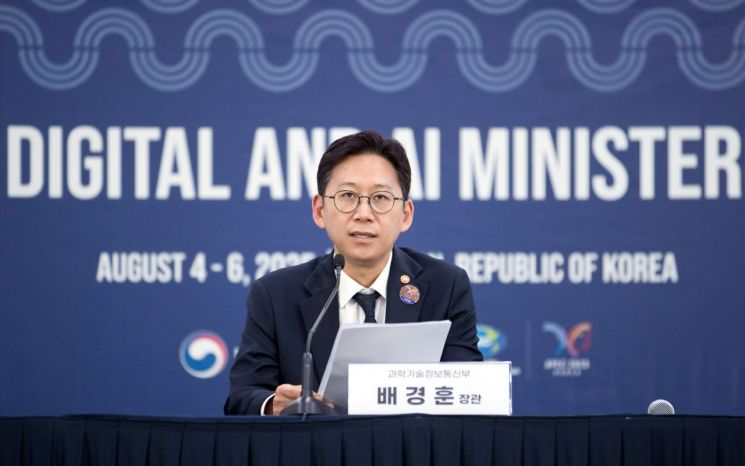
Minister of Science and ICT Lee Kyunghoon stated, “This R&D budget proposal is the largest ever, and we have dramatically expanded it not only to restore the research ecosystem but to achieve complete recovery and true growth,” adding, “Through a stable and predictable R&D investment system, we will work with the science and technology community to establish a sustainable research ecosystem.”
© The Asia Business Daily(www.asiae.co.kr). All rights reserved.
![Clutching a Stolen Dior Bag, Saying "I Hate Being Poor but Real"... The Grotesque Con of a "Human Knockoff" [Slate]](https://cwcontent.asiae.co.kr/asiaresize/183/2026021902243444107_1771435474.jpg)
















