Total Construction Value Rises, but Domestic Sector Shrinks
Building Segment Sees Largest Decline Since the IMF Crisis
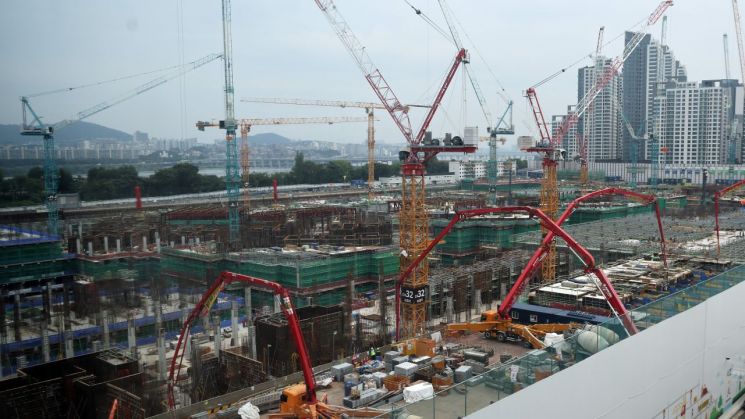
Amid unfavorable conditions in the construction industry, the total value of domestic construction work last year reached 316 trillion won, marking a 0.8% decrease. This represents the largest decline in 14 years since 2010, when the aftermath of the global financial crisis was felt. Within the domestic construction work, the building sector-including apartment projects-fell by 3.2%, the largest drop since 1999 during the foreign exchange crisis.
According to the "2024 Construction Industry Survey Results (Preliminary) [Construction Performance Section]" released by Statistics Korea on August 22, the number of construction companies last year increased by 1.4% from the previous year to 89,094, marking 12 consecutive years of growth. In the Seoul metropolitan area, the number rose by 0.9% to 31,320, while regions outside the metropolitan area saw a 1.7% increase to 57,774. By region, Seoul (-1.2%) and Sejong (-12.4%) saw declines, whereas Gyeonggi (2.2%), North Gyeongsang (2.8%), and South Chungcheong (3.8%) recorded increases.
The total value of construction work was 364 trillion won, up 1.4% (5 trillion won). While the domestic construction value decreased by 0.8% to 316 trillion won, overseas construction value increased by 18.3% to 48 trillion won. The 0.8% decline in domestic construction value is the largest drop since 2010 (-1.6%), when the global financial crisis had an impact. Overseas construction value rose in regions such as the Americas (40.3%) and the Middle East (31.9%).
For domestic construction, civil engineering projects such as roads and bridges (9.8%), industrial facilities such as power plants (1.6%), and landscaping (5.7%) all saw increases, but the building sector-including apartments and warehouses-declined by 3.2%. This decrease in the building sector is the largest since 1999 (-7.8%), during the foreign exchange crisis. By type, the composition of domestic construction work was: building (73.0%), civil engineering (15.2%), industrial facilities (9.3%), and landscaping (2.5%).
By type of construction business, the value of specialized construction work increased by 1.2% to 203 trillion won, and general construction work grew by 1.5% to 161 trillion won. Breaking down the specialized construction sector, the "specialized" category decreased by 2.6%, but electrical (8.1%), mechanical facilities (4.6%), and information and communications (3.9%) all increased. The composition was: specialized (28.9%), electrical (10.9%), mechanical facilities (7.7%), information and communications (5.6%), and fire protection (2.6%).
By client, public sector construction work (90 trillion won) increased by 7.2%, while private sector work (226 trillion won) decreased by 3.6%. Public sector growth was driven by local governments, whereas the private sector saw a decline, mainly in the real estate industry.

The domestic construction work performed by the top 100 construction companies totaled 116 trillion won, up 3.4%. Their share of the total construction value was 22.8%. Their overseas construction value reached 44 trillion won, an increase of 16.4%, accounting for a dominant 91.4% of the total overseas construction value.
The total value of construction contracts was 307 trillion won, up 3.4%. Domestic contracts increased by 3.4% to 267 trillion won, while overseas contracts rose by 2.9% to 41 trillion won. For domestic contracts, industrial facilities (-35.1%) and landscaping (-15.5%) declined, but building (9.5%) and civil engineering (13.0%) increased. Overseas contracts grew in the Middle East (91.9%) and Oceania (318.3%).
The top 100 companies' construction contracts amounted to 143 trillion won, up 4.6%, accounting for 46.6% of all contracts. Of this, domestic contracts increased by 5.0% to 105 trillion won, and overseas contracts rose by 3.4% to 38 trillion won.
© The Asia Business Daily(www.asiae.co.kr). All rights reserved.


















