Construction Companies: "We Can't Take on Projects With Over 20% Losses"
Ministry of Land, Infrastructure and Transport Pushing for Price Adjustment Exception
Ministry of Economy and Finance Maintains Principle: "No Exceptions"
Two Years Ago There Was Excitement...
Now Beneficiary Regions Shift From Expectation to Disappointment
It has been exactly two years since the signing of the implementation agreement for the Greater Seoul Metropolitan Express Railway (GTX)-C line, but not a single shovel has hit the ground. The project is facing significant difficulties as the Ministry of Land, Infrastructure and Transport and the Ministry of Economy and Finance remain locked in a prolonged dispute over the "realization of construction costs." Residents who had placed their hopes solely on the GTX are growing increasingly frustrated by the ongoing delays.
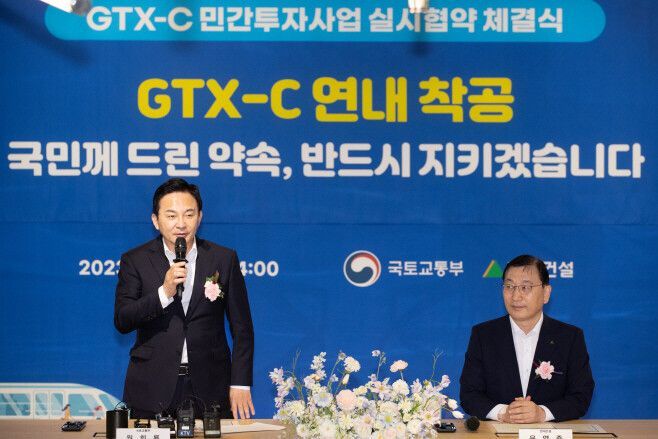 On August 22, 2023, at the signing of the GTX-B implementation agreement, Land, Infrastructure and Transport Minister Hee Ryong Won (left) and Hyundai Construction President Youngjun Yoon. Ministry of Land, Infrastructure and Transport. Photo by Ministry of Land, Infrastructure and Transport.
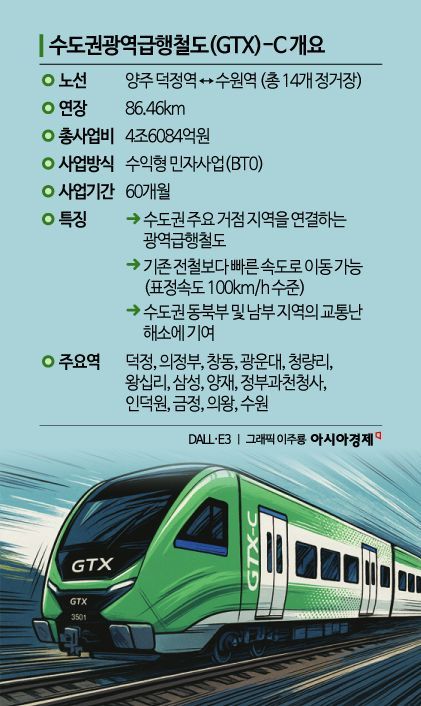
Over the past two years, disagreements between government ministries have not been resolved, causing the GTX-C project to come to a standstill. The GTX-C project is a large-scale metropolitan transportation initiative with a total budget of 4.6084 trillion won, designed to connect the north-south axis of the Seoul metropolitan area. The plan is to link Deokjeong Station in Yangju, Gyeonggi Province, to Sangnoksu Station in Ansan City via a 86.5km deep underground high-speed rail. All 14 stations are planned as transfer stations, allowing passengers to switch to regular subway lines, which has raised high expectations among residents living on the outskirts of the metropolitan area. Former Minister of Land, Infrastructure and Transport Hee Ryong Won and then-President of Hyundai Construction Young Jun Yoon, representing the construction consortium, signed the implementation agreement on August 22, 2023, promising to break ground within the year.
Construction Companies: "We Can't Take on Projects With Over 20% Losses"... Ministry of Land, Infrastructure and Transport Pushing for Price Adjustment Exception
This project, which was expected to begin immediately, has now been delayed for two years as of August 24, 2025. Not only has construction yet to begin, but even preparatory steps such as signing the construction contract and submitting the groundbreaking notice have not been completed. Considering the planned construction period of 60 months, the goal of opening by the end of 2028 is already out of reach. Furthermore, the likelihood of the project resuming anytime soon remains low.
The construction cost for GTX-C is estimated to be 600 billion to 700 billion won short of what was agreed upon at the time of the implementation agreement. A Ministry of Land, Infrastructure and Transport official stated, "We were unable to properly reflect the sharp increases in raw material prices and labor costs from 2021 to 2022 in the agreement," adding, "As a result, the construction costs do not match the current reality, making it difficult to start the project." The official explained that, due to tight deadlines at the time of the agreement, it was not feasible to accurately account for several years' worth of cost increases in a single calculation.
If the project proceeds under the terms of the current agreement, it is expected that there will be a negative margin of over 20% based on current standards. In other words, for every 10 billion won spent on construction, there would be a loss of 2 billion won. Because the more construction is done, the greater the losses, the signing of the construction contract has been repeatedly postponed. A Hyundai Construction representative commented, "It is difficult to proceed with the project under the current conditions," and emphasized, "Adjusting the construction costs to reflect reality is essential for the project."
To address the "realization of construction costs," the Ministry of Land, Infrastructure and Transport is requesting the Ministry of Economy and Finance, which oversees private investment projects, to apply a "price adjustment exception" policy. Under the Basic Guidelines for Private Investment Projects, this system allows the government to partially compensate for price increases within a certain range. If the exception is applied, the compensable range would be about 4.4%, or around 200 billion won. Although this would not fully eliminate the negative margin, it would make groundbreaking possible. A Ministry of Land, Infrastructure and Transport official explained, "Since there were commitments made in the implementation agreement, there is a consensus among construction companies that the project could proceed if at least some of the losses are reduced."
Ministry of Economy and Finance Maintains Principle: "No Exceptions"
The Ministry of Economy and Finance maintains that, under current regulations, projects with already signed implementation agreements are not eligible for the price adjustment exception. A ministry official stated, "Didn't the contractors thoroughly review the expected returns and risks before signing the agreement?" and added, "Even if they later realized it would result in losses, that is the responsibility of the private sector, and there are also issues of fairness with other private investment projects." Despite this, the Ministry of Land, Infrastructure and Transport continues to request an exception, citing the symbolic significance of the GTX project in transforming the metropolitan transportation system and concerns about declining public trust in government policy. However, there has been no significant progress.
Some have suggested alternative scenarios, such as changing the project structure or converting certain sections to government-funded projects. However, experts note that these options are unlikely to materialize, given that the Ministry of Economy and Finance holds the key decision-making power. While the GTX-C project remains stalled, the GTX-B line has recently signed construction contracts with a total of 17 contractors, putting the privately funded section of the project on track. The Daewoo Construction consortium also successfully completed fundraising with eight major financial institutions. After submitting the groundbreaking notice to the Ministry of Land, Infrastructure and Transport, the main construction phase, scheduled to last 72 months, has begun.
Two Years Ago There Was Excitement... Now Beneficiary Regions Shift From Expectation to Disappointment
In areas such as Yangju, Deokjeong, and Suwon, where expectations for the GTX-C opening were high, housing prices have dropped rapidly. According to KB Real Estate, in Okjeong New Town in Yangju, apartment prices for 84 square meters have fallen by more than 200 million won from their previous peaks in many cases this year. In contrast, areas such as Songdo and Namyangju, which are on the GTX-B route, are showing signs of recovery after a prolonged period of stagnation.
Jeon Jiweon, head of the Yangju branch of the Korea Association of Realtors, stated, "When Okjeong New Town was in the midst of sales, the biggest selling point for all construction companies was the GTX," and added, "Those who purchased apartments based solely on expectations for the GTX are now deeply disappointed, and the atmosphere has become gloomy due to the additional impact of falling prices."
© The Asia Business Daily(www.asiae.co.kr). All rights reserved.


















