Government Pushes "Self-Help First, Support Later" Principle
Conflicting Interests Among Companies Make Friction Unavoidable
Yeosu, Daesan, and Ulsan: Diverging Interests Across Three Major Petrochemical Complexes
The petrochemical industry is facing mounting pressure to reduce naphtha cracking center (NCC) capacity by 3.7 million tons, equivalent to up to 25% of domestic production, due to a surge of low-priced products from China. As a result, companies are increasingly wary of each other's moves. The government has set forth a principle of "self-help first, support later" for reducing NCC capacity, but as each company's interests diverge, concerns are growing that voluntary coordination will be difficult.
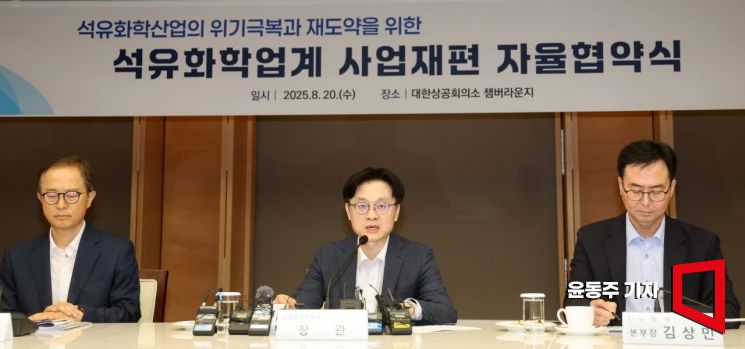 Kim Jungkwan, Minister of Trade, Industry and Energy, is delivering a keynote speech at the 'Voluntary Agreement Ceremony for Business Restructuring in the Petrochemical Industry for a New Leap Forward' held at the Korea Chamber of Commerce and Industry in Jung-gu, Seoul on August 20, 2025. Photo by Yoon Dongjoo.
The reason for this wariness is that industry players feel they have already done as much as they can. On August 20, after attending the "Voluntary Agreement Ceremony for the Petrochemical Industry's New Leap Forward" at the Korea Chamber of Commerce and Industry in Seoul, Jungwoon Nam, President of Hanwha Solutions, told reporters, "We have already shut down some facilities," indirectly indicating that there is little room for further reductions. He was referring to the suspension of some production facilities at Yeocheon NCC, a joint venture with DL Chemical. Anseop Choi, President of SK Geocentric, also drew a line when asked about a potential NCC integration with Korea Petrochemical, saying, "There's nothing to say at this time." Other executives present at the event-Seongwoo Heo, Vice President of GS Caltex; Gilsun Kang, President of Korea Petrochemical; Imjoo Jung, CEO of HD Hyundai Chemical; and Youngjun Lee, President of Lotte Chemical-remained silent in response to reporters' questions.
Domestic ethylene production is concentrated in three major petrochemical complexes: Yeosu, Ulsan, and Daesan. Of the total 14.7 million tons, more than half is located in Yeosu, South Jeolla Province. Companies such as LG Chem, Lotte Chemical, Yeocheon NCC, and GS Caltex operate around 6.4 million tons of NCC capacity in this region. Ulsan, with a capacity of 1.76 million tons, is led by SK Geocentric and Korea Petrochemical, and has a high proportion of propane dehydrogenation (PDH) facilities. Daesan has a capacity of 4.78 million tons, where Hanwha TotalEnergies, LG Chem, and Hyundai Chemical operate businesses based on a refinery-petrochemical integrated structure.
The reason for the ongoing standoff is that the government’s proposed reduction goes far beyond simply cutting production volumes. An industry official said, "A reduction target of 3.7 million tons per year essentially means shutting down two to three large NCCs," adding, "The larger the company, the greater the burden." By company, LG Chem (3.38 million tons) and Lotte Chemical (2.33 million tons) are the top two in the industry, followed by Yeocheon NCC (2.28 million tons), Hanwha TotalEnergies (1.52 million tons), Korea Petrochemical (0.9 million tons), GS Caltex (0.9 million tons), Hyundai Chemical (0.85 million tons), and SK Geocentric (0.66 million tons).
Reducing NCC capacity also inevitably leads to workforce restructuring, which is another source of concern for companies. It has been reported that in some industrial complexes, labor unions are expressing anxiety over job security due to NCC restructuring.
Significant friction is expected during the restructuring process. Although the government’s reduction target was derived from a voluntary consulting report recently commissioned by the industry from Boston Consulting Group (BCG), it did not include detailed implementation plans. Initially, the industry sought government assistance because each company's interests varied so widely that voluntary coordination alone was unlikely to be effective. As a result, even after the government proposal, there are concerns that conflicting interests will persist.
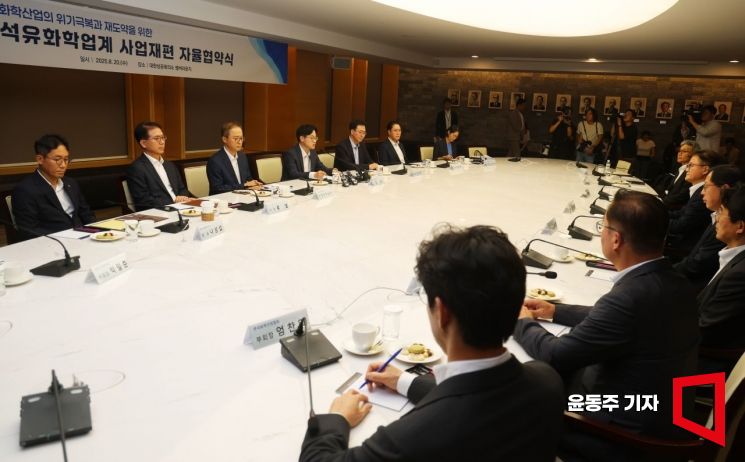 Kim Jungkwan, Minister of Trade, Industry and Energy, is delivering a keynote speech at the "Industry Self-Agreement Ceremony for Business Restructuring to Revitalize the Petrochemical Industry" held at the Korea Chamber of Commerce and Industry in Jung-gu, Seoul on the 20th. 2025.08.20 Photo by Yoon Dongjoo.
Various scenarios are being discussed both within and outside the industry regarding the upcoming restructuring. The main options include: vertical integration between refiners and petrochemical companies; joint operation of NCC facilities among petrochemical firms; and selective closures based on facility age or profitability. However, differing regional characteristics, corporate governance structures, and facility efficiencies mean that calculations about "who will cut first" vary from company to company.
There are also differences in the feasibility of implementing restructuring. Companies with single-group governance structures, such as LG Chem and SK Geocentric, can make quick decisions. However, joint ventures like Yeocheon NCC (Hanwha Solutions and DL Chemical), Hanwha TotalEnergies (Hanwha Impact and TotalEnergies), GS Caltex (GS Energy and Chevron), and Hyundai Chemical (HD Hyundai Oilbank and Lotte Chemical) must first coordinate among stakeholders. Korea Petrochemical, as an independent company with high owner equity, can make its own decisions, but its small size may put it at the top of the reduction priority list. In contrast, S-Oil, whose largest shareholder is Saudi state-owned oil company Aramco, is expected to focus on its refining and Shaheen Project rather than the petrochemical sector.
An industry official commented, "Now the real battle is about who will cut first," adding, "Not only facility age, profitability, and employment impact, but also the ability to make swift decisions due to governance structure will be critical factors in determining the direction of restructuring."
© The Asia Business Daily(www.asiae.co.kr). All rights reserved.
![Clutching a Stolen Dior Bag, Saying "I Hate Being Poor but Real"... The Grotesque Con of a "Human Knockoff" [Slate]](https://cwcontent.asiae.co.kr/asiaresize/183/2026021902243444107_1771435474.jpg)

















