Established and Operated to Implement the WHO Framework Convention on Tobacco Control
Reaccredited as an Internationally Recognized Testing Institution (ISO17025)
Strengthening Scientific Evidence to Protect Public Health
The Korea Disease Control and Prevention Agency (KDCA) announced that the National Smoking Damage Laboratory, which is currently in operation, was reaccredited as an internationally recognized testing institution (ISO17025) as of August 21. ISO17025 is an international standard established by the International Organization for Standardization (ISO).
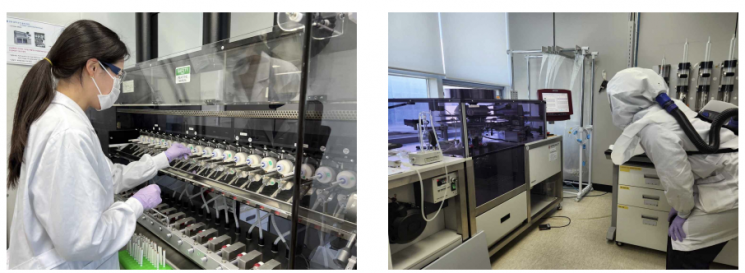 National Tobacco Harm Experiment Laboratory cigarette smoke generation device. A device that generates cigarette smoke and collects particles contained in the mainstream smoke. Korea Disease Control and Prevention Agency
The KDCA established the National Smoking Damage Laboratory in November 2015 to implement the World Health Organization (WHO) Framework Convention on Tobacco Control (FCTC), and received its first ISO17025 accreditation in 2017.
Since then, the laboratory has participated as a member of the WHO Tobacco Laboratory Network (TobLabNet), conducting joint research to establish international standard operating procedures (SOPs) related to the content and emissions of tobacco products. As of 2023, TobLabNet includes 40 institutions from 31 countries, including the United States, Canada, Germany, Japan, and China.
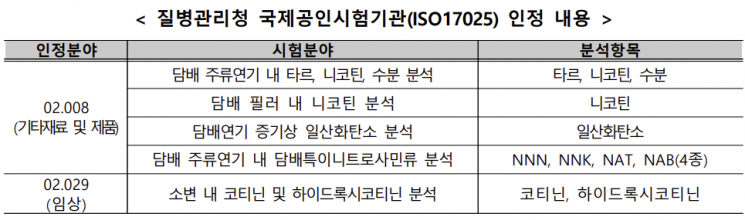
This time, the KDCA was reaccredited for testing methods covering a total of 11 analytical items: 9 components in tobacco and tobacco smoke, and 2 biomarkers of exposure in clinical samples (urine).
The KDCA Smoking Damage Laboratory ensures the objectivity and reliability of its analytical results through standardized procedures and a quality management system. The laboratory continuously strengthens its testing capabilities through internal quality control, participation in international proficiency assessments, and staff training. In addition, it is conducting the National Smoking Damage Biomonitoring Project and cell-level human risk studies reflecting the characteristics of Korean smokers.
Im Seungkwan, Commissioner of the KDCA, stated, "As an internationally accredited testing institution, we will continue our efforts to provide scientific evidence for protecting public health by objectively and reliably identifying the human health risks of tobacco and minimizing smoking-related harm."
© The Asia Business Daily(www.asiae.co.kr). All rights reserved.


















