Establishing the Basic Plan for Local Autonomy
Policy Vision and Implementation Strategies Outlined
Introducing Direct Democracy through the "Citizens' Assembly"
Strengthening Resident Autonomy Committees
Gwangmyeong City in Gyeonggi Province has presented a policy roadmap to strengthen citizen sovereignty.
On August 21, Gwangmyeong City announced that it had completed the "3rd Gwangmyeong City Basic Plan for Local Autonomy Research Project."
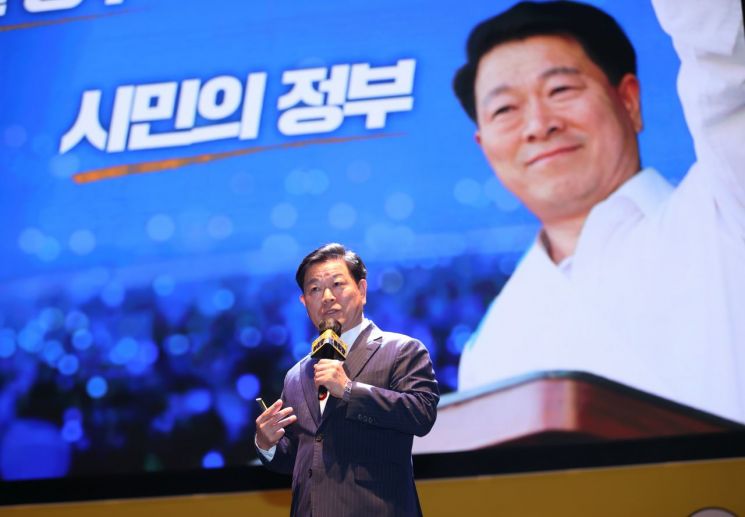 Park Seungwon, mayor of Gwangmyeong, is presenting a vision for realizing a citizen sovereignty government at the local autonomy forum "Local Autonomy Arirang" held at Gwangmyeong Theater last June. Provided by Gwangmyeong City
The newly established basic plan outlines the vision and implementation strategies that will guide the city's local autonomy policies for three years, from next year until 2028. The plan aims to comprehensively analyze local autonomy policies and develop phased development strategies to institutionally establish citizen sovereignty.
The city particularly plans to use the local autonomy policy as a foundation to become an exemplary model, building on the central government's direction of "strengthening national sovereignty and expanding participation."
The plan envisions "Gwangmyeong as a city of local autonomy where citizen sovereignty becomes a part of daily life," and presents concrete strategies and tasks in four areas: public-private governance, administrative innovation, educational autonomy, and resident autonomy.
In the area of "public-private governance," the plan includes the establishment of a permanent body, tentatively named the "Gwangmyeong Citizens' Assembly," which will integrate fragmented resident participation and deliberation organizations by department and introduce direct democracy systems. A resident participation platform will also be established and operated to provide administrative support for systems such as resident initiatives, resident recalls, and resident referendums.
For "administrative innovation," the plan includes various implementation tasks to resolve key city issues based on resident participation. Resident representatives will participate in departmental committees to ensure citizen involvement in municipal administration, and solutions to local issues will be sought based on this participation.
In the area of "educational autonomy," the plan aims to establish a basic education governance system that connects life and learning by involving diverse educational stakeholders in the community. In particular, a "Gwangmyeong-style elementary education care model" will be introduced, encouraging the city and local residents to actively participate in care education by utilizing local resources. The city will also establish the "Gwangmyeong Regional Education Council," a public-private-academic governance body, and the "Village Education Autonomy Council," which guarantees residents' active participation, to create a governance system for discussing and deciding on educational issues.
For "resident autonomy," the plan includes measures such as a quota system for resident autonomy committee members to encourage participation from various social groups, hybrid online-offline operations of resident autonomy committees, and the expansion of delegated work for these committees. Reflecting the characteristics of areas undergoing large-scale redevelopment, the plan also seeks to vitalize apartment communities by fostering apartment community activists and promoting public contest projects for apartment community agendas.
Park Seungwon, mayor of Gwangmyeong, said, "Based on this plan, we will further refine the framework of local autonomy policies and boldly innovate the overall administration," adding, "We will realize a true citizen sovereignty city where citizens are not just formal participants but become the main actors in municipal governance."
© The Asia Business Daily(www.asiae.co.kr). All rights reserved.