New iPhone Feature to Combat Voice Phishing
Stronger Spam and Smishing Protection with Call Screening and Message Filtering
Apple Highlights Enhanced Privacy and Security at Seoul Press Conference
Safari's Advanced Tracker Blocking Surpasses Chrome
"Hide My Email" and Face ID Offer Greater Personal Data Protection
AI Features Processed On-Device for Maximum Privacy
"Please state your name and the purpose of your call. I will check if the recipient is available to take your call."
"You are eligible for an insurance premium refund. Can you share your account number?"
A new feature designed to prevent voice phishing, a growing social issue, will be added to Apple iPhones. This is made possible through "call screening," which will be included in iOS 26, scheduled for official release next month. With this feature, the iPhone answers calls using an automated response system (ARS), requesting additional information from the caller. Users can review the ARS call content in text format. This feature is particularly useful when receiving calls from "unknown numbers"-numbers you have never contacted before and that are not saved in your contacts. Last year, more than 20,000 people in Korea suffered voice phishing losses totaling approximately 800 billion won, making this a potentially effective preventive measure.
Text messages suspected to be spam that are received by the iPhone are automatically moved to a dedicated spam folder. Messages identified as spam by Apple or mobile carriers, as well as those reported by users, are included in this folder. Links within messages in the spam folder are deactivated, and replies are not possible. This reduces the risk of becoming a victim of smishing.
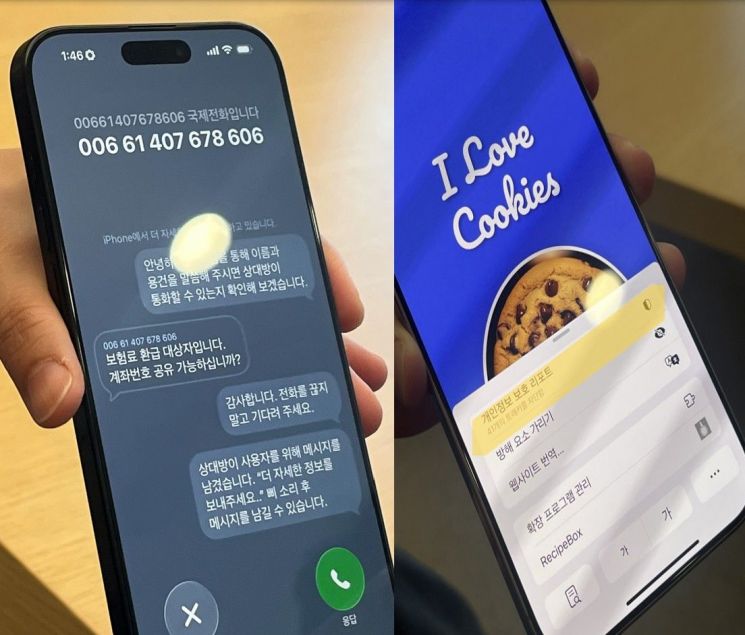 On the 20th, Apple held a press conference at ASEM Tower in Samseong-dong, Seoul, showcasing call screening (left) to prevent voice phishing damage and the tracker blocking feature of the Apple Safari browser.
On the 20th, Apple held a press conference at ASEM Tower in Gangnam-gu, Seoul, introducing various features related to privacy and security. With a recent surge in both large and small-scale cyber incidents in Korea, the need to promote privacy and personal data protection features has become more pronounced.
Apple emphasized not only phishing prevention but also the privacy features of its exclusive browser, Safari. When accessing websites through Safari, users can block trackers using the Intelligent Tracking Prevention feature. Apple explained that this feature leverages machine learning to prevent trackers from following users and is continuously updated.
Trackers are tools that record and analyze how long users stay on a website, what they click on, and which pages they view. This is why, after clicking on a product while online shopping, you might see ads for that product on other websites. Some websites reportedly use more than 100 trackers.
During the press conference, a privacy report was checked on a website, displaying the message "41 trackers blocked." Apple explained that Safari's tracker blocking feature is more advanced than that of Google's Chrome browser.

"Hide My Email" is a feature that generates randomly created email addresses. Emails sent to these addresses are forwarded to the user's personal inbox. This is useful when filling out surveys or subscribing to online newsletters without wanting to reveal your personal email address.
Password applications (apps) help users set secure passwords and prevent hacking. When users set their own passwords, they often choose easily guessable patterns or reuse similar passwords across multiple sites, increasing their vulnerability to hacking. Password apps can generate strong passwords to reduce the risk of hacking and prevent situations where passwords are lost.
The facial recognition feature "Face ID" accurately recognizes the user's face to prevent unauthorized access and misuse of the device. An infrared camera that detects light captures an image, and a dot projector projects thousands of dots to create a 3D map of the user's face. Apple claims the probability of someone other than the user unlocking Face ID is less than one in a million.
In contrast, the front camera of Android phones uses only 2D images, making precise facial recognition difficult and limiting its use mainly to selfies.
Apple also acknowledged the importance of protecting user data when utilizing artificial intelligence (AI) features. Text and photos processed with Apple Intelligence are handled either on the device itself ("on-device") or through private cloud computing, ensuring robust privacy protection.
However, Apple noted that when using ChatGPT by logging in with an OpenAI account on iPhones or other Apple devices, the conversation data may be transferred to OpenAI servers in accordance with OpenAI's policies.
© The Asia Business Daily(www.asiae.co.kr). All rights reserved.


















