Reviewing "Company Stake Acquisition" Instead of Finalized Subsidies
Foreign Media Reports Suggest Samsung Electronics May Be Included
Industry Voices Concern: "Overturning Agreements Raises Risk of Subordination in Negotiations"
The U.S. government is reportedly seeking to acquire stakes in foreign semiconductor companies investing in the United States, such as Samsung Electronics, following its move with Intel. This approach, which proposes exchanging subsidies determined under the CHIPS and Science Act (CSA) for company shares rather than providing the subsidies outright, has raised strong concerns within the South Korean semiconductor industry. There are also warnings that if the Donald Trump administration secures stakes in Korean companies, it could exert significant influence over their management.
According to the semiconductor industry and major foreign media outlets such as Reuters on August 20, the U.S. Department of Commerce is considering acquiring stakes in semiconductor companies currently investing in the United States. Previously, the Trump administration demanded a 10% stake in exchange for providing $10.9 billion (approximately 15 trillion won) in support to Intel, and there is speculation that this requirement could be extended to Samsung Electronics, TSMC, Micron, and others. This initiative is reportedly being led by U.S. Secretary of Commerce Howard Lutnick.
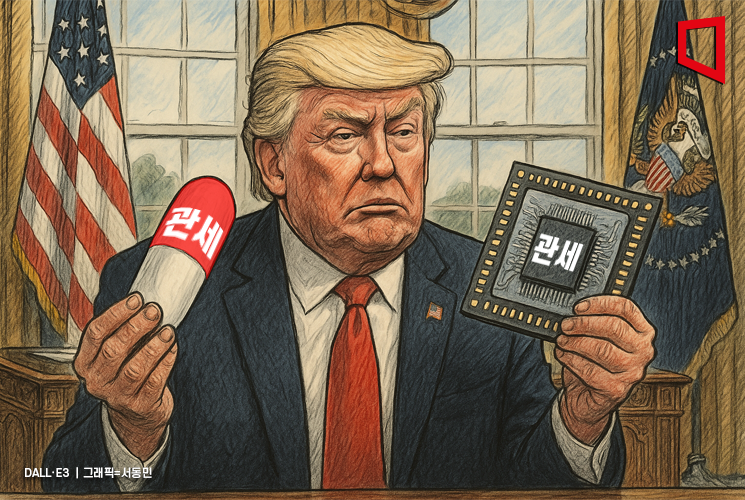
Most observers agree that this type of investment is highly unusual. In June of this year, the United States approved Nippon Steel's acquisition of US Steel on the condition that the U.S. government would hold a "golden share," granting it veto power over key management decisions.
The semiconductor industry has expressed strong concerns over the U.S. administration's actions. They argue that, given the counterpart is the United States, it is difficult to dismiss this as merely President Trump's characteristic "political bluffing," especially ahead of the upcoming Korea-U.S. summit.
Samsung Electronics and SK Hynix had already finalized the amount of subsidies they would receive under the CSA during the Biden administration, and determined their final investment amounts in the U.S. based on this. Since the subsidies were agreed upon as compensation for their investments, the industry widely views any unilateral demand for company shares as an additional requirement that is realistically unacceptable. Even SK Hynix, which has not yet been mentioned, is reportedly on edge over the possibility that the issue could expand to include them.
There are also concerns about indirect pressure beginning before semiconductor tariff rates have been finalized. At the end of last month, South Korea concluded tariff negotiations with the U.S., securing Most-Favored-Nation (MFN) status for tariffs on items such as semiconductors. Given that the European Union (EU) has set its semiconductor tariff rate at 15%, tariffs applied to South Korean semiconductor companies must be "15% or lower." There are worries that President Trump's unpredictable actions could overturn this arrangement.
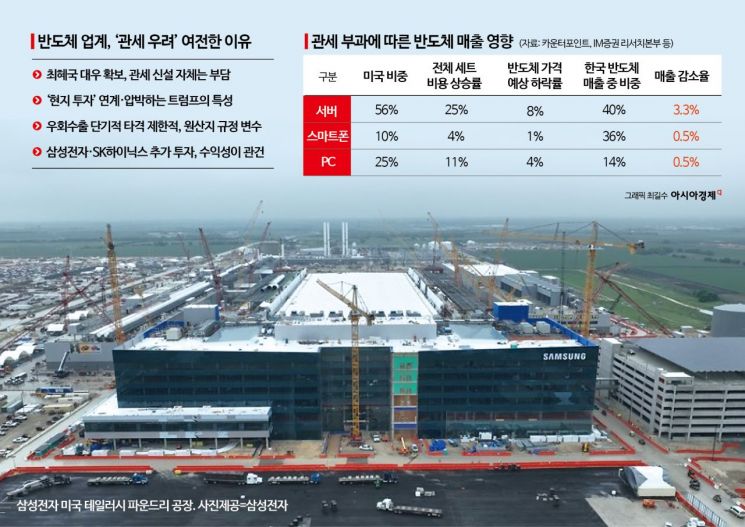
However, since local plant construction is already well underway, many believe that subsidy disbursement should be coordinated in a way that minimizes friction with the U.S. government. There are also calls to resolve the issue of semiconductor subsidy implementation at the upcoming Korea-U.S. summit, so that companies are not burdened by uncertain speculation.
An industry official stated, "Finalizing the investment amount based on the subsidy agreement is essentially the same as signing a formal contract between companies. While it would be reasonable to renegotiate the terms through mutual agreement, there are significant concerns that companies may be subordinated in the negotiation process simply because the counterpart is the U.S. government."
Meanwhile, Samsung Electronics has invested $37 billion (approximately 51 trillion won) to build its Taylor semiconductor plant in the United States, while SK Hynix is investing $3.87 billion (about 5.4 trillion won) to construct a high-bandwidth memory (HBM) packaging plant.
© The Asia Business Daily(www.asiae.co.kr). All rights reserved.
![Clutching a Stolen Dior Bag, Saying "I Hate Being Poor but Real"... The Grotesque Con of a "Human Knockoff" [Slate]](https://cwcontent.asiae.co.kr/asiaresize/183/2026021902243444107_1771435474.jpg)

















