265 Detected as of July This Year
Illegal Employment Through Proxy Registration Fees
Lack of Verification Leaves Regulatory Blind Spots
As the domestic food delivery market continues to expand, the number of undocumented foreign riders (delivery workers) entering the industry is on the rise.
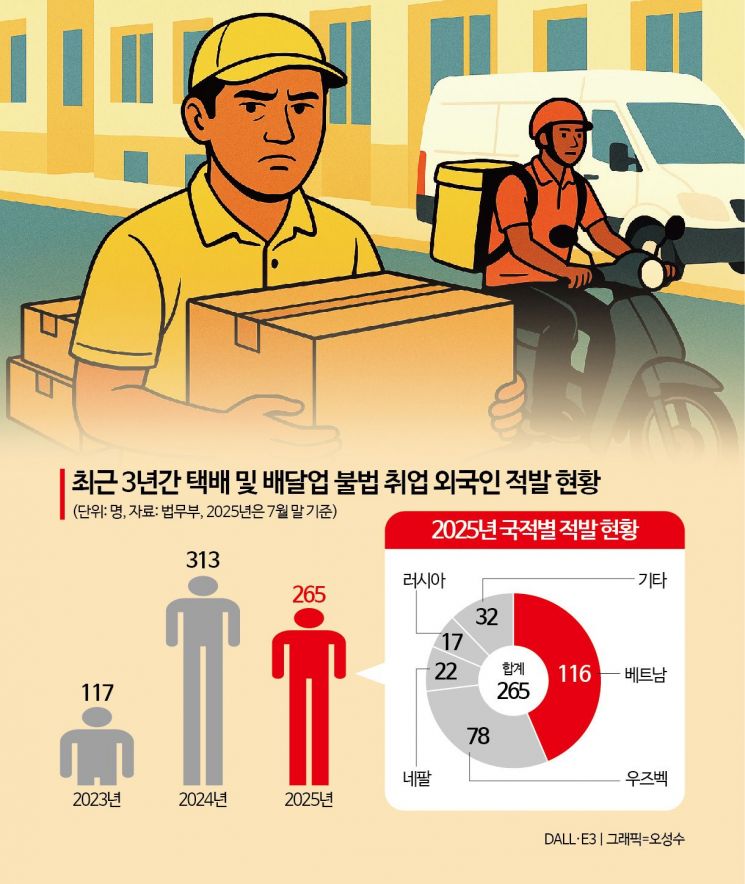
According to the Ministry of Justice on August 22, the number of foreigners caught illegally working in courier and delivery jobs has been steadily increasing, with 117 detected in 2023 when crackdowns began, 313 last year, and 265 as of the end of July this year. Among the undocumented foreign riders apprehended this year, more than 40% were Vietnamese, followed by individuals from Uzbekistan and Nepal.
The primary reason foreigners are able to work illegally is the practice of proxy registration by delivery agencies. Under current law, only those holding F-2 (residence), F-5 (permanent residency), or F-6 (marriage migrant) visas are permitted to work in delivery services. Foreign students with D-2 (student) or D-4 (language training) visas are not allowed to work in this sector. Nevertheless, some agencies register riders on delivery platforms under Korean citizens' names, then charge foreigners a proxy registration fee, thereby operating with cheaper labor. When an inquiry was made to a delivery agency in Bucheon about whether it was possible to work with a D-2 visa as a foreign student, the response was, "Come to the office, and we will connect you with the Vietnamese team leader." The Vietnamese team leader then said, "If you visit the office and speak with the boss, they will lend you an ID."
Currently, the rider verification procedures on delivery platforms are insufficient to prevent proxy registration. Rider Ha Jaekwang (41) explained, "Some places not only rent out Korean citizens' names and motorcycles, but also charge higher proxy registration and per-delivery fees than they do for Korean riders. There is no verification process for commercial transport insurance, and authentication is limited to a single text message, so there are intermediaries who broker these arrangements and collect commissions."

Korean riders complain that the indiscriminate entry of undocumented foreign riders is lowering the entry barriers for the industry, further reducing delivery fees, and making it difficult to handle accidents involving uninsured, undocumented foreign riders. Lee Minho (46), a rider working in the Yeongdeungpo area, said, "Delivery fees are already low, and with entry barriers dropping, only those riders who take out comprehensive commercial transport insurance are left struggling."
Choi Jaewon, a professor at the Korea Road Traffic Authority, also pointed out, "If undocumented foreign riders get into accidents while working without insurance, victims are unable to receive insurance compensation. If uninsured accidents become more frequent and the resulting damage is significant, the state may have to provide legal guarantees, leading to substantial social and economic losses."
Experts emphasize the need to establish clear employment structures in the delivery agency industry. Hwang Yongsik, a professor of business administration at Sejong University, said, "Undocumented foreign riders are a clear example of the realities faced by special employment workers whose employment status is not well defined. It is time to clarify employment structures, such as by introducing a registration system similar to that used for taxi drivers."
© The Asia Business Daily(www.asiae.co.kr). All rights reserved.


















