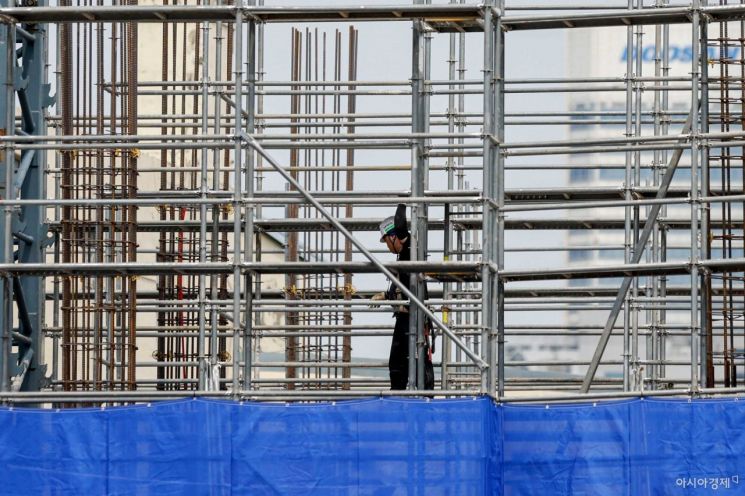
Claims have been raised that regulations in the construction industry are excessive compared to other sectors, leading to a decline in industry vitality.
The Korea Research Institute for Construction Policy (KRICP) held a seminar on August 20 titled "Driving Forces for Revitalizing the Construction Industry under the New Administration: A Major Shift in Regulatory Reform."
During the seminar, Kim Hwarang, Associate Research Fellow at KRICP, gave a presentation on "Current Status of Construction Industry Regulations and Rationalization Directions for Restoring Competitiveness." Kim pointed out that regulations in the construction industry are broadly distributed across multiple ministries. He also argued that overlapping regulatory structures, centered on the Ministry of Land, Infrastructure and Transport (MOLIT), have intensified regulatory strength and increased administrative burdens.
Out of a total of 1,157 regulatory laws managed by 45 central ministries, MOLIT accounted for 110 (9.5%), ranking first among ministries. The number of regulations managed per MOLIT official was up to 13 times higher than in other ministries. Excluding MOLIT, the number of construction-related regulatory provisions under the Ministry of the Interior and Safety, Ministry of Environment, Ministry of Employment and Labor, Ministry of Economy and Finance, Ministry of Trade, Industry and Energy, and Ministry of Oceans and Fisheries reached approximately 5,000.
Kim proposed key improvement measures including the reorganization of fragmented regulations, establishing communication channels for regulated parties, advancing MOLIT’s regulatory management system, and introducing a total volume management system for regulations.
He stated, "By introducing a total volume management system, when new or strengthened regulations are implemented in the construction industry, existing regulations should be abolished or eased to curb the overall increase, thereby creating a new trend of regulatory rationalization."
He added, "Regulatory rationalization is not only about restoring corporate vitality but also serves as a turning point for fundamentally transforming the construction industry. Now is the critical moment to boldly eliminate unnecessary regulations and provide an opportunity for the construction industry to make a new leap forward."
Park Sangheon, another Associate Research Fellow at KRICP, also pointed out problems with the regulatory system for the construction industry. Park emphasized, "To reduce the high rate of serious industrial accidents in construction and to enhance industry vitality, a comprehensive approach through regulatory streamlining is necessary."
© The Asia Business Daily(www.asiae.co.kr). All rights reserved.
![Clutching a Stolen Dior Bag, Saying "I Hate Being Poor but Real"... The Grotesque Con of a "Human Knockoff" [Slate]](https://cwcontent.asiae.co.kr/asiaresize/183/2026021902243444107_1771435474.jpg)
















