Government Holds Meeting to Discuss Restructuring Plans
Ten Companies Aim to Cut Facilities by Up to 3.7 Million Tons
"Plans Must Be Presented Swiftly, Even as Early as Next Month"
"Support Measures to Be Determined After Reviewing Submitted Self-Rescue Plans"
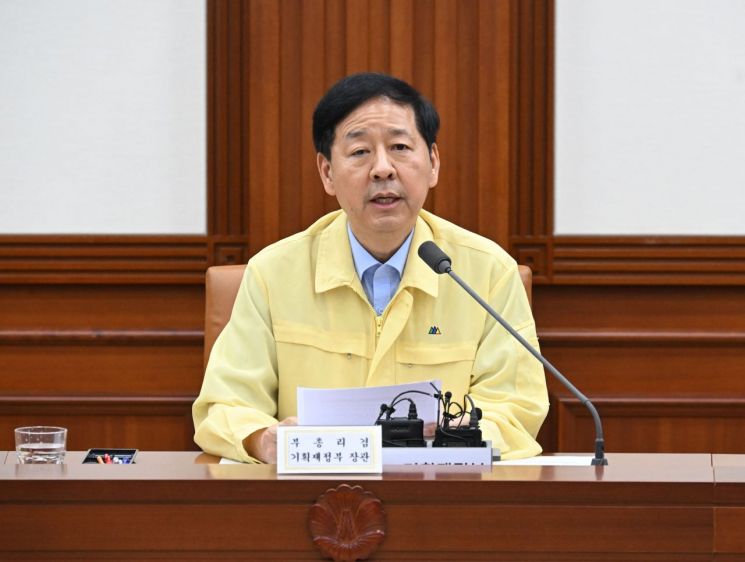 Deputy Prime Minister and Minister of Economy and Finance Koo Yoonchul is delivering opening remarks at the Ministerial Meeting on Strengthening Industrial Competitiveness held at the Government Seoul Office in Jongno-gu, Seoul, on the 20th. (Photo by Ministry of Economy and Finance)
The Lee Jaemyung administration has set a deadline for domestic petrochemical companies, which are facing limits due to oversupply from China and other factors, to come up with self-rescue measures for business normalization. The government made it clear that if companies responsible for poor performance present strong restructuring plans on their own, specific government support measures-such as financial and tax assistance-will be provided based on these efforts.
On the afternoon of August 20, the government held a Ministerial Meeting on Strengthening Industrial Competitiveness at the Government Seoul Office, presided over by Deputy Prime Minister and Minister of Economy and Finance Koo Yoonchul, to discuss restructuring plans for the petrochemical industry. The meeting was attended by the Minister of Trade, Industry and Energy, the Vice Chairman of the Financial Services Commission, the Second Deputy Minister for Government Policy Coordination, and the Governor of the Financial Supervisory Service.
In his opening remarks, Deputy Prime Minister Koo mentioned that a business restructuring agreement was signed with the participation of ten major petrochemical companies. He stated that each company should submit a detailed business restructuring plan by the end of the year, aiming to reduce facilities by up to 3.7 million tons.
However, regarding this restructuring, he commented, "It is regrettably overdue, and this is only the first step-there is still a long way to go." He pointed out that the problems facing the petrochemical industry are obvious, but the domestic sector has long ignored them. He strongly criticized, "Even though global oversupply from China and others was anticipated, domestic companies, intoxicated by past booms, expanded their facilities instead, missed the opportunity to shift to high value-added products, and are now facing severe difficulties."
Deputy Prime Minister Koo emphasized that the solution to overcoming the crisis lies in reducing excess facilities and fundamentally enhancing competitiveness. He stressed, "The crisis at hand cannot be overcome with a complacent mindset of simply waiting it out or hoping to dodge the storm. We must face this with a do-or-die determination."
He also urged, "Petrochemical companies and their major shareholders must present binding business restructuring and competitiveness enhancement plans with a sense of urgency-as early as next month, not just by the end of the year-based on their own painful self-rescue efforts."
The domestic petrochemical industry has been driven to the brink of survival due to years of declining profitability caused by oversupply from China and large-scale facility expansions. The situation is more urgent than ever, as S-Oil's Shaheen Project-the largest investment in the history of Korea's petrochemical industry-is set for completion next year. According to consulting services conducted by Boston Consulting Group (BCG), considering the operating profit and financial status of domestic petrochemical companies, if the current downturn continues, half of these companies will not be able to survive in three years.
Deputy Prime Minister Koo's pledge to face the crisis with a do-or-die determination reflects the gravity of the situation. Referring to the precedent set by the shipbuilding industry's restructuring, he said, "The shipbuilding sector's intense self-rescue efforts bore fruit, enabling it to reclaim its position as the world's top industry and make a decisive contribution to recent Korea-U.S. tariff negotiations. Although it will be painful, if the petrochemical industry follows in the footsteps of shipbuilding, it can also achieve a remarkable resurgence."
He emphasized the need for public-private cooperation to help the petrochemical industry make a comeback, stating that if the industry undertakes restructuring with a strong sense of resolve, the government will provide maximum support. After reviewing the voluntary restructuring plans submitted by individual companies, if they are deemed sincere, the government will promptly implement comprehensive support measures, including regulatory easing, financial assistance, and tax benefits. However, he made it clear that companies that delay restructuring or attempt to free-ride will be excluded from support and dealt with firmly.
© The Asia Business Daily(www.asiae.co.kr). All rights reserved.
![Clutching a Stolen Dior Bag, Saying "I Hate Being Poor but Real"... The Grotesque Con of a "Human Knockoff" [Slate]](https://cwcontent.asiae.co.kr/asiaresize/183/2026021902243444107_1771435474.jpg)

















