Calls for a 0.5 Percentage Point Rate Cut
"Indian-Style Arbitrage Is Unacceptable"
Scott Besant, the U.S. Secretary of the Treasury and the "tariff commander" of the Donald Trump administration, announced that this year's tariff revenue will exceed $300 billion. He strongly pressured for a rate cut by urging the Federal Reserve (Fed) to implement a "big cut" (0.5 percentage point rate reduction) in September, and revealed the schedule for meetings with candidates for the next Fed chair.
On the 19th (local time), Secretary Besant said in an interview with CNBC, "I have said that tariff revenue could reach $300 billion this year, but now I think we will have to significantly revise that figure upward."
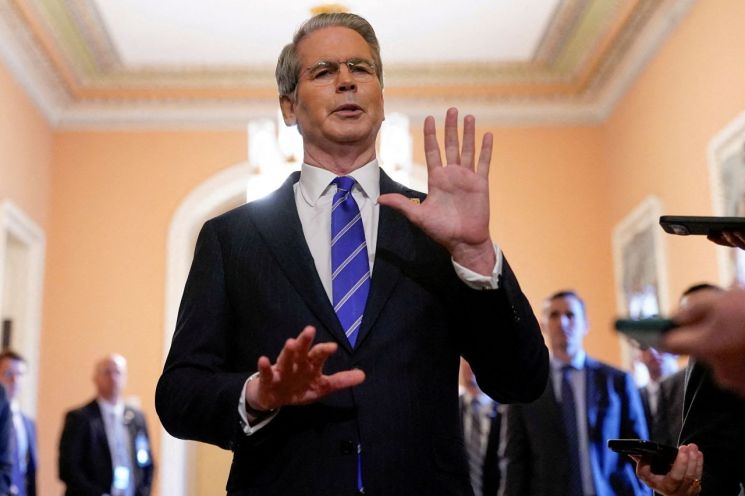
He stated, "To reduce the fiscal deficit as a ratio of GDP, we will begin repaying debt, and after that, I believe this could be used as an income compensation measure for the American people."
The process of selecting the next Fed chair has also begun in earnest. Secretary Besant said, "I plan to interview 11 strong candidates either just before or just after Labor Day (September 1), and will begin the process of narrowing down the final list to recommend to President Trump." He added, "These are people who are currently at the Fed, have previously worked at the Fed, or are in the private sector," and said, "I look forward to meeting all of them with an open mind."
The known candidates include Michelle Bowman, Vice Chair for Supervision at the Fed; Christopher Waller, Fed Governor; Philip Jefferson, Fed Vice Chair; Mark Sobel, who served as Deputy Director of the White House National Economic Council (NEC) during the George W. Bush administration; Lorie Logan, President of the Dallas Federal Reserve Bank; James Bullard, former President of the St. Louis Fed; as well as Kevin Hassett, Chairman of the White House National Economic Council, and Kevin Warsh, former Fed Governor, both of whom President Trump has mentioned publicly. CNBC reported that, in addition to these eight, David Zervos, Chief Market Strategist at Jefferies; Larry Lindsey, former Fed Governor; and Rick Rieder, Chief Investment Officer (CIO) of Fixed Income at BlackRock, are also on the list.
Jerome Powell's term as Fed chair runs until May 2026, but President Trump is pressuring Powell to resign, emphasizing the urgency of rate cuts and criticizing Powell for not meeting his demands.
Secretary Besant stressed that a 0.5 percentage point rate cut is necessary to revitalize the sluggish housing market. He said, "If we continue to suppress housing construction, what kind of inflation will we see in one or two years?" He added, "A big cut could keep housing prices low and stimulate construction over the next one to two years." In a media interview on the 13th, Secretary Besant also argued that the Fed should begin with a 0.5 percentage point cut in September and ultimately lower rates by as much as 1.75 percentage points.
Earlier this month, President Trump criticized India's imports of Russian crude oil and imposed an additional 25% tariff on top of the existing 25% reciprocal tariff. There have been criticisms that, while China is also a major importer of Russian oil, only India is subject to such high tariffs.
Regarding these claims, Secretary Besant said, "If you look back to before Russia's invasion of Ukraine, 13% of China's oil was already coming from Russia. Now it's 16%." He continued, "India was at less than 1% (before the Ukraine war), but now it's up to 42%. India is making huge profits and reselling it." He further pointed out, "This behavior by India, which could be called 'Indian-style arbitrage'-buying cheap Russian oil and reselling it as products-emerged suddenly during the war, and it is unacceptable."
Previously, on the 17th, Peter Navarro, White House Trade and Manufacturing Policy Advisor, also criticized India's purchases of Russian oil in a Financial Times (FT) op-ed.
According to commodity information provider Kpler, India is currently the largest importer of Russian crude oil, importing 1.5 million barrels per day as of last month, far surpassing China, which is the second largest at 1 million barrels per day. In this regard, Matt Smith, Kpler's lead oil market analyst, explained that India buys Russian oil at a discount due to sanctions, refines it, and then resells it to Europe and other countries that have imposed sanctions on Russia.
© The Asia Business Daily(www.asiae.co.kr). All rights reserved.
![Clutching a Stolen Dior Bag, Saying "I Hate Being Poor but Real"... The Grotesque Con of a "Human Knockoff" [Slate]](https://cwcontent.asiae.co.kr/asiaresize/183/2026021902243444107_1771435474.jpg)
















