Daishin Securities has recommended responding to the recent decline in the Brazilian stock market, triggered by US-imposed tariffs, by "increasing portfolio weight." The firm explained that the current tariff dispute between the two countries is closer to political pressure, and that Brazil's future economic recovery and a shift in monetary policy are expected.
Moon Geonwoo, a researcher at Daishin Securities, stated in the report "Brazil's Ultra-High Tariff Imposition: Political Pressure Rather Than Real Damage" on August 20, "It is more important to focus on whether there is real damage rather than just the tariffs imposed for political pressure." He emphasized, "Given the recovery of national fundamentals, strengthening of supply chains, and expectations for a shift in monetary policy, the current correction phase should be used as an opportunity to increase portfolio weight."
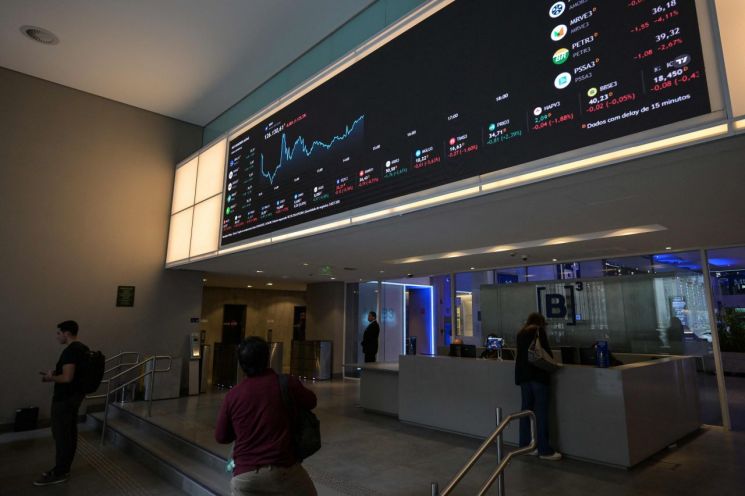
The Bovespa Index in Brazil, which hit an all-time high in early July, has recently been on a downward trend due to the shock of ultra-high US tariffs. In particular, the prospect of ultra-high tariffs on exports with a high share to the US, such as coffee and seafood, has raised concerns about a slump in export industries, adding downward pressure to the stock market.
However, Moon pointed out that the US-Brazil trade balance recorded a surplus of $29.34 billion last year, continuing a trade surplus since 2007. He analyzed, "The tariff dispute between the US and Brazil should be viewed as political pressure, not a trade conflict." He explained that this could be seen as a form of check against the BRICS region. Among Brazil's major export destinations, the US accounts for a smaller share (12.1%) than China (28.0%) and the European Union (14.3%), so the impact of the new tariffs is considered limited.
Accordingly, Moon suggested responding by increasing portfolio weight, focusing on the additional upside potential of the Bovespa Index. He emphasized, "The Bovespa Index's 12-month forward price-to-earnings (PE) ratio stands at 8.5 times, well below the five-year average of 12.9 times, indicating further upside potential." He added, "Although US political pressure may act as a source of uncertainty, it is important to note that last month the International Monetary Fund (IMF) raised its 2025 economic growth forecast for Brazil by 0.3 percentage points to 2.3% year-on-year, and that the Central Bank of Brazil (BCB) kept its policy rate unchanged for the first time in 12 months.
© The Asia Business Daily(www.asiae.co.kr). All rights reserved.

















